

























































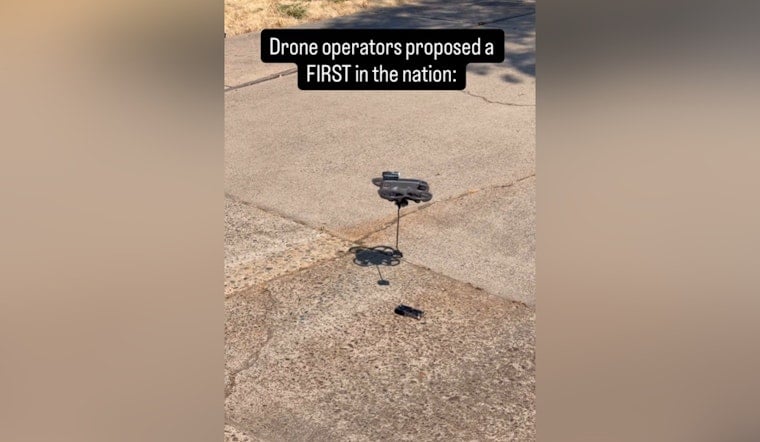
In a move the Sacramento County Sheriff’s Office is touting as a “nationwide first,” deputies say they flew a drone fitted with a powerful magnet inside a home and used it to pull a knife out of an armed suspect’s hand, ending a tense standoff without anyone getting hurt. The Special Enforcement Detail (SWAT) had the residence contained while remotely piloted aircraft and ground teams coordinated the unusual disarmament.
According to a post by the Sacramento County Sheriff’s Office on X, drone pilots spotted the man hiding in a corner of a garage and then flew in with a strong magnet attached to the aircraft, using it to pull the knife away. The office said the suspect was a known felon and a parolee at large who had previously been seen with a firearm, and described the magnet maneuver as a first-of-its-kind tactic that helped de-escalate the encounter.
The sheriff’s post said the drone deployment helped “protect both law enforcement personnel and suspects,” and noted that the county classifies some of its equipment as “military equipment” even when the devices themselves are commercially sold. The office did not release the suspect’s name or list any specific charges in the social media update, only saying the incident ended safely.
How deputies say the drone was used
Sheriff’s officials say the Special Enforcement Detail held a secure perimeter around the residence while remotely piloted aircraft were used to look into the garage and confirm there was a single person inside. A pilot then steered a small unmanned aircraft system close enough to bring the magnet into contact with the knife and separate it from the suspect’s hand, which deputies say lowered the danger for officers who would otherwise have had to go in physically.
Policy and oversight around law-enforcement drones
The Sacramento County Sheriff’s Office documents its drone fleet and how it uses it through an annual military equipment report. The county’s 2025 Military Equipment Use Report lists several commercially available drone models and says they are deployed to enhance safety and cut down on use-of-force incidents. The report also outlines the office’s training requirements and reporting rules for unmanned aircraft operations. Sacramento County Sheriff’s Office
At the federal level, the Federal Aviation Administration has warned against strapping dangerous weapons to drones and cites Section 363 of the 2018 FAA Reauthorization Act, which prohibits operating an unmanned aircraft with a “dangerous weapon” on board without explicit authorization. The agency notes that weaponizing a drone can bring civil penalties and says only the FAA Administrator can approve exceptions. FAA
More broadly, federal analyses describe law-enforcement drone programs as operating within a patchwork of FAA rules, internal agency policies and local reporting mandates. Agencies generally must document training, missions and privacy protections when using unmanned aircraft for tactical responses. For a national policy overview of how police use drones, see the federal legislative research on UAS and law enforcement. Congressional Research Service
This fits a growing local trend
Drone use by public-safety agencies around Sacramento has climbed in recent years, with neighboring departments turning to unmanned aircraft for pursuits, searches and evidence collection. Local reporting has highlighted cases such as Citrus Heights officers deploying a thermal drone in a DUI pursuit and West Sacramento police using an aerial camera to help track suspects in a stolen-car investigation. heat-seeking drone in a DUI chase and drone to help track stolen-car suspects.
What remains unclear
The sheriff’s brief public account focused on the tactics but left several basic questions unanswered. The office did not identify the suspect, did not detail any specific charges and did not provide a fuller timeline beyond its description of what unfolded in the garage. It is also not yet known whether the magnet-equipped drone move will trigger any formal review of tactics or policy changes at the local, state or federal level.
For now, the episode stands as a vivid example of how police are experimenting with relatively low-cost, commercially available drone technology to reduce immediate danger in barricade and hostage-style situations, even as federal rules continue to limit weaponized drone use and require documentation, oversight and public reporting for certain gear and missions.





