

























































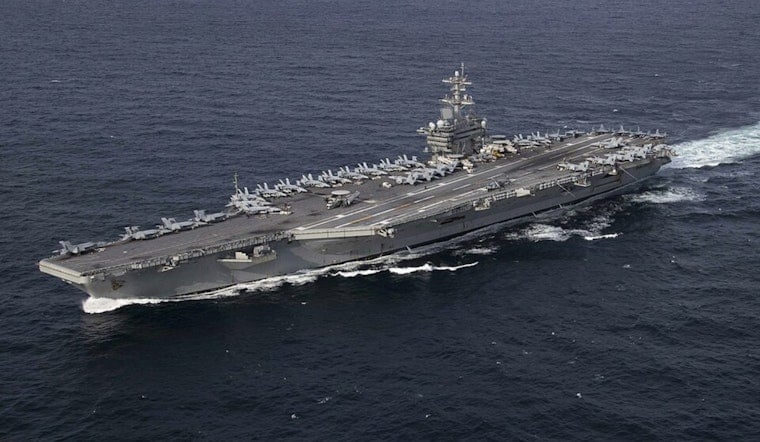
A fighter jet launched from the San Diego-based aircraft carrier USS Abraham Lincoln disabled a Palau-flagged oil tanker in the Gulf of Oman yesterday, U.S. military officials said, turning a routine intercept into a high-stakes confrontation at sea. The strike hit the ship’s engineering and steering spaces and left the vessel unable to continue toward an Iranian port. India’s shipping ministry reported a fire aboard the tanker but said all 24 Indian crewmembers were safe. The move is the latest step in a U.S. campaign to keep sanctioned ships from reaching Iran.
What U.S. officials say
In a post on X, U.S. Central Command said an F/A-18 Super Hornet from the carrier fired a precision munition into the Palau-flagged M/T Marivex’s engineering and steering spaces after the crew failed to comply with directions, rendering the ship no longer sailing to Iran, according to Stars and Stripes. CENTCOM said the strike followed repeated warnings and framed the action as part of an effort to enforce a blockade of Iranian ports.
Crew, rescue and sanctions
India’s shipping ministry said the Marivex had 24 Indian crew aboard and that a fire was reported but all were safe; the ministry said it was coordinating with the Indian embassy in Oman and Omani authorities, Reuters reported. Reuters also noted that the vessel has been linked to U.S. Treasury sanctions, a point U.S. officials highlight when explaining why they are taking enforcement actions at sea.
San Diego connection
The jet that carried out the strike launched from the USS Abraham Lincoln, a Nimitz-class carrier homeported at Naval Air Station North Island in San Diego, according to the U.S. Navy. Local reporting places the carrier in the region since earlier this year and underscores the direct link between San Diego-based forces and operations off Iran, The San Diego Union-Tribune reported.
Blockade enforcement and pattern
U.S. commanders say the interdiction is part of a maritime blockade that began on April 13. CENTCOM has said it has disabled multiple non-compliant vessels and redirected scores of others, according to the Navy Times. The Marivex episode follows earlier interdictions, including a May incident in which a jet from the same carrier disabled the Hasna after repeated warnings.
Legal and diplomatic questions
U.S. officials say the strikes enforce a blockade and target sanctioned actors, but legal scholars and diplomats warn that using munitions against commercial vessels raises questions about proportionality and maritime law. The Marivex’s reported sanction history, along with the involvement of Indian and Omani authorities in rescuing the crew, adds diplomatic layers that officials will have to manage, regional outlets report.
For San Diego, the episode is another reminder that locally based ships and aircrews are central to far-off operations with real political consequences at home. Local officials, families and maritime authorities are watching closely as rescue and salvage work continues.



_underway_in_the_Atlantic_Ocean_on_30_January_2019_(190130-N-PW716-1312).JPG)