

























































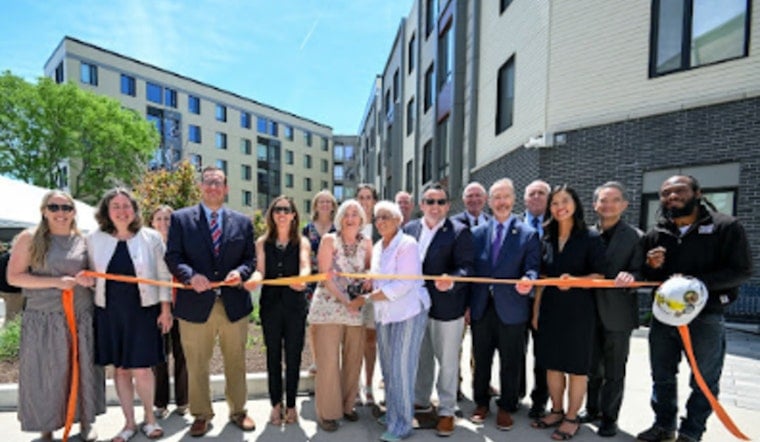
Mayor Michelle Wu, Congressman Stephen F. Lynch, Boston Housing Authority leaders and residents marked a big milestone Monday, cutting the ribbon on the final phase of the Anne M. Lynch Homes at Old Colony in South Boston. The ceremony capped more than a decade of work turning the 1940-era Old Colony public housing superblocks into a walkable neighborhood of modern, deeply affordable apartments. The completed redevelopment now includes 887 affordable units, up from the original 840, and is home to roughly 1,400 residents.
The city release notes that the sixth and final building is an 89-unit structure for families and seniors, built to Passive House standards and fully electric for heating, cooling and hot water. Across six phases, the project replaced all 840 original public housing units and added 47 new apartments. Officials have framed the effort as a national model for public-private partnerships and pointed to federal, state, municipal and private funding as key to getting it done, according to Boston.gov.
A Neighborhood Stitched Back Into South Boston
Instead of sticking with the old isolated superblock layout that defined much midcentury public housing, the Old Colony master plan reopened parts of the street grid, added new pedestrian walkways and created clearer connections to downtown and the waterfront. The redevelopment also brought in community spaces, including the Joseph M. Tierney Learning Center, which offers programming and supportive services for children, adults and seniors. Those and other planning and timeline details are outlined by the Boston Housing Authority.
Passive House, Union Labor And Training
Design teams leaned on Passive House techniques in multiple phases to reduce operating costs, improve indoor air quality and strengthen building resilience, an approach that Beacon Communities and The Architectural Team say has already drawn design recognition. City officials have also highlighted that the redevelopment was carried out under a project labor agreement using 100 percent union labor, and that the original agreement helped launch Building Pathways, a nonprofit focused on recruiting and advancing underrepresented workers in the building trades. Those construction and design choices sit at the center of the project’s sustainability and local labor goals, according to Beacon Communities.
How The Deal Came Together
According to officials, the transformation depended on a long-running mix of public and private funding, starting with an early American Recovery and Reinvestment Act grant, a $22 million HOPE VI award in 2011, and a $25 million investment from the City that helped carry later phases through. At the ribbon cutting, Congressmember Stephen Lynch pointed to roughly $500 million in federal resources tied to the multi-phase project. Financing partners and state agencies also credit their roles in filling gaps so that construction could continue across six phases without long interruptions, per the Boston Housing Authority.
What It Means For Residents And The City
Developers and public officials presented the project’s completion as the result of a long community effort to preserve deeply affordable, modern housing while reconnecting Old Colony with the broader South Boston neighborhood. Leadership at Beacon Communities has described the finished development as an enduring contribution that can function as a national model for renewing aging public housing sites. City and housing officials plan to keep tracking results on resident stability, energy performance and the workforce pathways tied to the project, noting that community programming will sit alongside the new homes, not as an afterthought but as part of the core design.


