

























































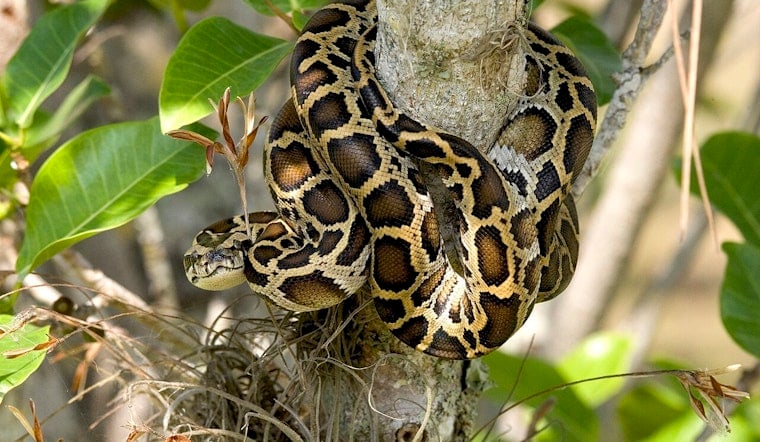
Southwest Florida just wrapped a massive python roundup, and the numbers are hard to ignore. Conservation teams with the Conservancy of Southwest Florida hauled roughly four tons of invasive Burmese pythons out of Collier County during this year’s breeding season, a record haul for the group. Working across about 200 square miles of wetlands, trackers captured 177 snakes and removed thousands of eggs, zeroing in on big breeding females before their nests could hatch. Biologists say every one of those removals is meant to ease the squeeze on native mammals and birds that have become regular prey for the giant constrictors.
Season totals and scale
According to the Miami Herald, the Conservancy's trackers recovered 177 Burmese pythons weighing a combined 8,080 pounds, along with more than 4,100 python eggs, during the November 2025–April 2026 breeding window. Captured females averaged about 95 pounds, and the largest snake this season measured 17 feet and 153 pounds. Investigators also found the remains of white-tailed deer in the stomachs of roughly one in four females. The Conservancy described the tally as its largest single-season biomass removal since the program launched in 2013.
How the trackers outsmarted breeders
The operation hinges on radio telemetry and specially tagged males, nicknamed "scout snakes," that lead field crews to breeding hotspots, researchers say. As outlined by The Wildlife Society, the Conservancy deploys about 40 of these scout snakes and tracks their movements throughout mating season to locate large females before they can lay eggs. That timing is tight but crucial, managers explain, because pulling breeding females and their clutches out of the ecosystem directly undercuts local reproduction.
From the field
“This was our first four-ton removal season. Our tagged scout snakes helped us locate large breeding snakes deep in the landscape before they had a chance to lay eggs,” Conservancy wildlife biologist Ian Bartoszek said in a statement quoted by the Miami Herald. Conservancy President and CEO Rob Moher added that “every python removed reduces pressure on the ecosystem,” underscoring why teams concentrate so heavily on adult females and their nests.
Why the egg numbers matter
The Florida Fish and Wildlife Conservation Commission notes that adult female Burmese pythons can lay between about 50 and 100 eggs in a single clutch, making nest removal a particularly efficient way to blunt recruitment, according to the FWC. Wildlife managers say suppression, not eradication, is the realistic goal, but emphasize that consistent, targeted removal can reduce local reproduction and give native species a better shot at recovering.
What comes next
The Conservancy’s latest season adds to years of python removal work across Southwest Florida. A program profile from The Wildlife Society notes that the group has removed many tons of python biomass since 2013 and uses carcasses for continuing research into diet, health and population trends. The state’s annual Florida Python Challenge, scheduled for July 10–19, 2026, will bring additional searchers and volunteers into the field for a summer removal push, according to the Florida Python Challenge. Officials are asking residents who spot large nonnative snakes to contact FWC resources instead of trying to handle removals on their own.





,_NPSPhoto,_R._Cammauf_(9101584016).jpg)