

























































Spring Hill leaders are eyeing a short-term sewer workaround that could send a slice of the city’s wastewater south to Columbia, in a bid to ease a growing capacity crunch at home.
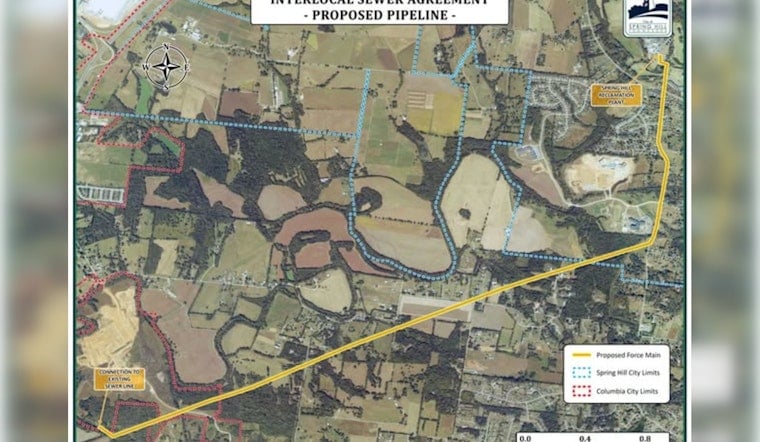
The Board of Mayor and Aldermen voted this month to have staff open talks with Columbia on an interlocal wastewater agreement that would route some Spring Hill flows to Columbia’s new treatment system. The move unlocks money for planning, engineering and legal work, but stops well short of approving any final deal. City materials frame the potential hookup as a temporary pressure valve for the system, not a permanent fix. A staff map shared publicly sketches out a possible pipeline route, with early estimates putting the project around $12 million.
BOMA Directive And The Plan
As outlined in Resolution 26-14 B from the City of Spring Hill, the Board instructed staff to coordinate with the City of Columbia to evaluate and negotiate a possible interlocal wastewater agreement and to spend on related planning and due diligence. The resolution labels this as a fact-finding step only. Any actual interlocal agreement, rate structure or construction commitment would have to come back to the Board for separate votes.
The staff memo describes the Columbia option as a near-term regional tool that would sit alongside longer-term strategies such as upgrading Spring Hill’s own plant or using decentralized treatment. In other words, the city is trying to keep several paths open while it figures out how to handle growth and state pressure on the system.
How The Hookup Would Work
City communications and a staff map posted on the city’s social feed show a proposed 12-inch gravity sewer main running from the Spring Hill Water Reclamation Plant along Mahlon Moore Road, then tracking a TVA easement for several miles before tying into an existing line on Columbia’s north side, according to a City of Spring Hill post.
The concept uses a metered connection into Columbia’s system so Spring Hill could send specific, pre-agreed volumes there for interim treatment. City officials say conversations with Columbia are ongoing, and they plan to share more details publicly as the negotiations and engineering work progress.
Price Tag And The Treatment Site
Local project listings linked to work at Spring Hill’s wastewater site show a roughly $12 million item tied to the same general area. A ConstructConnect entry lists a $12,000,000 centrifuge dewatering facility at 3893 Mahlon Moore Road, which is the reclamation plant property.
City budget packets also include funding lines for wastewater treatment plant expansion, gravity sewer planning and related capital work, signaling that Spring Hill is weighing several capital paths at once, including but not limited to an interlocal link. Any spending beyond studies and engineering would require fresh Board approval and likely review by state environmental regulators.
Why Columbia Is Being Considered
Spring Hill’s feasibility push leans on Columbia because Columbia has already lined up major wastewater capacity and upgrades in its capital program, making it a plausible short-term receiver of municipal flows. Local reporting on Columbia’s budget and capital plan details a multi-million-dollar wastewater project and pump station improvements that would add treatment headroom, which is why Columbia is in the conversation.
If an interlocal deal is worked out, Columbia’s own construction schedule and approvals would play a big role in how much Spring Hill flow could be shifted and when.
Next Steps And Regulatory Context
The Board approved the exploratory resolution unanimously and gave staff authority to pursue technical studies and negotiate terms, according to the city’s meeting packet. Spring Hill is operating under a TDEC consent order and a city-imposed sewer moratorium that cap allocations at the central plant, and the interlocal concept has been pitched as one possible way to stay on the right side of regulators while permanent fixes are developed.
Engineers, state officials and both cities would have to lock in details on metering, rates and environmental approvals before any wastewater is actually rerouted. City leaders emphasize that any final agreement would still need a public airing and a formal Board vote.
What Residents And Developers Should Watch
Property owners, developers and residents are being told to watch upcoming Board packets and the city’s social channels for engineering reports, public hearing notices and any draft interlocal language. For now, officials stress the idea is still in the feasibility phase. If the numbers and logistics check out, the Columbia hookup could soften near-term capacity limits while Spring Hill continues pushing its longer-range wastewater treatment projects forward.



