

























































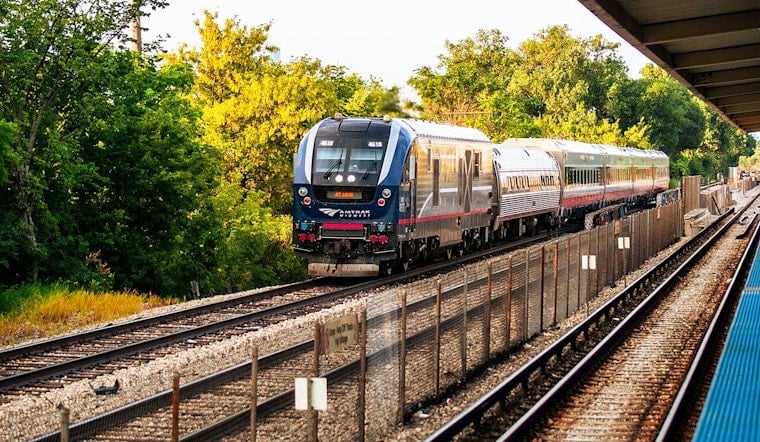
Illinois leaders chasing a high-speed rail dream between East St. Louis and Chicago just got a harsh dose of math. The rosiest ridership forecast on the table says a dedicated line would pull in roughly 8,000 riders per day, or about 2.8 million passengers a year. Pair that with big operating costs and a hefty need for taxpayer subsidy, and some members of the Illinois High-Speed Rail Commission are openly wondering whether the numbers pencil out at all.
The debate now is whether to keep chasing a mostly new, purpose-built corridor through the middle of the state or to scale back the vision before it ever leaves the station.
According to IDOT, the top-performing option is a largely greenfield route starting in East St. Louis and stopping in Springfield, Decatur, Champaign and University Park before rolling into downtown Chicago. That setup was modeled to draw about 8,060 daily boardings and roughly 2.82 million trips a year, with an end-to-end travel time just under two and a half hours.
The consultants built their forecast around 16 round trips in each direction and a fare of $0.40 per mile. Those assumptions drove a series of sensitivity tests on how tweaks to train frequency, ticket prices and station locations would affect ridership and revenue, and commissioners pressed the team to walk them through the fine print.
What the numbers mean
Per St. Louis Magazine, that $0.40 per mile fare would come out to about $124 for the full 310-mile trip. On the cost side, operating and maintenance for the highest-ridership route would run close to $490 million a year, while fares would bring in only about $232 million.
That leaves roughly a $250 million annual subsidy gap at the 16-train frequency. Cutting service to eight round trips in each direction trims daily ridership by around 1,000 riders and lowers the subsidy need by about $43 million. Shifting stations from suburban sites into downtowns, meanwhile, bumps ridership by about 15 percent in the scenarios the team tested.
Those tradeoffs put the core dilemma in plain view: more trains and relatively low fares make the service more attractive but drive up public costs, while fewer trains save money but turn off potential riders.
Why commissioners pushed back
Several commissioners balked at the size of the public investment relative to the ridership projections.
“It seems to be a big investment for not a substantial growth in ridership potential here for this system,” Commissioner Erin Aleman told St. Louis Magazine. Another commissioner questioned why some scenarios would run only eight trains a day when higher frequency is usually considered essential to coax drivers out of their cars and onto transit.
What is next
The consultants said they plan to hold a final virtual public meeting, lock in the ridership and revenue forecasts and complete a final report in the coming months before the commission issues a formal recommendation, according to the slide deck presented to the group.
That schedule gives local officials, advocates and residents one more chance to weigh in on station locations, fare strategies and whether construction should be phased. The commission could endorse a segment-by-segment rollout, a lower-service launch that ramps up over time or a full greenfield build, depending on how the final numbers and public feedback shake out.
Where this would land
On paper, the projected annual boardings are strong enough to rival some newer premium rail corridors in the United States. Even so, they come with a sizable public tab for both construction and day-to-day operations.
Commissioners now have to decide whether to trim service levels and stage construction to ease the near-term hit to the budget or to pursue the complete build, which would demand a long-term subsidy commitment and steady political support to keep the trains running.



