

























































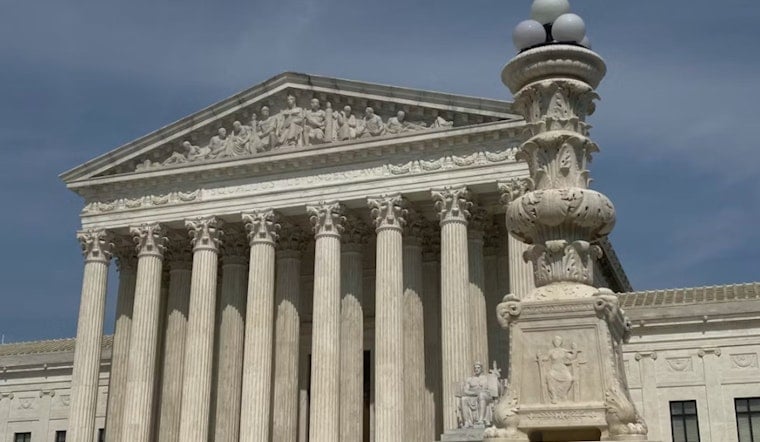
The Supreme Court on Tuesday handed the Trump administration a significant immigration victory, ruling 6-3 that the government can more easily parole returning green-card holders and place them into removal proceedings without first clearing a heightened proof hurdle at the border. The case traces back to a 2012 encounter involving Muk Choi Lau, a lawful permanent resident who was paroled rather than admitted when he re-entered the United States after being accused of selling counterfeit goods.
The case and the ruling
Writing for the six-justice majority, Justice Clarence Thomas rejected the argument that border officers had to meet a demanding evidentiary standard before treating Lau as an applicant for admission. As reported by The Associated Press, Thomas concluded that “Border officers did not have the burden to establish by clear and convincing evidence that Lau had committed a crime involving moral turpitude.”
The dispute appears on the court’s docket as Blanche v. Lau (No. 25-429), and the justices heard arguments in April, according to the Supreme Court docket. The decision cements how immigration officials may treat lawful permanent residents who leave the country and then come back while facing criminal accusations.
How Lau's case unfolded
Lau, a Chinese national who became a lawful permanent resident in 2007, was charged in New Jersey in May 2012 with selling nearly $300,000 worth of counterfeit Coogi shorts. He briefly left the country after those charges, then returned in June 2012. On that return, immigration officers chose to parole him into the country rather than formally admit him.
After Lau later pleaded guilty, the Department of Homeland Security moved to have him removed from the United States. The U.S. Court of Appeals for the Second Circuit sided with Lau and held that officers at the border had to possess “clear and convincing” evidence of a crime involving moral turpitude at the moment of reentry in order to treat him as an applicant for admission, SCOTUSblog reports. The Supreme Court’s ruling wipes out that win for Lau and resets the evidentiary burden in the government’s favor.
Legal implications
Legal analysts say the decision clarifies which side carries the key burden of proof at the border. Under the ruling, the government can parole a returning green-card holder, then rely on evidence that develops later in removal proceedings, rather than proving disqualifying conduct immediately at the port of entry. The Legal Information Institute notes that the distinction matters because a lawful permanent resident who is admitted has different protections and obligations than someone treated as an “applicant for admission.”
Justice Ketanji Brown Jackson dissented, warning that the decision leaves returning residents in what she described as “immigration limbo.” She cautioned that “I worry that the Court has now handed the Government a massive blank check,” according to The Associated Press.
Where this fits in the court's immigration docket
The decision lands in the middle of a packed Supreme Court immigration calendar, with the justices also weighing challenges to birthright citizenship, fights over asylum rules, and disputes involving temporary protections, a group of cases that observers say could further reshape who is exposed to removal, according to SCOTUSblog. Advocates on both sides of the immigration debate expect lawyers to test the scope of the Lau ruling in immigration courts and federal appeals in the months ahead.
For green-card holders and the attorneys who advise them, the immediate takeaway is practical and sobering: travel while under criminal charge or investigation now carries a heightened risk of being paroled into removal proceedings, rather than simply readmitted. Lawyers say fresh rounds of litigation are likely as lower courts, federal agencies, and noncitizens try to map the new contours of parole authority after this Supreme Court decision.





