

























































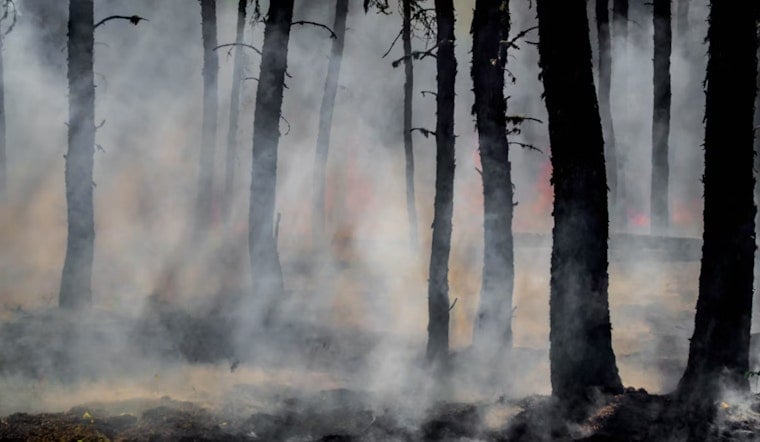
Years of hard-won progress on smog are starting to slip away as wildfire smoke pushes U.S. air quality in the wrong direction. New research shows that average ground-level ozone, the key ingredient in smog, has begun to climb again and, if current trends continue, could creep back toward early-2000s levels within the next couple of decades.
How scientists stitched together a coast-to-coast ozone map
A research team led by Weizhi Deng at the University of Iowa set out to answer a basic question with surprisingly little hard data behind it: how much ozone are people actually breathing, and where. To get there, they combined sparse federal regulatory monitors with satellite observations, weather data and emissions models, then trained machine-learning algorithms to turn that grab bag of inputs into a daily ozone record with 1-kilometer resolution that spans the entire continental United States.
When they looked at trends in that high-resolution map, they found ozone starting to rise around 2015 and estimated roughly a 4% national increase since then. The methods and trend details are laid out in a Research Square preprint, which the authors say helps fill gaps left by the limited network of federal smog monitors.
Another team tallied ozone’s hidden wildfire toll
A separate analysis published this spring tried to tease out what happens to ozone specifically on smoky days. Using surface monitors, satellite data and machine learning, the researchers isolated ozone changes during smoke episodes and found that wildfire smoke can drive up daily ozone by as much as about 16% at some locations.
They also estimated that smoke-driven ozone contributed roughly 2,045 excess deaths per year on average between 2006 and 2023. The work underscores that ozone, not just tiny airborne particles, is becoming a bigger public-health problem, according to a Science Advances paper.
Smoke travels far, and a lot of people are in the path
Researchers say a surge in large fires, including the record acreage that burned in Canada in 2023, has sent smoke and ozone far beyond the fire lines, exposing tens of millions of Americans. One recent national analysis found that during heavy smoke seasons in 2022 through 2024, roughly 43 million people experienced ozone levels above the current EPA standard. Federal fire statistics also show that average annual burned area has increased compared with earlier decades, a reminder that this is not just a bad year or two, according to reporting by The Associated Press.
Urban air policy is colliding with wildfire reality
The human cost is already showing up in the American Lung Association’s latest State of the Air report. Millions of people live in counties that earned failing grades for ozone or particle pollution, and the group says climate-driven extremes and wildfire smoke are making it harder to maintain the long-term cleanup gains achieved by tighter emission rules and cleaner technology.
Local officials and health advocates are seizing on those findings as they push for more monitoring, cleaner fuels and stronger ozone protections, according to the American Lung Association.
Scientists want more sensors, sharper models and smarter forecasts
Researchers argue that the country still does not have enough monitors in enough places to fully capture how wildfire smoke is changing ozone on the ground, especially in smaller communities that may already be vulnerable. Better spatial coverage, they say, has to go hand in hand with improved air-quality models.
Federal and academic teams are now working on higher-resolution forecasting tools and artificial-intelligence systems to predict smoke chemistry and ozone formation more accurately. That effort, described by the National Science Foundation, is part of a broader push to give the public clearer and more timely health warnings when smoke rolls in.
What you can do when the air turns hazy
Public-health agencies recommend keeping an eye on local air-quality reports, cutting back on outdoor exertion on high-ozone or smoky days and using N95 or P100 respirators when particle levels spike. For step-by-step guidance on staying safe during wildfire smoke episodes, federal health officials point people to the CDC along with local air-quality resources such as AirNow.





