

























































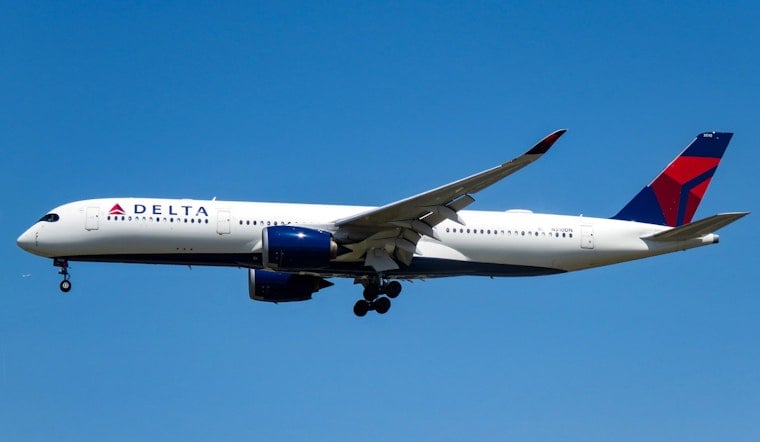
Humanoid robots are officially persona non grata on Delta. The Atlanta-based carrier has told customers it will not fly life-sized machines that look or act like people or animals, even if their owners are ready to spring for a seat. The airline says the robots’ lithium batteries pose a safety risk, so for now these high-tech travel companions are blocked from both the cabin and the cargo hold.
The move makes Atlanta’s hometown airline one of the first major U.S. carriers to clearly draw the line on robot passengers. According to 95.5 WSB, Delta announced Tuesday that it is banning humanoid robots from its flights because of safety concerns involving their lithium batteries. United Airlines and Southwest Airlines rolled out similar restrictions earlier this month.
Delta’s official policy, posted by Delta Air Lines, describes the move as a temporary ban on robots designed to resemble or imitate humans or animals in appearance, size, movement or behavior. The airline says these machines are not treated as assistive devices and do not qualify as trained service animals. Smaller toy robots can still fly as long as they comply with the standard carry-on, storage and battery requirements.
Why The Battery Rules Matter At 35,000 Feet
The issue is not a sci-fi robot uprising but a very real risk of battery fires. The Federal Aviation Administration warns that lithium-ion batteries can overheat and go into thermal runaway if they are damaged, overheated, overcharged or packed the wrong way.
Federal rules for passengers generally allow lithium-ion batteries up to 100 watt-hours without any special approval, require airline sign-off for batteries between 101 and 160 watt-hours, and ban batteries above 160 watt-hours from passenger aircraft entirely. The FAA also points out that airlines are free to adopt stricter policies, which gives carriers room to shut down a growing category of gear that does not neatly fit under the usual phone-and-laptop baggage rules.
Southwest’s Robot Passengers Helped Set The Pattern
Delta’s ban follows a similar crackdown at Southwest, which reacted after large robots turned up on flights and videos of the scene spread online. KERA News reported that Southwest cited the size of the robots’ lithium-ion batteries when it prohibited humanoid and animal-like robots from its planes.
An Bebop’s flight delay detailed how a four-foot robot named Bebop helped cause roughly an hour of delays on a Southwest flight after crew members determined that its battery exceeded the airline’s limits. Another robot, Stewie, turned into an online spectacle when it flew with its own purchased seat, but with this new wave of airline rules, buying a ticket for a robot is no longer a reliable workaround.
What Atlanta Travelers Need To Know
For Atlanta flyers hoping to bring a humanoid or animal-like robot along, Delta’s current stance is blunt: no seat in the cabin and no spot in checked luggage. The airline says it will keep reviewing and updating the policy as the technology evolves, according to 95.5 WSB.





.jpg)