

























































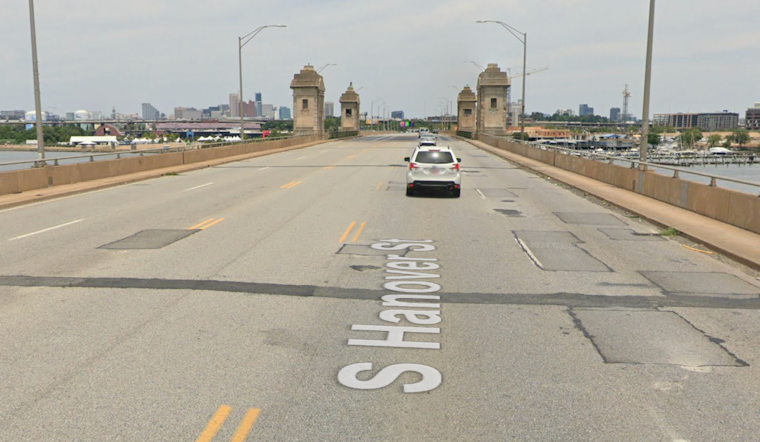
It is the kind of thing that makes your heart skip a beat on the morning commute: a clear view of the road and water below where solid bridge decking is supposed to be. That is what one cyclist says he saw on the Hanover Street Bridge in early July, and his photo set off a fresh round of repairs and a louder debate over what to do with the 110-year-old span.
Crews have since rolled out temporary steel plates and started swapping out deteriorated open-grid panels while city and state officials argue over the same big question that has been hanging over the bridge for years: fix it up again or start over with something new.
Ivan DeGraff, who bikes across the bridge, snapped a picture of the hole and told WMAR-2 News that “I can see the road and the river through the bottom of the bridge.” The station shared his photo with the Baltimore Department of Transportation, which told the outlet that crews are in the process of replacing the open-grid decking and that new panels are being manufactured and will be installed once fabrication wraps up.
Short-term fixes, long planning horizon
For now, Baltimore has money to study the problem, not to pour concrete and steel. The city landed a $15.5 million RAISE grant in 2024 to cover NEPA work, environmental review and preliminary design for the Revitalize Hanover Street Corridor, according to a U.S. Senate press release announcing the award.
Officials point out that the RAISE cash is strictly for planning. Any actual rebuild will need a separate stack of state and federal construction dollars before shovels can hit the ground.
Traffic and inspection reports
In the meantime, the old bridge is doing a lot of work. Nearly 29,000 vehicles cross the half-mile span on a typical day, according to the Maryland Department of Transportation's Traffic Monitoring System.
A city inspection completed on Dec. 8, 2025, flagged areas of deteriorated decking, and the city estimates that routine maintenance alone runs about $500,000 a year. Those figures were reported publicly by WMAR-2 News as crews continued to patch worn panels just to keep traffic moving.
What a rebuild would take
Baltimore's recent priorities letter to the state does not sugarcoat the price tag. The city warns that final design alone could run more than $10 million and that construction of whichever option is ultimately chosen “could exceed $250 million.” That language appears in the city's FY-2027 priorities file to MDOT.
The Revitalize Hanover Street Corridor study, which covers roughly 2.4 miles from I-95 to the Anne Arundel County line, is intended to steer the NEPA process and public outreach before engineers land on a preferred design, according to the city's project report.
Neighbors want clearer timelines
People who live near the bridge and those who cross it daily say the fixes feel like a never-ending game of whack-a-mole. They want a firmer timeline for a permanent overhaul that would bring wider, safer sidewalks and protected bike lanes, priorities that local planning discussions have already emphasized.
Planners say those community wishes will be folded into the NEPA study. Even so, fabrication lead times for new bridge components and the long slog of lining up construction funding mean drivers and cyclists should probably get used to those temporary steel plates and piecemeal repairs sticking around for months or even years.





