

























































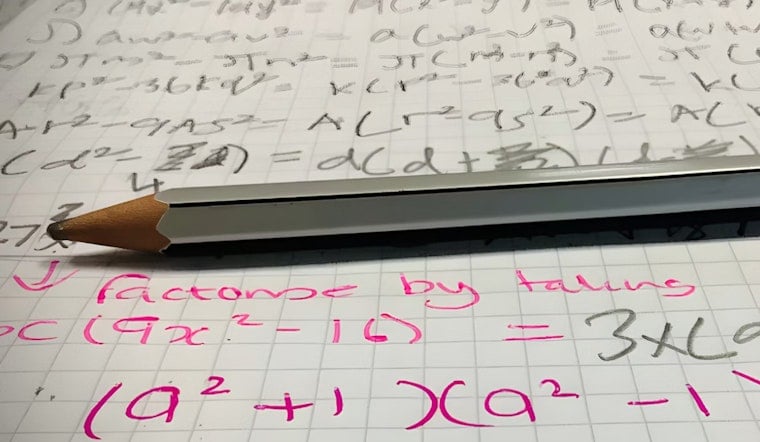
Cambridge Public Schools tried to turn every eighth grader into an Algebra I student this year. Now district numbers show the bold experiment has come with a steep price: more than six in 10 rising ninth graders will have to repeat Algebra I in high school. Families and some teachers say the accelerated push packed classrooms, sped up lessons and left a lot of kids feeling lost.
According to The Boston Globe, the district told the school board that over 60 percent of this year’s eighth-grade cohort did not reach the level needed to move on and will take Algebra I again as freshmen. The Globe reports the district required a second adult, a special educator or math interventionist, in each eighth-grade Algebra I class. Despite the struggles, just under half of students who will repeat the class are being placed into an honors option at Cambridge Rindge and Latin. District officials told the board that the results make clear more work is needed in earlier grades to get students truly ready for accelerated coursework.
How Cambridge Ended Up Here
District leaders say the algebra push came after years of debate, not a snap decision. According to minutes from the Cambridge School Committee, the board in 2024 adopted a motion to offer in-school programs so students could complete Algebra I by fall 2025 and to convene educators to determine whether to return to heterogeneous instruction by fall 2026.
The district’s own roundtable report, published by Cambridge Public Schools, shows that the earlier two-tiered structure for middle school math left wide gaps by race and income. That was the main rationale, officials say, for trying a detracked approach with added supports. The roundtable materials describe those subgroup gaps and recommend coaching for teachers, summer programs for students and WIN blocks as part of the fix.
Teachers And Parents React
Some educators told reporters that once the new plan actually hit classrooms, it felt rushed and thin on details. Parents described students suddenly thrown into a faster pace and more abstract material than they were used to.
“Both my kids have been bored in math for many years,” one Cambridge parent said, a comment reported by The Boston Globe. For families like that, the move to put everyone into Algebra I sounded like overdue ambition, not reckless acceleration.
Superintendent David Murphy stressed the complexity of getting this right. “The work of identifying the best possible academic trajectory for all students is never finished,” he told the paper, and the district says it is reviewing this year’s outcomes and the supports that were in place.
What Research Says About ‘Algebra for All’
Education researchers have long warned that simply bumping students into higher-level courses without matching supports can backfire. Reporting and analysis from Chalkbeat and The Hechinger Report show that Minnesota’s statewide push to require Algebra in eighth grade did not produce a lasting surge in students taking calculus. In some studies, students who were hastily accelerated actually scored worse on standardized tests.
Experts cited in those pieces say that when acceleration works, it usually comes with serious backup: extra class periods, tutoring, intensive teacher coaching and careful attention to who needs what support, not just a more impressive course title on the schedule.
What’s Next For Students
Cambridge officials say the district is trying to shore up that kind of backup now. The plan includes a menu of supports such as extra programming, bootcamps and small-group intervention, and administrators have told the School Committee they will track how this cohort fares as it moves through high school.
The Cambridge School Committee minutes note that administrators will convene teachers and publish reports so future decisions about pacing and placement can be guided by equity data. If educators judge the system ready, the district hopes to return to a fully heterogeneous model by fall 2026.
For families weighing what this all means, district officials and some parents argue that early exposure to Algebra in middle school can still open doors to higher-level math later on. The catch, they say, is that those opportunities only really materialize if the system invests in the catch-up supports struggling students clearly need.
The Cambridge experiment captures the central math-policy dilemma: accelerate too fast and risk leaving students behind, move too slowly and risk choking off opportunity. School leaders say the real verdict will come next year, when this class settles into ninth grade and the district has to show whether its supports can turn a rocky Algebra I debut into a more equitable long-term trajectory.



