

























































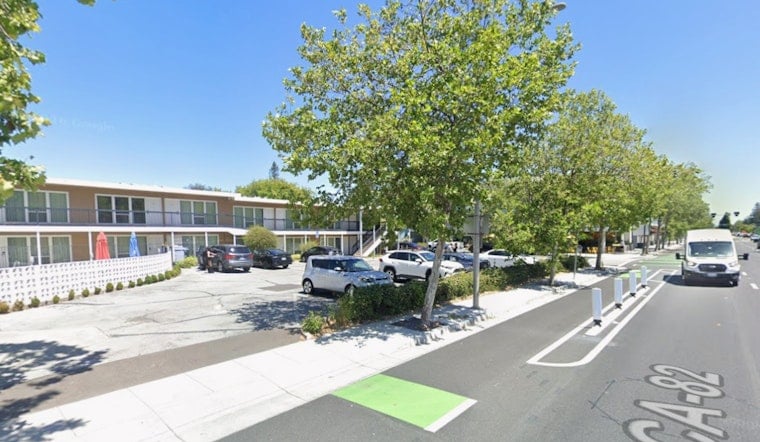
The Coronet Motel on El Camino Real could be cleared out for a new six-story apartment building if a fresh proposal from a local developer moves forward. The plan calls for 76 apartments, including 12 income-restricted units, stacked in five floors of housing over a basement and ground-level parking on a roughly 0.38-acre parcel just south of California Avenue.
Bayhill Ventures filed a preliminary application with the city last Wednesday, arguing the site qualifies under California’s new transit-oriented housing rules. As reported by the Palo Alto Daily Post, the property is owned by Brender Commercial Land Holdings and currently holds a 22-room motel with a small surface parking lot. The developer ties the timing directly to recent state housing changes that took effect this month.
What The Proposal Would Build
According to San José Spotlight, Bayhill’s early blueprint envisions a 65-foot-tall, six-story building with 76 apartments: 48 one-bedrooms, 23 two-bedrooms and five studios. About 152 parking spaces are planned, and 12 of the homes would be set aside as affordable units.
In a letter to city staff, the applicant’s attorney wrote that “SB 79 is currently fully effective in Palo Alto, except at certain sites designated as local historic resources as of January 1, 2026.” The filing also cites Senate Bill 330 as a way to lock in the development standards in place when the application is submitted, and says Bayhill intends to file a formal application within 180 days.
Why The Timing Matters
The state’s Abundant and Affordable Homes Near Transit Act (SB 79) took effect July 1 and sets minimum statewide standards for building height and density near qualifying transit stops, according to bill language on the California Legislative Information site. In mid-June, Palo Alto officials weighed an urgency ordinance that would have delayed SB 79 locally but ultimately chose not to adopt it.
That decision created a short window for developers to submit projects that could rely directly on SB 79 before the city’s own implementing rules kick in. City planners say that is exactly why Bayhill’s paperwork landed on their desks on July 1, the first day the law was in force.
El Camino Pipeline And Local Context
The Bayhill plan is the latest in a growing lineup of sizable housing proposals along El Camino Real, a corridor city leaders have been steering more development toward. The Mountain View Voice has documented one of the largest nearby proposals, a 368-unit, seven-story complex at 3150 El Camino Real. San José Spotlight has also highlighted nonprofit and affordable housing concepts on other parcels along the same stretch.
Taken together, the applications show Palo Alto increasingly channeling growth to major arterials like El Camino Real instead of deeper residential neighborhoods, a practical shift that still tends to draw scrutiny from nearby residents.
Legal And Permitting Notes
Because the preliminary filing leans on SB 79 and explicitly cites SB 330, the Coronet Motel redevelopment would be reviewed under the state’s newer transit-oriented housing framework and, if the developer’s legal reading holds up, under the zoning and development standards in place once the application is deemed complete.
SB 330, the Housing Crisis Act of 2019, limits cities from adding new objective standards to qualifying housing projects after an application has been submitted, according to the bill text on LegiScan. From here, Bayhill’s next step is to file a full application and enter the city’s formal review process, where planners, neighbors and the City Council will all have their chance to weigh in before any permits are issued or appeals are launched.





