

























































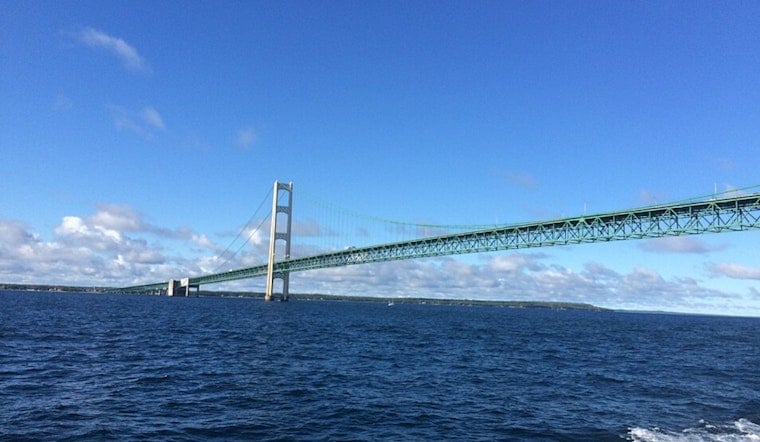
The Mackinac Bridge, Michigan’s five-mile "Mighty Mac," has cleared a collapse-risk review tied to big-ship collisions, state officials said Wednesday. Engineers found the probability of the span collapsing from a large vessel strike to be very low. Using an AASHTO Method II calculation, consultant Parsons estimated the bridge’s total annual collapse frequency at about 0.000097, roughly a 1-in-10,350-year return period, and 0.000045 for a one-way traffic scenario. The Mackinac Bridge Authority says both numbers land below national safety thresholds. The review followed a National Transportation Safety Board request for vulnerability checks after the March 2024 collapse of Baltimore’s Francis Scott Key Bridge.
Parsons analysis and MBA reaction
The Mackinac Bridge Authority said it reviewed a summary of the Parsons study at its meeting yesterday and signed off on the consultant’s conclusion that the bridge meets AASHTO reliability criteria. “This report confirms what we’ve long believed to be true, that the risk of the Mackinac Bridge collapsing due to being struck by a vessel is extremely low,” Bridge Director Kim Nowack said.
According to the Mackinac Bridge Authority, officials submitted the full study to the NTSB in March and made a one-page summary of the findings public.
Why the review was required
The safety check traces back to NTSB guidance after the Francis Scott Key Bridge collapse, when investigators told the owners of 68 U.S. bridges to run vessel-strike vulnerability assessments. The NTSB determined that the Key Bridge’s calculated collapse probability was far above the AASHTO threshold, and that finding helped trigger a nationwide push to reexamine similar spans.
As outlined by the NTSB, those vulnerability reviews are meant to flag situations where owners may need to adopt risk-reduction measures.
What Parsons examined and what was released
Parsons’ study took into account the bridge’s structural capacity, the layout of the Straits of Mackinac, and the types, sizes, and frequencies of vessels that move through the waterway. The firm has long handled inspection and engineering work for the bridge.
The summary released by the Mackinac Bridge Authority notes that Parsons used an AASHTO Method II calculation and relied on vessel-movement data in the analysis. As described in Parsons project materials, the summary says a major vessel impact would likely cause localized damage while the overall stability of the foundations would be maintained.
A short collision history
The Mighty Mac is not a stranger to bumps and scrapes, and so far it has shrugged them off. A contractor workboat scraped a north-end pier in 2021, and in May 2023, a crane boom mounted on a barge struck the main span, causing about $145,000 in bridge damage.
Bridge officials described the 2021 contact as cosmetic. The NTSB’s investigation into the 2023 allision documents the collision and estimated repair costs. For those incidents, see local reporting by 9&10 News and the related NTSB investigation.
What, if anything, will change
The bridge authority did not announce any operational changes tied to the review and released only the consultant’s summary. Staff told local media that the full technical report was being withheld for security reasons.
Parsons reportedly did not make recommendations beyond what appears in the summary. The authority said it would inform the public if the study’s findings eventually lead to changes in procedures or to closures. As reported by MLive, the Mackinac Bridge Authority emphasized that the full study had already been sent to the NTSB for its records and review.
Bottom line for travelers
For drivers and residents, the immediate takeaway is straightforward. The Mackinac Bridge Authority says the span meets AASHTO risk criteria and remains in routine operation, with inspections and maintenance continuing. Officials urged the public to keep an eye on authority channels for any future notices about closures or operational changes.





