

























































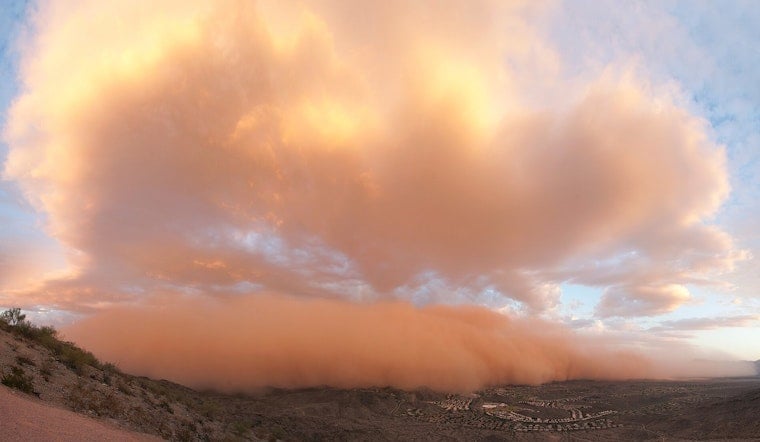
Valley residents are heading straight into the thick of monsoon season as experts warn 2026 could bring an unusually active dust storm year. Blinding brown walls of dust, locally called haboobs, can slam visibility to near zero and send coarse particulates spiking into the air, creating immediate road hazards and short term health risks. Officials and researchers are pushing a few simple, repeatable steps for drivers and households so people are not caught off guard when that wall of dust shows up on the horizon.
As reported by Atlanta News First, meteorologists and public health specialists say a mix of prolonged dryness and energetic summer storms has primed the Valley for more, and sometimes larger, dust events this season. The piece, produced by Karina Rubio, highlights how fast an ordinary drive can turn life threatening when visibility suddenly vanishes.
New PHX-DUST scale gives officials a common language
Researchers at Arizona State University have rolled out the Phoenix Dust Storm (PHX-DUST) scale, a new tool that classifies storms after they occur. Events are ranked from Category 1 through Category 5, based on short term PM10 levels, wind and duration. According to ASU Now, each category corresponds to a range of peak dust concentrations, starting at roughly 1,000 μg/m³ for the lowest tier and climbing to about 5,000 μg/m³ for the most severe. The goal is to give agencies a shared way to compare storms, talk about their intensity and fine tune response plans.
Driving: Pull aside, stay alive
The top safety rule is simple: do not try to drive through a dust wall. Pull over and wait it out.
Per the Arizona Department of Transportation, drivers who are caught in a dust storm should safely pull off the paved portion of the roadway, set the parking brake, turn off all vehicle lights, including hazard flashers, and keep their foot off the brake so trailing drivers are not drawn toward their taillights.
The National Weather Service uses the same “Pull Aside, Stay Alive” wording in its Dust Storm Wireless Emergency Alert templates. A study in the Western Journal of Emergency Medicine found that this specific messaging was associated with fewer motor vehicle trauma cases after haboobs, which is about as clear an argument for following the script as you are going to get.
Protect your lungs and indoor air
For people with asthma, COPD, heart disease or other sensitivities, dust days are not the time to push it. When a storm moves in, stay indoors, keep windows and doors closed and skip outdoor exertion.
The Arizona Department of Health Services recommends using air conditioning on recirculate when possible, running high efficiency filters or a HEPA purifier at home and considering a well fitting respirator if you absolutely must be outside. Federal air quality resources at AirNow offer Air Quality Index forecasts along with guidance on masks and filtration.
Valley fever: a real but complicated risk
State health information notes that desert dust can carry Coccidioides spores, the fungus that causes Valley fever. At the same time, large reviews and surveillance studies show that the link between short dust events and spikes in reported Valley fever cases is mixed.
The clinical overview from the CDC describes how spores become airborne when soil is disturbed. Yet a broad analysis published in GeoHealth concluded there is no consistent association between individual dust storms and increases in Valley fever reports, underscoring that the disease risk is real but not neatly tied to every haboob that rolls through.
A short prep checklist
Before you plan outdoor time, check current air quality and keep an eye on the forecast. If you have to travel, know your route and have traffic and closure updates ready to go through AZ511 or other alerts from the ADOT system. Keep water, phone chargers and a basic emergency kit in your car so you are not stranded without essentials.
Bookmark AirNow for quick AQI checks, use AZ511 for live road conditions via the ADOT portal and look at PHX-DUST reporting from Arizona State University after major events to see how a given storm stacked up.





.jpg)