

























































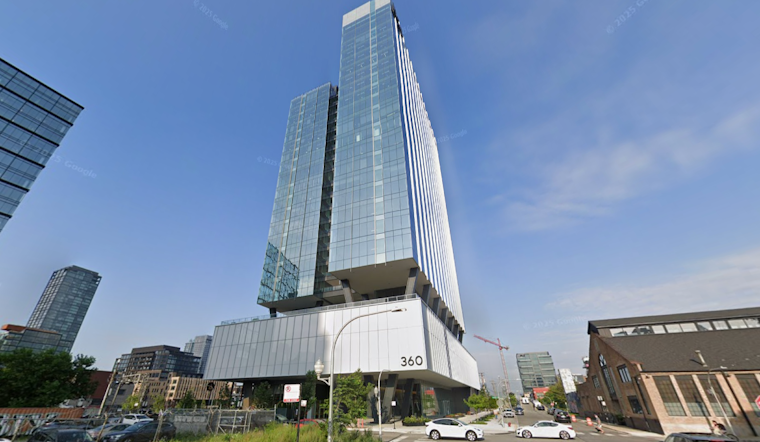
Chicago’s Fulton Market just scored another vote of confidence from the lending world: A JPMorgan Asset Management fund and Sterling Bay have secured a $213 million refinancing for one of the neighborhood’s newest office towers. The deal gives the ownership group fresh breathing room as Chicago’s office market continues splitting between polished, well-leased properties and older buildings struggling to attract capital.
The three-year loan for 360 North Green closed last week, according to Bloomberg. Barings issued the financing, while JLL Capital Markets advised Sterling Bay; the 2024-built tower is about 76% leased, with roughly 500,000 square feet of office space.
Sterling Bay describes 360 North Green as a Class A project and the Midwest headquarters for Boston Consulting Group, with retail, outdoor space, a fitness center, bar and lounge, and even a duckpin bowling lounge. The developer’s property profile places the building squarely in Fulton Market, where newer offices have continued to pull tenants away from much of the traditional Loop.
Fulton Market Is Winning Chicago’s Office Split
The financing arrives against a backdrop that remains anything but uniform. Cushman & Wakefield reported that Chicago’s overall central business district vacancy rate reached 27.2% in the second quarter, while Class A vacancy fell to 23% and trophy-building vacancy dropped to 13.4%.
Fulton Market was one of the few downtown submarkets posting positive absorption through midyear, with 259,000 square feet of net gains, according to the report. That flight to newer, amenity-heavy buildings is the market’s central divide: The city still has plenty of empty office space, but the best-positioned towers are competing in a much healthier lane.
Hoodline’s earlier local coverage noted that 360 North Green was already drawing major tenants before its opening, including Boston Consulting Group and Greenberg Traurig. The building’s leasing story has since changed, but its location and newer construction remain exactly the kind of characteristics lenders are favoring in a market where age, amenities and tenant quality can make or break a refinancing.
The new debt does not solve Chicago’s broader office problems, and it is not a sign that every building can refinance on similar terms. But as Bloomberg noted, the transaction highlights the widening gap between high-end properties that can still attract financing and buildings that remain stuck in the capital-markets penalty box.





