

























































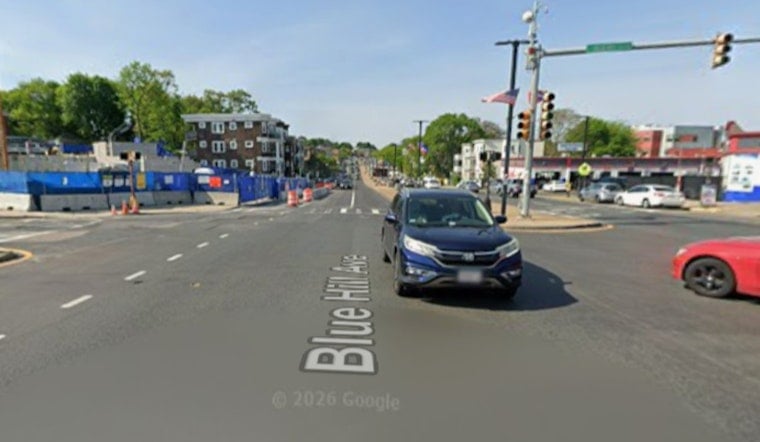
On the dead-end block of Culbert Street in Mattapan, the ground has literally been shaking for months as dynamite blasts and heavy machinery make way for a five-story, 41-unit building at the corner of Blue Hill Avenue. Longtime Black homeowners say the constant noise, dust and vibrations have left cracks in floors and foundations and rattled an 86-year-old neighbor. Many worry the new complex will pack more cars onto already tight streets, worsen parking headaches and accelerate the kind of churn that pushes families out.
Residents say construction crews have at times blocked access to Woodhaven and Culbert streets, cutting off the small cul-de-sac from the main road. Online community meetings meant to address those issues have been bumpy, with tech glitches and frayed tempers. As reported by the Dorchester Reporter, project leaders, including Lincoln Avenue Communities, Dellbrook Construction, the Boston Fire Department, National Grid and the blasting contractor, have repeatedly fielded questions about blast schedules, dust control and rodent activity. The project’s update page also logs ledge removal, blast reports and measures to track dust and pests during excavation.
According to the City of Boston, the plan for 1471 Blue Hill Ave calls for a roughly 49,000-square-foot, five-story building with 41 income-restricted rental units, along with associated parking and community space. The city’s environmental notice pegs the total estimated project cost at about $28.6 million and lists Lincoln Avenue Capital Northeast as the developer. Construction is officially underway, with a timeline showing key milestones, although a final completion date has not yet been set.
Safety Fears and a Cluster of Gas Leaks
Neighbors say the disruption has gone well beyond dust and noise. They report that an 86-year-old resident’s furnace pipe exploded during one round of blasting and that several homes developed new cracks and separated floorboards they believe are tied to the work. The Boston Globe reports that National Grid documented 16 new natural-gas leaks within a half-mile radius of the construction site between September 2025 and March 2026. City officials say the Boston Fire Department provided an on-site detail during blasting and that gas sniff testing was carried out before and after each explosion.
City and Developers Stand by the Project
City planners say they did respond to early objections. According to officials, they scaled back the original proposal and added more parking and a special loading zone after residents raised concerns. “Transforming a long-vacant site near public transit into 41 affordable homes is a meaningful investment in Mattapan’s future,” Sheila A. Dillon, the city’s chief of housing, told The Boston Globe. The city emphasizes that all 41 apartments will be income-restricted and that multiple funding streams were stacked to keep the units affordable.
Part of a Bigger Blue Hill Ave Overhaul
The building site sits in a stretch of Blue Hill Avenue that is already in the crosshairs for major transit and streetscape changes under the city’s City of Boston Blue Hill Avenue Transportation Action Plan, which aims to upgrade bus service, sidewalks and overall safety. Reporting shows the MBTA recently landed about $80.3 million in federal funding for a center-running bus lane project whose total costs have been estimated between $150 million and $160 million. Residents say the combination of new bus lanes, multiple housing projects and other changes has hit all at once, making it feel less like gradual improvement and more like a tidal wave.
That broader push, which includes new transit lanes, parcel sales and various development incentives, helps explain why a single five-story building on a short, quiet street has triggered so much alarm.
What Neighbors Are Demanding Now
Culbert Street residents say they are not against affordable housing in Mattapan. What they want, they insist, is straightforward: clearer communication, daily blast logs and independent air and vibration monitoring tied directly to promised mitigation. The project’s update page notes a rodent mitigation plan, post-blast reporting and the end of blasting operations in late February, but neighbors argue those steps arrived only after months of upheaval and have not fully restored trust.
As construction moves ahead, residents and local officials say the real test will be whether those living closest to the work have a meaningful say in how new housing and transit investments reshape life for long-time homeowners on this small Mattapan cul-de-sac.




