

























































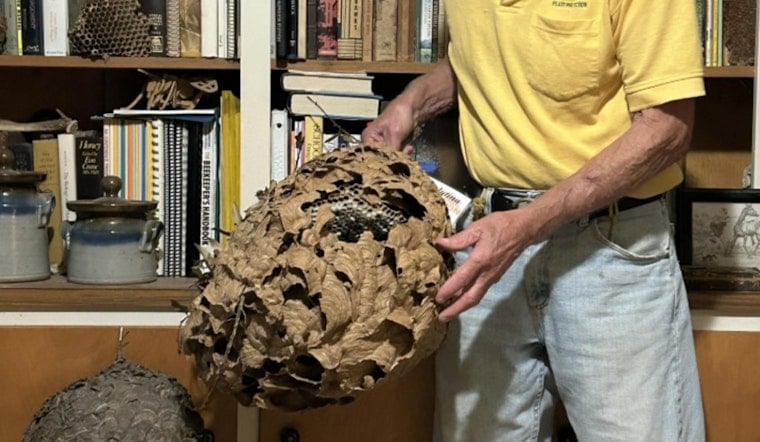
North Carolina’s first confirmed presence of invasive yellow-legged hornets was discovered after a homeowner near Charlotte noticed suspicious activity at a hummingbird feeder. State and federal agriculture teams have since placed more than 200 traps around the Union County property while searching for the nest.
The North Carolina Department of Agriculture said the hornets were confirmed in Matthews, near the Union and Mecklenburg county line. A follow-up survey found additional adult hornets, prompting an ongoing response by the department and the U.S. Department of Agriculture’s Animal and Plant Health Inspection Service.
As reported by WBTV, officials are asking beekeepers in southern Union and Mecklenburg counties to watch for “hawking-like behavior” around their hives. That means hornets hovering near hive entrances and grabbing bees as they come and go — a hunting pattern that can reduce foraging and contribute to colony failure.
Why the hornets are a bigger problem for bees than people
Yellow-legged hornets, or Vespa velutina, are native to Southeast Asia and have dark bodies, yellow-tipped legs and yellow-orange bands near the end of the abdomen. The USDA’s APHIS says mature nests can contain thousands of workers and that the invasive species could threaten honeybees, native pollinators and crops if it becomes established.
The discovery is the latest step in a southward-to-northward spread that had already put Charlotte-area beekeepers on alert. NC State Extension reported in December that a confirmed nest had been found in York County, South Carolina, just south of Charlotte, after earlier detections in Georgia and other parts of South Carolina.
Officials have not said how large the North Carolina presence may be, and the current trapping operation is aimed at locating the nest and determining whether additional hornets are nearby. The state agriculture department said the new detection has led to increased surveillance in southern Union and Mecklenburg counties.
What residents should do if they see one
Residents should not disturb a suspected nest or attempt to capture a hornet by hand. NCDA&CS says people who spot a possible yellow-legged hornet should take a photo from a safe distance, include a size reference if possible and submit the sighting through the state’s yellow-legged hornet reporting tool.
The insect is not the northern giant hornet — sometimes called the “murder hornet” — that was detected in the Pacific Northwest. According to NC State entomologists, the main concern with this species is its threat to honeybee colonies and pollination, while the risk to people is similar to that posed by other native stinging insects.





