

























































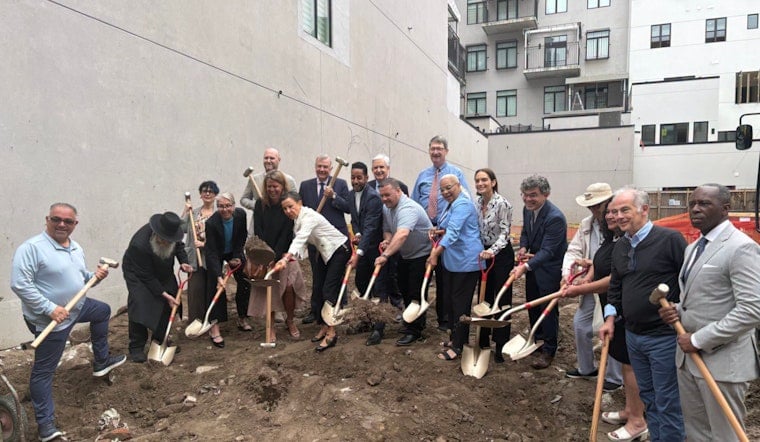
Construction crews have officially broken ground on Bartlett Crossing Phase Two at 667 Flushing Avenue and 31 Bartlett Street in Brooklyn’s Broadway Triangle. The $71.5 million phase will add 78 permanently affordable apartments in two nine-story buildings, part of a larger plan to turn long-vacant city parcels into 390 homes. Community leaders, nonprofit partners and elected officials gathered at the site to mark the start of work.
Governor Kathy Hochul and state housing officials cast the project as a community-driven push for more deeply affordable homes in North Brooklyn, according to Homes and Community Renewal. The state said Bartlett Crossing is financed through a mix of Low-Income Housing Tax Credit equity, New York City HPD subsidy through the ELLA program, NYSERDA support and anticipated Brownfield tax credits. Officials noted that this phase follows an earlier redevelopment on adjacent parcels and advances the state’s broader housing plan.
Unified Neighborhood Partners, a joint venture of St. Nicks Alliance, Southside United HDFC–Los Sures, RiseBoro Community Partnership and United Jewish Organizations of Williamsburg, is serving as the project’s developer, New York YIMBY reports. The team won the Broadway Triangle RFP and is leading a multi-phase redevelopment that centers permanently affordable housing and long-term community stewardship.
Design and sustainability
Magnusson Architecture and Planning PC is the architect of record, and firm renderings show coordinated façades, recessed windows and rooftop photovoltaic canopies topping both buildings. The larger Bartlett Street building is designed to wrap around a three-story holdout structure, while the Flushing Avenue building incorporates a landscaped setback at the eighth floor, according to Magnusson Architecture and Planning. The design pairs contemporary, tightly insulated building envelopes with visible green features intended to help keep operating costs down for residents.
The development is planned as all-electric and will seek Enterprise Green Communities Plus standards, along with ENERGY STAR Multifamily New Construction and EPA Indoor airPLUS certifications. Planned systems include high-efficiency variable refrigerant flow heating and cooling, energy recovery ventilators and high-performance windows aimed at boosting both indoor air quality and energy performance. The 78 apartments will range from studios to four-bedrooms, serve households earning up to 80 percent of area median income, and include 16 units with project-based rental assistance plus eight reserved for referrals from HPD’s homeless services unit, according to New York YIMBY.
Site history and cleanup
The Phase Two parcels are vacant, city-owned properties between Throop and Harrison avenues that have undergone environmental review and remediation planning. New York State Department of Environmental Conservation records identify the addresses as 663–667 Flushing Avenue and 29–31 Bartlett Street and outline the Brownfield Cleanup Program remedy and institutional controls that must be maintained during construction, according to the DEC decision document. Those requirements shaped the pre-construction cleanup and continue to guide site work.
New York City housing officials joined the groundbreaking, and HPD Commissioner Dina Levy said the “real measure” of Bartlett Crossing will be the families who ultimately move into the homes, in a post on the agency’s LinkedIn page. City and state officials, along with the nonprofit sponsors, pointed to the decades-long community process behind the Broadway Triangle plan and underscored the project’s focus on family-sized apartments and supports for vulnerable residents, according to NYC HPD.
With site work now underway, attention turns to how construction progresses and how Bartlett Crossing Phase Two fits into the neighborhood’s broader affordability goals. The project represents another concrete step in the Broadway Triangle masterplan to turn underused city land into permanently affordable homes for North Brooklyn residents.



