

























































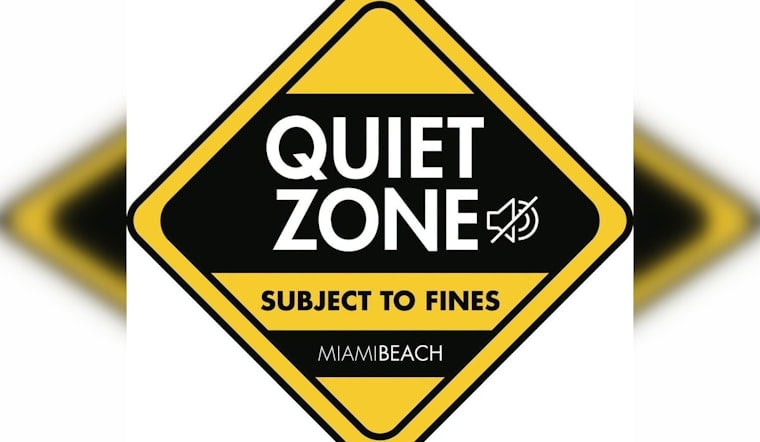
If you like to cruise South of Fifth with the engine screaming and the bass rattling windows at 2 a.m., Miami Beach just put up a big yellow hint that your party may be over. The city has launched a one-year Quiet Zone pilot in the neighborhood, complete with new signage and beefed-up evening patrols, to clamp down on revving engines, modified exhausts and amplified car stereos.
What the pilot does
The Quiet Zone Pilot Program centers on large bright yellow aluminum signs posted at key entry points to the South of Fifth area, clearly warning drivers that loud vehicles are not welcome. The test period will run for 12 months while the city tracks whether noise complaints go down. During evening and overnight hours, officers are authorized to write tickets for excessive vehicle noise, according to Local10.
How it was approved
The pilot grew out of a City Commission resolution that adopted a recommendation from the Public Safety and Neighborhood Quality of Life Committee. That resolution directed city staff to install the Quiet Zone signage and to rely on existing Miami Beach Police Department resources for stepped-up enforcement in the area. The measure formally created a one-year South Fifth Quiet Zone, laid out in the official record summarized in the City Commission agenda.
Enforcement so far
Police were already leaning into noise enforcement under a campaign dubbed "Operation Quiet Streets." Miami Beach police officials told commissioners that MBPD issued about 675 citations for loud vehicle noise in 2025, then piled up roughly 513 citations in just the first two and a half months of 2026. Those numbers, presented at the March 18 commission meeting, were used to argue that the city needed more tools to discourage late-night cruising and rolling sound systems, as shown in the Miami Beach Commission video.
What officials said
Vice Mayor Laura Dominguez, who sponsored the Quiet Zone measure, said the effort "is aimed at the people who create so much noise with their vehicles that they become a neighborhood nuisance." Mayor Steven Meiner backed the move, saying residents "deserve to rest peacefully." City leaders say they will review the data and neighborhood feedback once the yearlong trial is complete before deciding whether to expand the program beyond South of Fifth, according to Local10.
Legal and code notes
Officers can write citations when they personally observe violations under existing state law and Miami Beach noise ordinances, according to NBC 6 South Florida. Commission records also show that the city is working on a related change to Chapter 46 of the municipal code, the section that covers noise, to shorten the distance used to establish prima facie evidence of a violation. City officials say that tweak would make nighttime enforcement more workable for officers on the street, a topic detailed in the Miami Beach Commission video.
What residents should expect
The yellow Quiet Zone signs are already up at the neighborhood’s entry points, and enhanced patrols are expected to continue through the one-year pilot. The city administration must evaluate how the test goes and report back to commissioners after 12 months. Residents who still find themselves jolted awake by roaring engines or thumping bass are being urged to keep logging complaints through official city channels while the pilot is underway, per the City Commission agenda.
Officials say the Quiet Zone is an attempt to walk a fine line between Miami Beach’s nightlife economy and the right of people in South of Fifth to actually sleep at night. The administration plans to release enforcement data as the year progresses, and neighborhood groups have already signaled they will be watching closely to see whether the Quiet Zone really dials down the late-night roar.





