

























































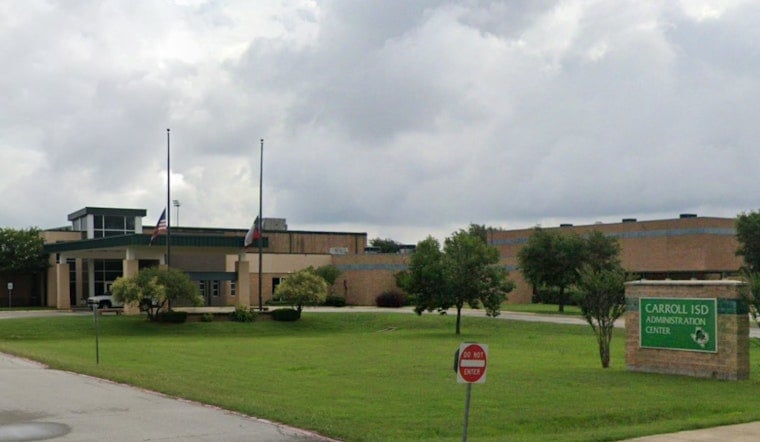
Tarrant County's culture wars stepped squarely into the Commissioners Court yesterday, as members approved a proclamation praising Southlake's Carroll Independent School District for its role in the U.S. Supreme Court's recent decision on transgender athletes. The recognition passed on a 3–1 vote during yesterday's meeting, while residents packed the room, held signs, and used public comment to argue both for and against the move. County officials framed the gesture as a nod to the district's litigation and advocacy in the broader Title IX fight.
Republican Commissioner Matt Krause brought the proclamation forward, and County Judge Tim O'Hare joined him in presenting it to the Carroll school board. Board president Cameron Bryan accepted and thanked the court for the recognition. According to reporting from the Fort Worth Star-Telegram, the resolution credits Carroll ISD's 2024 lawsuit against the U.S. Department of Education with helping shape key portions of the Supreme Court's opinion.
How the district got here
Carroll ISD filed its lawsuit against the Education Department in 2024, arguing that the agency overstepped when it interpreted Title IX to cover gender identity and sexual orientation and that those changes undercut what the district describes as Title IX's original sex-based protections. The district's claims, detailed in public filings, attracted support from Alliance Defending Freedom. The legal record is laid out in court documents and contemporaneous reporting.
What the Supreme Court decided
On June 30, 2026, the Supreme Court issued its ruling in consolidated cases that included West Virginia v. B.P.J. and Little v. Hecox, holding that states may bar transgender girls and women from competing on teams designated for biological females. The court interpreted "sex" in Title IX in a way that allows states to set eligibility rules for sex-separated teams. The decision affirms significant state leeway on who can play on girls and women's teams, while leaving several administrative and policy questions for schools and agencies to hash out later. The full legal reasoning and early fallout are detailed in the Supreme Court opinion and subsequent analysis.
The Tarrant County proclamation itself became a proxy fight over that ruling. Some attendees applauded, while others held signs reading "shame" and warned that the move would further stigmatize transgender residents. Democratic Commissioner Roderick Miles cast the lone no vote. During public comment, resident Deborah Kratky told officials the proclamation is "also politically divisive" and "puts a target on transgender people's backs." As the Fort Worth Star-Telegram noted, residents lined up to speak on both sides.
The clash was not exactly out of character for Tarrant County, which has become a frequent stage for national school and culture debates to play out in local meetings. County leaders and advocacy groups have repeatedly brought hot-button social issues into what used to be sleepy agenda items. Analysts say figures such as County Judge Tim O'Hare have championed a slate of conservative priorities that shape which fights end up in front of the court. Reporting from the Texas Tribune traces how those dynamics have influenced local decision-making.
Legal implications
Legal analysts say the Supreme Court's ruling primarily shores up state laws that separate teams by biological sex, while still leaving room for future challenges targeting federal guidance or specific school policies. Some related lawsuits have already been paused or dropped in the wake of the decision, and experts expect a patchwork of differing state rules and enforcement approaches going forward. For readers tracking the next wave of litigation and legislation, a CRS analysis and coverage from the AP outline the immediate post-ruling landscape.
For now, the Tarrant County proclamation is largely symbolic. It publicly salutes a local school board's legal strategy and clarifies where several county leaders stand on an issue that has already fueled heated exchanges in town halls and school board meetings. Neither Carroll ISD nor county officials announced any new policy changes at the session, leaving schools, parents and lawmakers to continue debating how the Supreme Court's decision will translate into on-the-ground rules for student athletes.





