

























































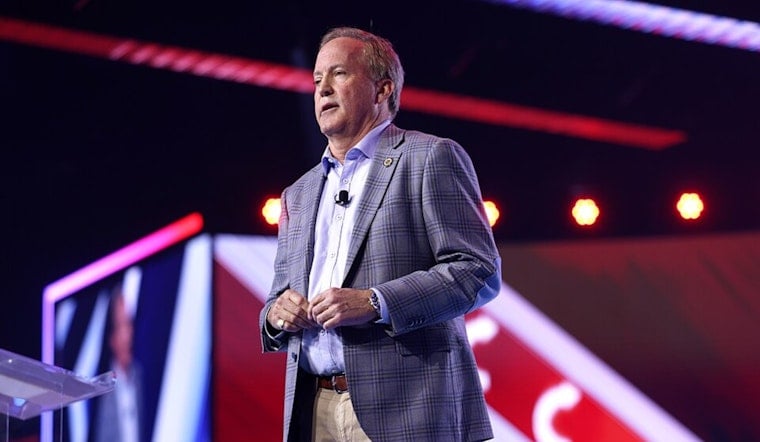
Ken Paxton is facing fresh scrutiny over a cell tower deal on the campus of Baylor, Scott & White Medical Center in Frisco, Texas, where the Republican Senate candidate once sat on the hospital board while his own company leased land there to wireless carriers. The arrangement has become the newest flashpoint in a U.S. Senate race that polling shows has grown increasingly competitive against Democratic nominee James Talarico.
According to reporting from El Paso Times reporter Adam Powell, Paxton served on the hospital board from 2003 until 2013, the same period during which his company, Premier Vertical Properties, established a lease agreement for a cell tower on the hospital's grounds. Paxton co-founded Premier Vertical Properties in 2005 alongside Texas telecom executive Richard Sine, according to Forbes. The following year, in 2006, Premier Vertical Properties signed a deal with T-Mobile to lease space on the 119-foot tower, according to the same Forbes reporting.
The tower's history traces back to when the hospital operated under a different name and corporate parent. Facebook posts relaying New York Times reporting note the facility's early lease documentation named the hospital's then-parent company, Tenet Hospitals. The company has since expanded its carrier roster considerably: Verizon Wireless signed on in 2016, and Dish Wireless followed in 2024, per Forbes.
Questions Over Board Involvement
Central to the controversy is whether Paxton had any hand in approving the very lease that has enriched his company. The New York Times reported that a hospital board would need to review and approve a decision to lease land to a cell tower company such as Premier, but the outlet said it remains unclear whether Paxton participated in discussions about the contract between the hospital and his company, or whether he ever voted on it.
Democratic rival James Talarico's campaign has seized on the ambiguity. Ryan Martin, a spokesperson quoted in the seed reporting, said that Paxton self-dealing himself a lucrative cell tower by leveraging his position as a board member is classic corruption. Martin also said Paxton has made millions while serving in public office, and separately accused him of rigging the system to help himself get rich while working Texans struggle.
Madison Cercy, deputy director of communications for Paxton's campaign, did not respond to a request for comment on the report, according to the seed reporting.
A Six-Figure Income Stream, Modestly Valued
The financial details of the arrangement have drawn particular attention. The cell tower has generated a six-figure payout for Paxton roughly every 18 months since 2006, according to New York Times reporting. Forbes similarly found that on Paxton's 2025 federal financial disclosures filed for his Senate bid, he estimated his stake in Premier Vertical Properties at between $250,000 and $500,000 — even as he reported the business produces between $100,000 and $1,000,000 in income on that same roughly 18-month cycle.
Paxton did not list the tower's physical address on his state or federal financial disclosures, according to New York Times reporting relayed on social media, which meant investigative journalists had to locate the site using Collin County deed records. Industry experts expressed surprise that Paxton's company acquired the cell tower in such a prime location, near a highway and a hospital in a busy area of Frisco.
Wealth Built on a Public Salary
As Texas Attorney General, Paxton earns an official state salary of $153,750 annually, a figure set by the Texas Legislature that has not changed since he took office in January 2015, according to The Texas Tribune. Against that backdrop, Paxton has an estimated net worth of $13 million and owns 15 properties across five states, per the seed reporting — a portfolio that a separate Forbes financial analysis pegged at roughly $10 million in value across at least 14 properties, offset by about $4.7 million in outstanding mortgage debt.
The cell tower is not Paxton's only notable private investment. He also received a payout of approximately $2.2 million in 2019 when police video technology firm WatchGuard, in which he held a stake, was acquired by Motorola, according to Forbes. Critics, including Talarico, have framed the cell tower lease as part of a pattern; Paxton's supporters counter that his commercial real estate dealings reflect lawful, savvy entrepreneurship rather than corruption.
Paxton has faced criticism for dodging questions about how he became a multimillionaire on a taxpayer-funded salary, according to the seed reporting. The scrutiny follows his 2023 impeachment by the Texas House on corruption and bribery allegations, his subsequent acquittal by the Texas Senate that September, and the Texas House's April 2025 vote granting him $64,000 in back pay for his suspension period, as Houston Chronicle reported.
A Tightening Race
The cell tower story lands as Paxton struggles in the polls against Talarico. An August Texas Pulse poll conducted by ReconMR and the Texas A&M Bush School showed Talarico leading Paxton 47% to 43% among likely voters, a shift from a dead-heat 46%-46% split in June, a trend Hoodline previously reported.
Paxton secured the Republican nomination on May 26, defeating four-term incumbent Senator John Cornyn with 63.8% of the vote in the GOP primary runoff after being endorsed by President Donald Trump. Paxton was also seen leaving Senate Majority Leader John Thune's office at the U.S. Capitol in Washington, D.C. in early June. Texas Democrats have continued to attack Paxton over his finances and past conduct as the November 3 general election approaches, with the cell tower deal now added to a list of grievances that includes questions about his voting address and past prosecutorial decisions.



