

























































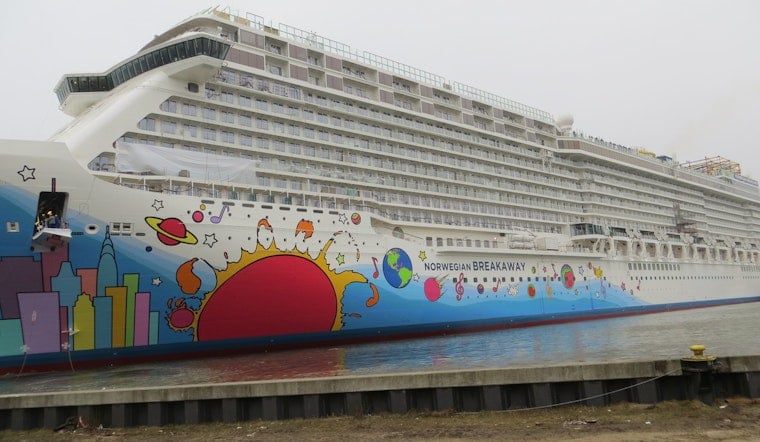
Federal agents boarded two cruise ships docked in Boston over the weekend and arrested 11 foreign nationals accused of receiving and distributing child sexual abuse material, U.S. Customs and Border Protection announced Thursday. The operation targeted Holland America Line's Volendam and Norwegian Cruise Line's Norwegian Breakaway, and all 11 people taken into custody are being processed for removal from the United States.
According to NBC Boston, the group includes nine citizens of the Philippines, one citizen of Indonesia and one citizen of Nicaragua. CBP said the arrests happened between Friday and Sunday, though authorities have not disclosed how many arrests occurred aboard each ship, nor have they said whether the 11 people worked on the vessels. None of their identities have been released.
Per an official release from U.S. Customs and Border Protection, all 11 non-citizens were processed for removal under Section 212(a)(2)(A)(i)(I) of the Immigration and Nationality Act, the provision that renders non-citizens inadmissible for crimes involving moral turpitude. That statutory route allows federal authorities to push the suspects out of the country without a domestic criminal trial. CBP and Homeland Security Investigations searched the subjects' living quarters and electronic devices as part of the shipboard action.
A Florida-Based Task Force Comes North
The Boston boarding wasn't handled by local agents alone. It was conducted jointly by CBP officers at the Port of Boston, Homeland Security Investigations Boston, HSI Fort Lauderdale, and the CBP Fort Lauderdale-Hollywood International Airport Human Trafficking Unit, according to the CBP release. That out-of-state staffing reflects where the cruise industry itself is based — South Florida ports host the majority of major cruise line headquarters and vessel operations, prompting federal authorities to centralize maritime CSAM intelligence in specialized Florida units.
CBP and HSI undertake the effort, known as Operation Tidal Wave, in coordination with the Internet Crimes Against Children Task Force and the National Center for Missing and Exploited Children. Julio Caravia said the operation demonstrates the critical role CBP officers play in identifying and stopping threats to public safety. “Protecting children from exploitation is among our highest priorities,” Caravia said, adding that authorities will use every available authority to disrupt possession and distribution of child sexual abuse material and prevent involved people from entering or remaining in the United States.
The 11 individuals were processed with assistance from maritime shipping agents and were scheduled for immediate departure from the United States, per the CBP release. Shipping agents typically represent cruise operators in port logistics and help coordinate crew visa processing and travel arrangements, which made them the mechanism for getting the suspects off American soil quickly rather than holding them in federal detention.
Part Of A Bigger Federal Campaign
Boston's weekend sweep is not an isolated incident. In late April, federal agents ran a similar Operation Tidal Wave action at the Port of San Diego, boarding eight cruise ships — including Disney Magic and Holland America's MV Zaandam — and detaining 28 crew members suspected of CSAM offenses, as reported by the Washington Times. That operation ultimately confirmed 27 crew members for CSAM involvement following digital forensic searches.
Federal prosecutors in California filed no formal criminal charges in district court against those detained crew members, choosing instead to deport them after revoking their visas, the Washington Times reported. Legal experts cited in that comparison noted that deporting foreign crew members without U.S. criminal trials avoids creating a public record and keeps them off sex offender registries — a pattern that appears to be repeating in Boston.
Operation Tidal Wave relies on intelligence generated through CyberTipline reports from the National Center for Missing and Exploited Children, which tracks digital media hashes across internet platforms to help agents identify specific crew members before boarding a vessel. NCMEC serves as the national reporting hub for child sexual exploitation and routes actionable leads to federal law enforcement, allowing agents to target individuals rather than search entire crews at random.
Boston's Growing Cruise Season Under Scrutiny
The operation landed during a busy year for Boston's cruise industry. Flynn Cruiseport Boston, operated by Massport in South Boston's Seaport District, set its 2026 schedule to host 23 cruise brands and nine homeport vessels between April and November, including the Norwegian Breakaway — the largest cruise ship ever homeported in Boston. The terminal handled more than 455,000 passengers during its 2025 season, according to Massport.
Major cruise operators, including Disney Cruise Line, said following prior Operation Tidal Wave actions in May that they enforce zero-tolerance policies for child exploitation, cooperate fully with federal agencies, and immediately terminate implicated personnel, per a report carried by CBS News. International cruise ship workers are typically placed through third-party staffing agencies before joining ship crews, a structure that maritime and legal analysts say raises open questions about whether deported workers could later seek maritime employment elsewhere through similar agencies.
The procedural choice at the center of Operation Tidal Wave — deportation over prosecution — stands in contrast to other CSAM cases that have moved through Hoodline's own coverage of cruise-adjacent federal enforcement. In February, Hoodline reported that CBP officers boarded Royal Caribbean's Freedom of the Seas at PortMiami and arrested a passenger after discovering CSAM on his phone during a border inspection, relying on the same border search doctrine that permits federal officers to inspect digital devices without a warrant at international sea ports. And in a case Hoodline covered in December 2024, a 42-year-old man was sentenced to 15 years in federal prison after a CBP smartphone search at a Florida cruise terminal uncovered CSAM, prosecuted under the Department of Justice's Project Safe Childhood initiative — a criminal path that Operation Tidal Wave's foreign crew cases have so far avoided.



