

























































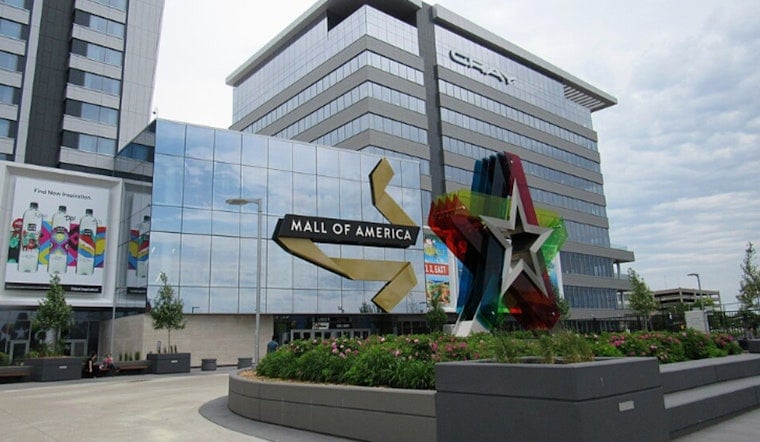
Roughly 120 high school robotics teams packed into Mall of America's North Atrium this week, wiring up robots and running drills for a three-day tournament that doubles as the unofficial kickoff to VEX Robotics' 20th competitive season. The teams are chasing four coveted invitations to the 2027 VEX Robotics World Championship in St. Louis, awarded to the Excellence Award winner, the Skills Champion, and two Tournament Champions.
According to WJON, the Bloomington event marks the fifth anniversary of VEX Robotics Signature Events being held at Mall of America, and this year's tournament is free for the public to attend. Students spent their summer months designing, testing, and refining their robots ahead of the competition, per the same report. The event is hosted by the University of North Dakota's College of Engineering & Mines, which took over primary hosting and sponsorship duties for the Mall of America event in 2025, using the high-visibility mall setting as a recruitment platform for prospective engineering students, according to UND's College of Engineering & Mines.
Demand to compete this year outpaced the available slots. Registration for the August tournament filled all 120 team spots well in advance, leaving an additional 29 high school teams on an official waiting list, per Bloomington AI. The field drew teams from 25 U.S. states as well as international squads from Canada, Mexico, China, and Taiwan, according to University of North Dakota reporting on the event.
A New Game Debuts on a Very Public Stage
This season's tournament also marked the debut of the V5 “Override” game challenge, the newly introduced format governing VEX's 2026-2027 competition year. Robotics Education Ireland describes the challenge as pitting two-team alliances against each other on a 12-by-12-foot field, with matches consisting of a 15-second autonomous period followed by a 1-minute, 45-second driver-controlled period.
The choice of venue is deliberate. Last year's tournament, staged in the same North Atrium, reached an estimated 200,000 daily mall visitors in person while attracting more than 10,000 online livestream viewers watching for early-season robot strategies, per UND's College of Engineering & Mines. Competitive robotics teams worldwide track early Signature Events like this one to study the emerging robot designs that tend to define the rest of the season.
Behind the Scenes: Fees, Housing Rules, and a League Split
Competing came with real logistical demands. Teams paid a $450 registration fee to participate and were required to book accommodations through the official event housing portal, with noncompliance risking removal from the tournament, according to event organizer RobotEvents.
The Mall of America event also arrives amid a broader restructuring within student robotics. Before this season began, VEX Robotics and the Robotics Education & Competition Foundation split into separate competition frameworks, with VEX now managing “V5 Override” while the REC Foundation runs a distinct program called “Achieve Pinnacle,” according to organizational details reviewed by Creator Academy. VEX-affiliated programs remain enormous in scale globally, encompassing more than 1.1 million student participants across 70 countries, per the REC Foundation.
Robotics as a Pipeline to Tech Jobs
For UND and its partners, the tournament is framed as more than a trophy chase. Event partner NCAT has published workforce data projecting that Minnesota will add over 92,000 tech jobs by 2033, with median wages 106% higher than the statewide career average — a statistic UND and regional institutions point to when describing competitions like this one as pipeline programs feeding future engineering talent.
VEX Robotics kicked off its 20th season this week at Mall of America, with organizers and host university alike betting that the spectacle of 120 teams building and battling robots in a busy retail atrium will pay long-term dividends, both for the students chasing a St. Louis championship berth and for a state looking to fill a wave of high-wage tech jobs in the years ahead.





