

























































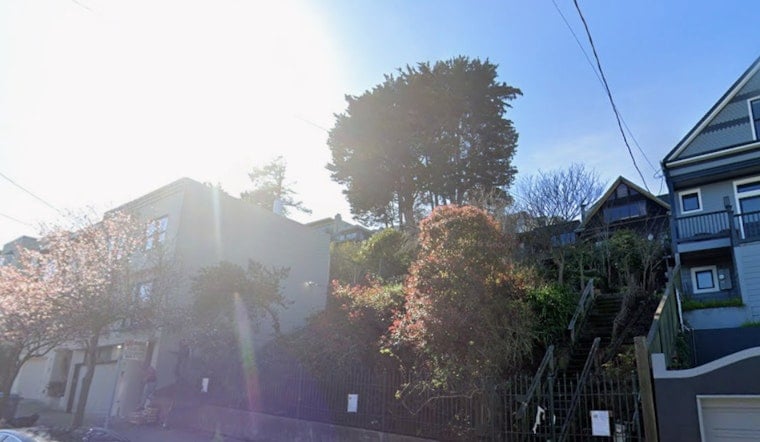
A 1905 wooden shingle house at 20 Fountain Street in San Francisco's Upper Market neighborhood is slated for demolition to make way for a three-unit residential building spanning four floors and a basement garage. The property, two blocks from the Noe Valley basketball court and three blocks from Douglass Playground Park, sits on a stretch of Fountain Street between 24th and 25th Streets.
According to San Francisco YIMBY, updated permits filed for the site call for roughly 7,300 square feet of new construction, including about 5,700 square feet of housing and an 830-square-foot basement garage. The garage is designed to hold parking for three cars and three bicycles. Renderings included with the filing show a residential-style facade with articulation, balconies, and bay windows, designed by Earle Weiss of Mill Valley-based E.E. Weiss Architects.
The property is owned by Daniel Buckley, who purchased it for $2.8 million in 2017, per the same filing. Neither a construction timeline nor an estimated construction cost has been shared for the project.
Why the Century-Old House Can Come Down
Demolishing a structure this old in San Francisco typically triggers historic-preservation scrutiny, since city planning procedures require a historic evaluation for any building more than 50 years old before a demolition permit can be issued. But a 2017 Historic Resource Evaluation conducted by Tim Kelley Consulting concluded that the 1905 house was not eligible for individual listing on the California Register of Historical Resources, clearing that hurdle years before the current application.
That evaluation matters because of how much the permitting landscape has shifted since. San Francisco previously required mandatory Planning Commission hearings for residential demolitions under Planning Code Section 317. Under Planning Director Bulletin No. 8 and California Senate Bill 9, qualifying multi-unit infill projects on single-family lots like this one now receive ministerial review, exempting them from both CEQA environmental review and the old conditional-use demolition approval process, according to SF Planning.
Part of a Bigger Fountain Street Redevelopment
The 20 Fountain Street proposal is not standing alone. Site plans show the project is paired with a second multi-unit residential building planned for the adjacent parcel at 22 Fountain Street under a separate application, with matching structures designed by the same architecture firm for the same property owner, San Francisco YIMBY reports. Once complete, future residents would be about 15 minutes on foot from Noe Valley Town Square.
A Zoning Shift Years in the Making
The project lands amid a broader citywide transformation of how San Francisco regulates residential density. In December 2025, Mayor Daniel Lurie signed the city's Family Zoning Plan into law, ending single-family-only zoning citywide and legalizing multi-family residential development in neighborhoods that were previously restricted to detached houses. The change, which took effect in January 2026, undid zoning rules dating back to 1978 that had confined nearly 40 percent of the city's land area to single-family housing, according to SF Planning.
The rezoning push is driven in large part by state law. Under California's 2023-2031 Sixth Cycle Housing Element, San Francisco must plan for 82,069 new housing units, including more than 46,000 designated as affordable for low- and moderate-income households — nearly triple the production goal the city faced during the prior 2014-2022 cycle. Streamlined approval pathways like California Senate Bill 684, which took effect in July 2024 and was updated in 2025, now allow small infill developments of up to 10 units on eligible parcels to move through a faster, ministerial approval process aimed at missing-middle housing.
Not everyone believes the city's current approach goes far enough. In February 2026, housing advocacy groups including YIMBY Law and California Housing Defense Fund filed a lawsuit against San Francisco, alleging that its newly enacted Family Zoning Plan fails to meet state-mandated housing capacity targets, as reported by the Davis Vanguard. State housing law requires the city to demonstrate realistic capacity for more than 82,000 new residential units by 2031, a benchmark the lawsuit claims remains unmet.
High Land Values Fuel Infill Push
The financial logic behind projects like 20 Fountain Street traces back to Noe Valley's real estate market, one of the priciest in San Francisco. Mid-2026 transaction data put the neighborhood's median home sale price between $2.35 million and $2.48 million, according to Redfin figures cited in the YIMBY report. Land values that high give property owners strong incentive to replace single detached homes with multi-unit buildings that can generate more housing yield per lot.
City data underscores how far the zoning changes extend. San Francisco's Office of Economic Analysis reported in October 2025 that the city's rezoning strategy covers more than 92,000 parcels, raising default residential building heights from 40 feet to either 50 or 65 feet in many neighborhood districts, per SF.gov. Combined with the December 2023 Housing Constraints Legislation, which eliminated Planning Commission hearing requirements for code-compliant residential projects outside priority equity geographies, the regulatory path for projects like the one proposed at 20 Fountain Street has grown considerably shorter than it once was.




