

























































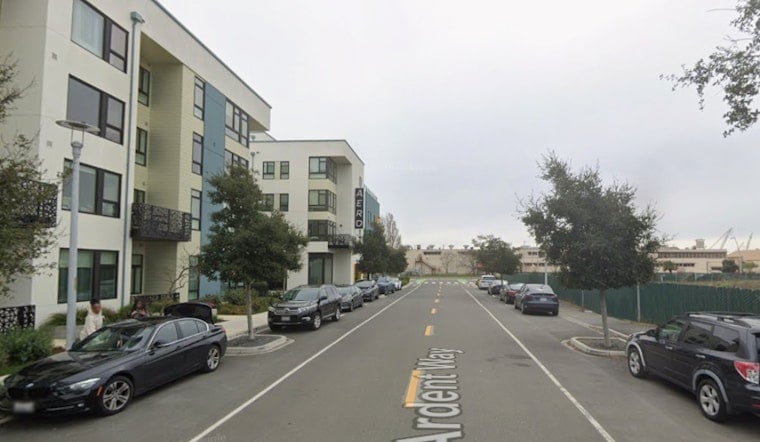
A disagreement over just 25 federal housing vouchers is threatening to freeze one of the Bay Area's largest housing pipelines: as many as 2,300 planned homes at Alameda Point, the former Navy base being reshaped into a waterfront neighborhood. At the center of the standoff is Stardust Gardens, an 80-unit supportive housing project meant to replace dilapidated World War II-era barracks currently housing formerly homeless residents.
The dispute involves whether the Alameda Housing Authority can commit to transferring 25 housing vouchers to Stardust Gardens, a project being developed by MidPen Housing, according to a report by the San Francisco Chronicle. The housing authority has said the transfer would violate U.S. Department of Housing and Urban Development regulations, which oversee the voucher system and, per the agency, require that the vouchers become tenant-based rather than remain attached to the specific project. Tenant-based vouchers can subsidize rent in any number of affordable buildings, while MidPen has said it has used a two-step voucher transfer process successfully in several other counties.
The stakes go well beyond the 80 units at Stardust Gardens. Alameda Point's redevelopment requires work across 32 acres of land, and city officials warn the entire push could grind to a halt over the unresolved voucher question. Alameda City Manager Gerry Beaudin said the dispute is holding back 2,300 housing units, and that the 25 households in question are physically in the path of development, per the Chronicle's report.
A City Policy That Ties Market-Rate Homes to Affordable Units
The reason a small voucher dispute can stall thousands of homes traces back to Alameda's own development rules. The Alameda City Council has required market-rate developers at the base to complete the affordable component of their projects before advancing further phases, and Mayor Marilyn Ezzy Ashcraft has said the Alameda Point plan requires each development phase to be 25% affordable. That threshold is notably higher than the citywide standard: the City of Alameda's 2023–2031 Housing Element mandates at least 25% deed-restricted affordable housing on city-owned land at Alameda Point, compared with a 15% mandate elsewhere in the city.
That policy means the neighboring West Midway Development Plan, a 26-acre project bringing 478 market-rate homes and more than $20 million in developer-financed infrastructure, is effectively linked to Stardust Gardens breaking ground. According to Alameda Point Info, that shared infrastructure is designed to serve both the market-rate development and the adjacent supportive housing campus, meaning a delay in one stalls the other. Ashcraft has said the dispute could bring development to a screeching halt.
Formerly Homeless Residents Await a Long-Planned Move
Stardust Gardens is intended to be the first phase of a much larger supportive housing effort. It is meant to house formerly homeless people currently living in deteriorating World War II-era barracks, with residents from Building Futures for Women and Children and Operation Dignity slated to move into the new units, per the Chronicle's reporting. The 80-unit project is only the initial phase of the broader Rebuilding Existing Supportive Housing at Alameda Point (RESHAP) master plan, which, according to San Francisco YIMBY, ultimately calls for 332 affordable homes on nearly eight acres, replacing 201 aging military units co-developed by MidPen Housing alongside Alameda Point Collaborative, Operation Dignity, and Building Futures.
MidPen Housing president Matt Franklin has said the project's financing stack is fully ready to go, but the developer still needs about $22 million in tax credits, with its application due in early September. Franklin has also said that residents in supportive housing tend to prefer moving into new units within their existing neighborhood, where they can keep working with their existing case managers, rather than relocating elsewhere. Under the housing authority's position, the 25 households currently holding vouchers could instead choose a mobile voucher usable somewhere else, rather than staying with the project.
State Grants Already Committed, But at Risk
Money is not the obstacle so far, at least at the state level. MidPen Housing raised $48 million from two state grant programs, according to Franklin, and in December 2025 the California Strategic Growth Council awarded MidPen and the City of Alameda $44.5 million in Affordable Housing and Sustainable Communities funds, per MidPen Housing. That grant also funds zero-emission electric ferry charging infrastructure and bicycle safety upgrades at Alameda Point. A February city authorization further detailed that the same grant includes funding for zero-emission ferry charging capability at the Seaplane Lagoon terminal, infrastructure meant to support higher-frequency SF Bay Ferry service between Alameda Point and San Francisco.
If Stardust Gardens does not break ground, the delay puts that infrastructure grant money at risk and could also delay the next market-rate buildings planned for the area, which are meant to include streets, parks and additional housing. Other developers are already waiting for Alameda Point land to be unlocked. City Island Development, a subsidiary of the Alameda Housing Authority, is seeking financing for a project called Estuary II and hopes to apply for tax breaks in the middle of 2027 — timing that depends on the broader logjam clearing first.
A Decade of Rebuilding a Former Naval Base
Alameda Point has been in active development for more than a decade, transforming the mothballed naval base into a mixed neighborhood that has already delivered nearly 700 housing units. The site includes playing fields, gyms, and Spirits Alley, home to distilleries, breweries and wineries, alongside the Alameda Point Food Bank, which serves more than 1,200 families. The area's land-use framework traces back to the 2016 Main Street Neighborhood Specific Plan, which governs 108 acres near the Main Street Ferry terminal and Seaplane Lagoon, blending supportive housing, historic preservation, and transit-oriented development.
Alameda Point Collaborative first obtained 34 acres on the former Naval Air Station in the late 1990s through federal land transfers under the McKinney-Vento Homeless Assistance Act, which prioritized surplus military property for organizations serving unhoused people after base closures. That history laid the groundwork for more recent projects, including the Housing Authority of the City of Alameda's opening of Estuary I and Linnet Corner last September, which brought 109 affordable homes — 45 for formerly unhoused individuals and 64 senior apartments — to 12 acres of former base land, as Hoodline previously reported. Just months later, Alameda and Alameda Point Collaborative also opened Arnold's Place, a 50-bed medical respite facility for unhoused residents recovering from illness or surgery, as part of the broader Alameda Wellness Campus.
City officials, the housing authority and MidPen Housing all describe themselves as sharing the same underlying goal of housing people in need, but the current standoff shows how a narrow federal administrative rule can collide with a decades-old local redevelopment framework. The full Alameda Point vision includes about 580 affordable housing units as part of its overall plan, a target that depends on resolving the voucher question before Stardust Gardens, and everything tied to it, can move forward. For now, the project remains stuck between HUD's voucher regulations and a city inclusionary policy designed to guarantee affordable housing keeps pace with market-rate growth on the former base.


