

























































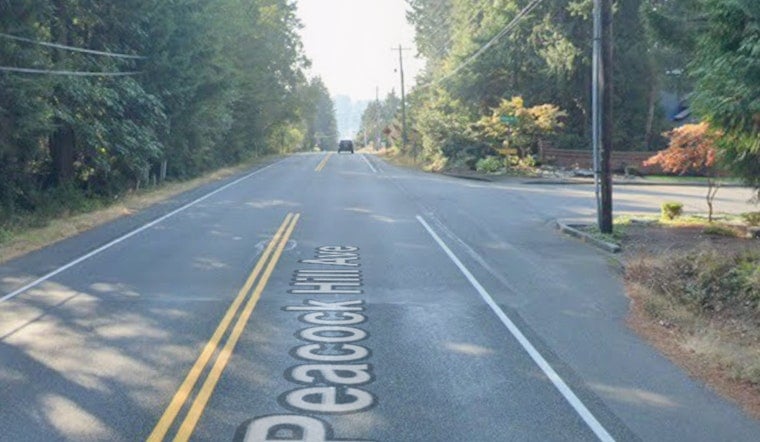
Construction crews are busy on both sides of Peacock Hill Avenue Northwest in Gig Harbor, where builder MainVue Homes is putting up 30 new single-family homes across two adjacent luxury subdivisions. The Reserve will bring 14 homes starting at roughly $1.3 million, while Harbor Run, about a mile away, will add 16 homes starting at roughly $1.2 million. Both developments feature move-in-ready homes with four or five bedrooms ranging from over 3,000 to more than 4,000 square feet.
The two projects, though built by the same company, sit on opposite sides of a jurisdictional line. As reported by the Tacoma News Tribune, The Reserve is located within Gig Harbor city limits at 10017 Peacock Hill Ave., while Harbor Run sits just outside city limits, across from the Harbor Hill neighborhood, on roughly five acres at 3725 107th St. NW in unincorporated Pierce County. That split means the two subdivisions answer to different regulators: Gig Harbor issued building permits for some homes at The Reserve, while Pierce County issued permits for Harbor Run's model homes and remaining site development work, according to the News Tribune's reporting, credited to reporter Julia Park.
Crews were actively working at both developments as of August 14, according to the same report. The Reserve will be built on two adjacent parcels totaling just under 10 acres, zoned low density residential — a designation that typically allows up to four lots per acre. The project traces back to an initial submission in 2016, with the Gig Harbor hearing examiner approving the subdivision in November 2017. Eric Baker confirmed to the News Tribune that the city approved The Reserve's subdivision and issued its building permits.
Why the Two Sites Face Different Rules
Peacock Hill Avenue Northwest functions as more than a street name on a map — it is effectively a municipal boundary. As Hoodline previously reported, developments on the east side of Peacock Hill fall within Gig Harbor city limits and go through city hearing examiners, while west-side projects like Harbor Run remain under unincorporated Pierce County's land-use authority, per the Tacoma News Tribune. That patchwork means the same builder is navigating two separate sets of permitting rules just a mile apart.
Both sites also carry wetland considerations baked into their design. The Reserve slopes down from Peacock Hill Avenue Northwest toward a wetland and includes a 25-foot densely vegetated buffer around the entire development, the News Tribune reports. Harbor Run's site, formerly vacant, includes its own buffer for a nearby wetland, and its final plat requires completion of required site improvements before approval. MainVue proposed 16 home lots at Harbor Run plus tracts preserving trees and open space, though the development currently has no set completion date for the overall project.
Luxury Pricing in a Tightening Market
The $1.2 million to $1.3 million starting prices at Harbor Run and The Reserve sit well above the broader local market. Across 214 closed home sales in Gig Harbor over the 12 months ending in August, the median sold price was $825,000, with the middle half of transactions closing between $650,000 and $1,035,000, according to data from Resideline. Separately, Gig Harbor's median overall listing price reached $880,000 in August, averaging $395 per square foot, according to RexMont Real Estate, which points to demand for Peninsula School District access and commuter proximity to the Tacoma Narrows Bridge as key drivers of peninsula pricing.
Both The Reserve and Harbor Run have some lots still available for sale, according to MainVue's website, and The Reserve offers weekly open houses. MainVue built its Puget Sound presence on Australian-influenced floor plans featuring covered outdoor living rooms and integrated glass wall systems, a design approach the company introduced to the region years ago, according to KING 5 News. The builder operates under Sumitomo Forestry, the Japan-based parent company that announced a $4.5 billion acquisition of Tri Pointe Homes in February, expanding its U.S. portfolio toward delivering roughly 18,000 homes annually, according to Builder Magazine.
Infrastructure and Regulation Racing to Keep Pace
The new luxury subdivisions are landing in a peninsula already absorbing the strain of rapid residential growth. Nearby Swift Water Elementary, a 74,000-square-foot school Peninsula School District opened in 2021 under a $198.55 million voter-approved bond, was built specifically to relieve severe overcrowding tied to earlier housing expansion in Gig Harbor North — the district's first new elementary school in 34 years. Meanwhile, the city broke ground this spring on a multi-year overhaul of the 38th Avenue and 56th Street corridor near Peacock Hill, installing a deep gravity sewer main and a $1.64 million roundabout, work Hoodline detailed earlier this year, funded partly through state Transportation Improvement Board grants and local utility fees.
City leaders have also moved to tighten environmental rules around exactly the kind of wetland-adjacent slopes where The Reserve and Harbor Run sit. In March, Gig Harbor advanced draft code updates to enlarge stream and wetland buffers and impose stricter mitigation requirements on new residential projects. The growth pressures have even fueled talk of redrawing the map altogether: local organizers registered an exploratory committee earlier this year proposing to split Gig Harbor and the Key Peninsula off from Pierce County into a new Peninsula County, though creating one would require state legislative approval and a voter petition. In August, Gig Harbor joined Pierce County and neighboring jurisdictions in adopting resolutions for a Unified Regional Approach to share housing data and coordinate services across the growing region.





