

























































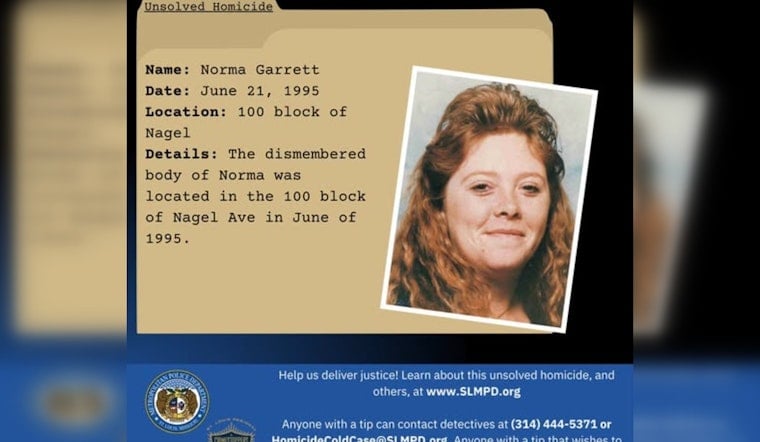
Norma Garrett's dismembered body was discovered in the 100 block of Nagel Avenue on June 21, 1995, and more than three decades later, no one has ever been arrested in her killing. The St. Louis Metropolitan Police Department is once again asking the public for help, renewing its appeal for information in a homicide that has sat unsolved since the Clinton administration.
The case was detailed in a recent post from the St. Louis Metropolitan Police Department (OFFICIAL) on Facebook, which labeled Garrett's death an unsolved homicide and asked anyone with information to come forward. The department did not disclose further details about the circumstances of her death or any potential motive, sticking to the bare facts of the date, location, and manner in which her body was found. Nagel Avenue sits in the historic Carondelet neighborhood near South Broadway and the Mississippi River, a stretch of the city long known for its mix of 19th-century housing and riverfront industrial land, according to St. Louis Patina, which notes Carondelet was annexed by the city back in 1870.
A Case Handed to a Dedicated Cold Case Unit
Garrett's file is one of many that now fall under SLMPD's Cold Case Squad, a specialized unit within the department's Bureau of Investigative Services established in February 2019 specifically to revisit homicides from the 1980s and 1990s. The unit was created to give dedicated investigative attention to cases that stalled before today's forensic tools existed. That mission matters in a city facing a staggering backlog: a joint investigation by St. Louis Public Radio, APM Reports, and The Marshall Project found that more than 1,000 homicides committed in St. Louis over a ten-year span remain unsolved.
The scale of that backlog traces back to longstanding clearance struggles. An analysis of SLMPD records from 2017 through mid-2023, published by St. Louis Public Radio and APM Reports, found that nearly 60% of city homicides went unsolved, with detectives clearing fewer than half of cases involving Black victims compared to two-thirds of cases involving white victims. Researchers who studied the data pointed to detective staffing shortages, high caseloads, and damaged community trust as key drivers behind the low clearance numbers.
Modern Forensics Have Cracked Old Cases Before
Despite those obstacles, updated DNA re-testing and genetic genealogy tools have produced real breakthroughs on decades-old files. Advanced forensic technology enabled SLMPD detectives to solve nearly 30 cold cases from the 1980s and 1990s in 2021 alone, according to Uncovered, though the site notes that physical evidence collected in 1995, the year Garrett died, predated today's high-sensitivity DNA profiling and genealogy databases. It remains an open question whether any evidence recovered from the Nagel Avenue scene is still suitable for that kind of modern lab re-testing.
SLMPD has pointed to recent wins as evidence that persistence on cold cases can pay off. Last August, the department made an arrest in the 17-year-old murder of off-duty officer Demond Taylor, a case Hoodline previously reported was solved through continued re-examination of physical evidence and witness interviews alongside federal law enforcement partners. The department also reported clearing 84% of its homicide cases in 2025, though KSDK reporting cautioned that official clearance rates blend cold cases resolved from prior years together with current-year investigations, since standard FBI clearance formulas divide all cases closed in a given year by the number of new homicides reported that same year.
How to Submit a Tip
Anyone with information on Garrett's case can contact SLMPD homicide detectives directly at (314) 444-5371 or by email at [email protected], the address the department maintains specifically to collect community leads on unsolved homicides spanning back several decades. Tipsters who wish to remain anonymous can instead call St. Louis Regional CrimeStoppers at 866-371-TIPS (8477), which offers cash rewards of up to $5,000 for anonymous tips leading to an arrest, according to KSDK. CrimeStoppers operates as an independent nonprofit funded by grants and private donations rather than taxpayer money.
Program rules published by St. Louis Regional CrimeStoppers spell out how that anonymity is protected: rewards are distributed using confidential code numbers and passwords, without ever asking for personal identification, and tipsters with a legal duty to assist law enforcement are excluded from eligibility. Callers who qualify can arrange to collect cash payouts at secret locations using their assigned codes, without ever signing a document. More information on Garrett's case and other unsolved homicides is available at www.slmpd.org.
Garrett's case joins a growing list of decades-old St. Louis homicides the department has publicly resurfaced in recent months, including the killings of Richard Walters and Antonio Martin. Whether new attention brings new leads in the 1995 Nagel Avenue case remains to be seen, but for now, Norma Garrett's killer has never been identified.



