

























































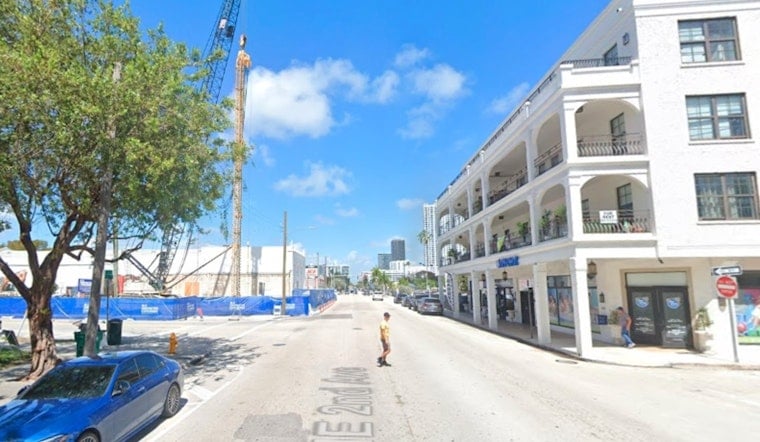
Drilling equipment and excavators are now working the ground at 1600 Northeast 2nd Avenue in Miami, where foundation piling has begun on a 33-story residential tower that will eventually rise roughly 384 feet above the Omni District. The project, known as 1600 Edgewater, is set to bring 282 rental units, a rooftop pool, and a rooftop restaurant to a half-acre lot that sat vacant after the demolition of the low-rise commercial structures that once occupied the site.
As reported by Florida YIMBY, the site preparation and foundation permits have already cleared the city, and construction crews have moved into what the outlet describes as the first major stage before the reinforced concrete superstructure goes up. The building's master permit, however, tells a more complicated story: according to Floridian Development, that permit, covering an estimated $93 million in construction costs, remained under review for developer corrections as of earlier this month even as foundation drilling advanced.
Miami's phased permitting process allows exactly this kind of overlap. The city permits high-rise builds in stages, so site prep and foundation drilling can move forward before the master permit clears in full, per Floridian Development's reporting. The master permit itself covers nearly 500,000 square feet of construction, according to the site's own facts, with the vertical construction permit already approved even as the broader document awaits sign-off.
From Go-Kart Track to 33-Story Tower
The site's path to this point stretches back to 2022, when the family-owned Sabet Group, led by Andre and Edward Sabetfard, bought the roughly half-acre parcel for $14.3 million. It was the firm's first Miami project, expanding a California- and New York-based commercial development operation with more than 35 years of experience into South Florida, according to The Real Deal.
Before Sabet Group's arrival, the property housed a 10,700-square-foot commercial building dating to 1950 that spent decades as the headquarters of repair shop Miami Cash Register, which had owned the land since paying $410,000 for it in 1985, the outlet's reporting notes. The building was later leased out to a go-kart amusement operation before it was torn down to make way for the tower now under construction.
Zoning Bonus Traded Affordable Units for Extra Height
1600 Edgewater's scale grew substantially between its initial filing and its final design. The tower's height climbed from a base zoning limit of 25 stories to 33, and its unit count rose from 250 to 282, after Sabet Group tapped Miami's public benefits bonus program and agreed to set aside 20 units for affordable housing, The Real Deal's reporting shows. Those affordable units will be reserved for households earning at or below 60 percent of area median income, per the project facts.
The mechanism behind that trade is written into the city's zoning code. Under Section 3.14 of Miami 21, developers in dense T6 urban core zones can secure a 30% to 50% boost in total floor-lot ratio by building affordable housing or contributing cash to the city's Public Benefits Trust Fund, according to Bilzin Sumberg. The City of Miami Planning Department began updating the program's fee multipliers this year to match current real estate values, the firm's analysis notes. Commercial space in the project grew too, from an originally planned 6,615 square feet to 9,519 square feet, while parking expanded from 328 to 352 spaces, most of which will sit within the building's podium.
Design Board Attached Conditions to Its Approval
Miami's Urban Development Review Board unanimously recommended design approval for the project in March 2025, but not without strings attached. The board's conditions included visual screening for the eight-story parking garage, relocation of a utility access door on Northeast 16th Street, and the addition of operable windows with Juliet balconies, according to Traded. Kobi Karp Architecture & Interior Design drew up the plans, and GT McDonald Construction is serving as general contractor, with completion anticipated in 2028.
The units themselves will range from studios to one- and two-bedroom layouts, spread across indoor and outdoor amenities that include the rooftop pool and restaurant, with commercial space positioned throughout portions of the development. The site sits near the northeast corner of Northeast 16th Street and Northeast 2nd Avenue, just south of Edgewater proper, with the Metromover's School Board Station along Northeast 15th Street standing as the nearest transit stop.
A Neighborhood Name, But a Different District on the Map
Despite carrying the Edgewater name, the tower is technically located inside Miami's Arts & Entertainment, or Omni, District, while Edgewater officially begins across the street, according to Miami Condo Investments. Developers frequently attach the Edgewater name to projects along the Northeast 2nd Avenue corridor because of its market visibility, the outlet notes, even when the parcel technically falls on the other side of the boundary.
That boundary matters because the site sits within the Omni Community Redevelopment Agency district, a public CRA established in 1987 to revitalize underused urban land and expand affordable and workforce housing around Downtown Miami, according to the Omni CRA. The agency works with public and private partners to support mixed-income housing and civic infrastructure, placing 1600 Edgewater's affordable set-aside squarely within that broader public mission.
Arriving Amid a Crowded Rental Pipeline
1600 Edgewater is joining a South Florida rental market that is already digesting a wave of new supply. CoStar data cited by Hoodline's coverage of the nearby Biscayne tower recorded roughly 18,600 apartment completions across the region in 2024 and another 12,718 in 2025. Nearby projects adding to that competition include Melo Group's 1,178-unit Biscayne 18 and LCOR's 544-unit 1775 Biscayne, both rising within the same stretch of corridor.
The surrounding neighborhood is also grappling with infrastructure strain that predates any of the new towers. A $600 million priority drainage upgrade under Miami's Stormwater Master Plan is targeting severe localized flood risks affecting a majority of Edgewater and Arts & Entertainment District properties, Hoodline has reported. City officials floated creating a Resilience Trust Fund funded by developer density fees to pay for flood pumps and seawalls late last year, underscoring the tension between rapid vertical growth and the ground it's built on.
For now, the visible progress at 1600 Northeast 2nd Avenue is limited to piling rigs and excavators working the foundation, with the taller question — whether the $93 million master permit clears review, and how another 282 units will land in an already-saturated rental market — still unresolved.





