

























































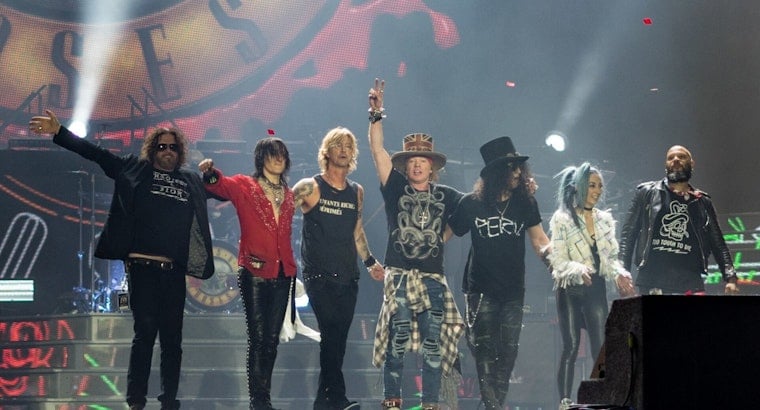
Thirty-five years after Axl Rose leapt into the crowd at Riverport Amphitheatre and touched off a three-hour riot that injured dozens and tore up a brand-new Maryland Heights venue, St. Louis fans still can't quite agree on how they feel about Guns N' Roses. That mix of nostalgia, wariness, and grudging affection is resurfacing again this month as the band prepares to play Busch Stadium.
The riot broke out on July 2, 1991, while Guns N' Roses was roughly 80 minutes into its set and playing “Rocket Queen,” according to the St. Louis Post-Dispatch. Axl Rose attacked an audience member who was wielding a prohibited video recorder and then jumped into the crowd himself, according to seed facts drawn from the Post-Dispatch's reporting. A photo caption cited by the paper attributes the spark to Bill “Stump” Stephenson, a local musician who now plays in the St. Louis band Southside Five, who was reportedly taking photos of Rose during the performance when the singer confronted him.
What followed was chaos. As reported by the Los Angeles Times, an estimated 2,500 fans stormed the stage after the band abruptly walked off, destroying equipment, fencing, and landscaping at the amphitheater, which had opened in Maryland Heights just weeks earlier on June 14, 1991. The three-hour riot injured roughly 60 people, including 13 law enforcement officers, and drew an emergency response of more than 300 police officers, with 16 people booked on suspicion of riotous behavior, the Los Angeles Times reported. Riverport Amphitheatre, built for $12 million with a 20,000-person capacity, sustained an estimated $200,000 to $300,000 in damage, per the Post-Dispatch.
A Years-Long Legal Fallout for Axl Rose
The consequences for Rose stretched well beyond that July night. He was arrested at JFK Airport in July 1992, and in November of that year a St. Louis County Court convicted him of misdemeanor property damage and assault charges, according to WhatCulture. A judge dismissed the more serious felony incitement-to-riot charges, ruling that Rose had not directly incited the crowd. He was ultimately sentenced to two years' probation and ordered to pay a $50,000 fine to local charities.
The bitterness didn't stay confined to the courtroom. Just two months after the riot, Guns N' Roses released their companion albums “Use Your Illusion I” and “Use Your Illusion II,” and tucked a printed message reading “F*** You, St. Louis” into the liner notes' thank-you section, a detail highlighted by a Facebook post from Rock N' Roll True Stories. It was a blunt signal of how raw the animosity remained between the band and the region that had effectively banned them.
A 26-Year Silence, Then a Homecoming
Guns N' Roses didn't play St. Louis again for 26 years. When the band finally returned on July 27, 2017, it wasn't a quiet reconciliation — they played a 3.5-hour set for 35,000 fans at The Dome at America's Center, as part of the second North American leg of their Not in This Lifetime... Tour, according to Ultimate Classic Rock. That lineup included guitarist Richard Fortus, a St. Louis native who grew up attending local schools and music shops in the region, per background shared by the St. Louis Cardinals. Fortus, who joined the band in 2002, gave the 2026 return a distinctly local face when he visited Busch Stadium in late 2025 to help promote the show.
Old wounds reopened briefly in 2023. A planned Guns N' Roses concert at Busch Stadium, scheduled for September 9 of that year, was postponed the day of the show due to an illness affecting Rose and was officially canceled weeks later without a rescheduled date, the Los Angeles Times reported at the time. Ticket holders were refunded after rumors briefly circulated about vocal strain, adding another layer of frustration to the band's already complicated history in the region.
Busch Stadium Awaits a Second Chance
Now Guns N' Roses is set to try again. The band is scheduled to play Busch Stadium on August 16 as part of its 2026 World Tour, with Public Enemy opening, according to the St. Louis Cardinals and MLB.com. It's the latest stop on a tour that has already brought the band through other major markets this year, including stadium dates covered in Hoodline's Raleigh stadium takeover and their earlier-announced San Diego stop.
The Riverport Riot sits within a broader pattern from that era. The Use Your Illusion Tour, which ran from January 1991 through July 1993 and spanned 192 shows across 27 countries, was marked by frequent riots and schedule disruptions, according to American Songwriter — including a notorious August 1992 riot in Montreal when Rose abruptly ended a joint concert with Metallica. St. Louis's own chapter in that volatile history has left a lasting connection with local fans, one built as much on wariness as on the excitement of a stadium show finally arriving as promised.





.jpg)