

























































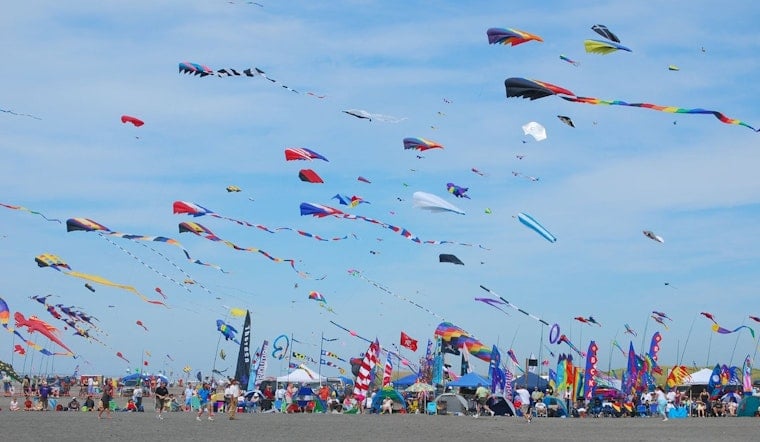
Vehicles rolled straight onto the hard-packed sand of the Long Beach Peninsula last week as thousands gathered for what one of the event's founders once called “the Super Bowl of kite festivals.” The Washington State International Kite Festival wrapped its 45th summer of flying on the southwest Washington coast, drawing an event organizers say ranks among North America's largest kite gatherings.
The festival ran August 17 through August 23 along the Bolstad Beach Approach and the adjacent half-mile Long Beach Boardwalk, according to the Astoria-Warrenton Chamber of Commerce. As Oregon Public Broadcasting reported, the gathering began modestly in 1981 when Harry Osborne started the festival and it attracted only a few kiters in its first year. Eric Forsberg, who has attended every Long Beach festival since 1982, said the festival's popularity has exploded in recent years.
The scale of the event today is hard to miss. Per Wikipedia, the seven-day gathering draws an estimated total attendance of more than 100,000 spectators and kite flyers to the Long Beach coast each August, with competitive and stunt teams arriving from countries including Japan, Germany, France, and Australia. Forsberg, who owns several hundred kites and has made many himself, serves on the World Kite Museum's board of directors.
A Beach Built for Driving and Flying
Part of what makes the spectacle work is the peninsula itself. According to OPB, the Long Beach Peninsula has a continuous 28-mile beach, and under Washington state administrative law the ocean beach is legally designated as a state highway, complete with a 25 mph speed limit, as reported by MyNorthwest. That rule lets spectators drive vehicles directly onto the hard sand to watch and launch kites, though state parks rangers still enforce traffic laws and keep drivers off the soft dunes and wet tide sand that shelter razor clam beds.
Not every day cooperated with the wind. Strong winds made August 22 too windy for many kites along the southwest Washington coast, per OPB, and many kite flyers sought shelter in their cars on the beach rather than risk their gear. It was a reminder that even a festival built around wind can be undone by too much of it.
Endurance Records and a Founder's Ambition
The festival has long had a competitive, almost obsessive streak. Harry Osborne himself attempted to break the world record for keeping a kite continuously in the air, and OPB reported that world record stood at 169 hours. That figure sits close to, though not identical to, the mark cited by Greater Seattle on the Cheap, which credits a team from Edmonds Community College with a Guinness World Record of 180 hours, or 7.5 days, set at that same inaugural 1981 event — a discrepancy the dossier does not resolve.
Mike Sterling, who lives in Portland and travels to kite festivals across the region in a 1969 Volkswagen microbus, enters handmade kites in competitions and recently won a second-place ribbon. Sterling told OPB that kite flying can give people a brand new life. Thad Walton, 60, traveled from Lehi, Utah, and described kiting as a cathartic release from a hectic work life, saying he uses kites to let his problems run off the kite line.
A Hobby With a Human Cost — and a Warning
For some flyers, the appeal goes beyond hobbyist pride. Doc Counce, a former Navy corpsman, said flying kites has helped his PTSD and added that the sport uses no fuel and makes the sky pretty. Walton, meanwhile, gives away dozens of extra kites to children for free and warned that the sport could die without youth participation — a concern he raised while traveling to festivals as far-flung as Washington, Michigan, and Italy.
Tiffany Hsu, who has attended the festival since childhood, brought her own family to this year's event. Their presence points to a generational pull that Walton's warning suggests can't be taken for granted.
The Museum Behind the Festival
Long Beach is home to the World Kite Museum, and the event is inseparable from that institution. Its core collection traces back to 1989, when Dorothea Checkley donated her late husband David Checkley's collection of 248 Asian kites, a gift that eventually expanded to over 700 traditional Japanese and Chinese kites, according to Discover Our Coast. The museum also displays historical military kites, including World War II barrage kites used to defend Allied naval ships and “Gibson Girl” radio transmitter kites issued in survival rafts for downed aviators, and it is described as the only institution in the Western Hemisphere dedicated exclusively to the history, science, art, and sport of kites.
The festival's cultural programming extends well beyond sport kites. The event showcases the Buffalo Kite Project, created in 2013 by curator Terry Zee Lee, which exhibits 14 large flying canvases painted by Native American artists representing nine Native Nations including the Salish Kootenai, Crow, Northern Cheyenne, and Oglala Lakota, per the same account from Discover Our Coast. State agency ArtsWA has separately designated downtown Long Beach and its oceanfront boardwalk as a Washington State Creative District, recognizing the town's seaside arts culture anchored by the museum.
Money, Memorials, and What Comes Next
The festival's civic value shows up in the city's own books. For its 2026 fiscal budget, the City of Long Beach allocated $54,000 from its municipal lodging tax fund to directly support the World Kite Museum and the festival, according to the Chinook Observer, funding that covers security, sanitation, and promotion drawn from revenue collected on overnight visitor stays. OPB noted the festival benefited Long Beach after the decline of the local fishing industry, and Osborne is credited with describing the Long Beach event as the Super Bowl of kite festivals.
On the festival's final Sunday, organizers held a traditional memorial ceremony in which professional fliers and families send up specialized kites carrying the names of kite enthusiasts who died during the preceding year, as reported by The Daily Astorian. The Sunday tribute marks both a solemn remembrance and, in practice, the start of planning for next summer's gathering — a rhythm that has carried the festival through 45 summers of kite flying along this stretch of coast.



