

























































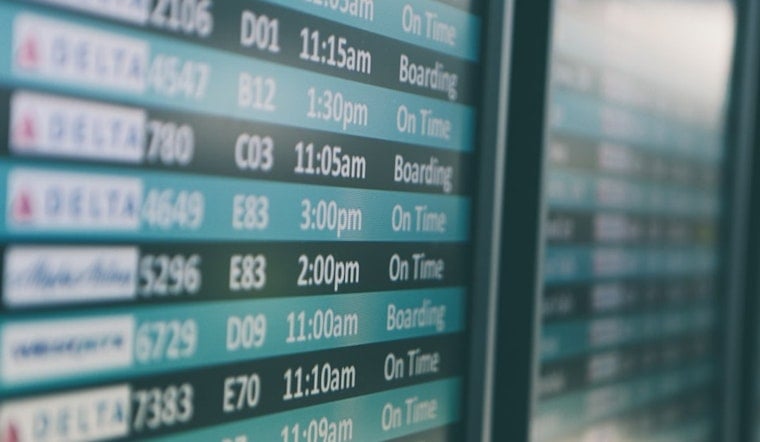
More than 775 flights were delayed and 52 were canceled across the United States on Tuesday, as thunderstorms in the Southeast and low clouds along the West Coast collided with a chronically understaffed air traffic control system to snarl travel from Boston to Denver. Boston Logan International Airport logged the most delays of any U.S. airport with 19, while Nantucket Memorial Airport saw the most cancellations with 11.
According to NJ.com, JetBlue led all U.S. carriers Tuesday with 48 delays and 9 cancellations, more than any other airline in the country. The outlet, whose reporting on the disruptions comes from national trending news writer Katherine Rodriguez, also noted that gusty winds were expected to affect planes taking off and landing in Newark, according to the Federal Aviation Administration.
The FAA's Air Traffic Control System Command Center flagged active thunderstorm initiatives across Florida and the Southeast, along with low ceilings in San Francisco and San Diego, in its operational plan for the day. Per the Federal Aviation Administration, the agency forecast ground delay programs and ground stops touching Orlando, Tampa, Miami, Fort Lauderdale and Denver. Thunderstorms were expected to cause delays or cancellations in Dallas-Fort Worth, Fort Lauderdale, Miami, Orlando, Tampa and Denver, while low clouds threatened similar disruptions in San Francisco and San Diego, the agency said. According to the Federal Aviation Administration, Newark Liberty International Airport's maximum number of scheduled operations per hour is 72 through the end of the Summer 2026 scheduling season. According to a Nov. 27, 2024, Federal Aviation Administration slot-administration notice, Newark Liberty International Airport has capacity limits intended to mitigate delays and congestion.
A Controller Shortage Behind the Chaos
Weather alone doesn't fully explain why routine summer storms keep cascading into national delay counts. Federal aviation workforce data reviewed by Deep Arrival in June showed the FAA operating with roughly 10,800 fully certified air traffic controllers against an internal target of 13,800 — a deficit of about 3,000, or 20%, across towers and regional radar centers. New controllers require three to five years of specialized facility training before earning full certification, meaning the shortfall isn't one the agency can close quickly. According to the U.S. Government Accountability Office, total flights using the air traffic control system increased by about 10 percent to 30.8 million between fiscal years 2015 and 2024.
That staffing gap has been compounded by controller absenteeism in key regions. Earlier this month, Transportation Secretary Sean Duffy said sick callouts reached 40% to 60% at key facilities in the New York region, according to TheTravel, while FAA ground stops were reported at eight major Northeast hubs on Aug. 7. In response, the FAA has leaned on an unconventional recruitment push: an April campaign targeting video gamers for their spatial awareness and multitasking skills brought in more than 2,000 trainees, meeting 94% of the agency's annual hiring goal, Duffy announced, as reported by CBS News.
Why JetBlue Keeps Topping the List
JetBlue's repeated appearance atop delay and cancellation rankings traces back to documented internal problems. A July press release from the Air Line Pilots Association, previously reported by Hoodline, detailed how crew scheduling desk failures left JetBlue pilots stranded overnight and unreachable, forcing the airline to cut its JFK Airport operations by half and cancel nearly 1,000 flights in a single weekend. Those scheduling bottlenecks help explain why the carrier remains especially vulnerable when weather or staffing shortages strain the system.
Federal hub capacity limits add another layer of fragility. To prevent airspace overload during the 2026 summer travel season, regulators capped Chicago O'Hare at 2,708 flights per day from May 17 through October 24 — nearly 15% below scheduled airline capacity. Those caps leave little operational buffer, so when convective weather compresses arrival windows, airlines are often forced into outright cancellations rather than absorbing delays. Tuesday's disruptions followed a similar pattern seen earlier in the month, when severe convective weather forced ground stops at five major airports on August 9, while August 10 saw over 2,036 delays and 263 cancellations nationwide, with O'Hare experiencing the largest disruption, as Hoodline reported in its . The U.S. Government Accountability Office reported that a 2023 air-traffic-control system outage caused cancellations of over 1,300 flights and delayed almost 10,000 other flights throughout the day.
What Delayed and Canceled Passengers Can Do
Passengers facing extended delays have firmer legal footing than in years past. Under Department of Transportation regulations, travelers whose domestic flights are delayed three hours or more, or canceled outright, are entitled to an automatic cash refund to their original payment method if they decline rebooking, according to FlyClaimer. Airlines must process credit card refunds within seven business days under the federal rule. A separate DOT policy update, however, gives airlines enforcement discretion through July 2027 to rebook passengers on renumbered flights without triggering mandatory cancellation refunds, as long as the trip ultimately operates without significant delay.
Passengers should also know that checked baggage delays carry their own refund protections: airlines must automatically refund bag fees if luggage isn't delivered within 12 hours for domestic flights, or 15 to 30 hours for international trips, per DOT consumer protection rules. NJ.com's Rodriguez, who has covered travel advisories, TSA-related news and recalls for more than five years, advised that travelers with connecting flights allow extra time when passing through busy airports, and that anyone facing delays check flight status regularly through their airline's app or website. She also recommended keeping essential items in carry-on luggage and enabling app notifications for gate changes, delays and cancellations, while those with canceled flights should rebook as soon as possible.





