

























































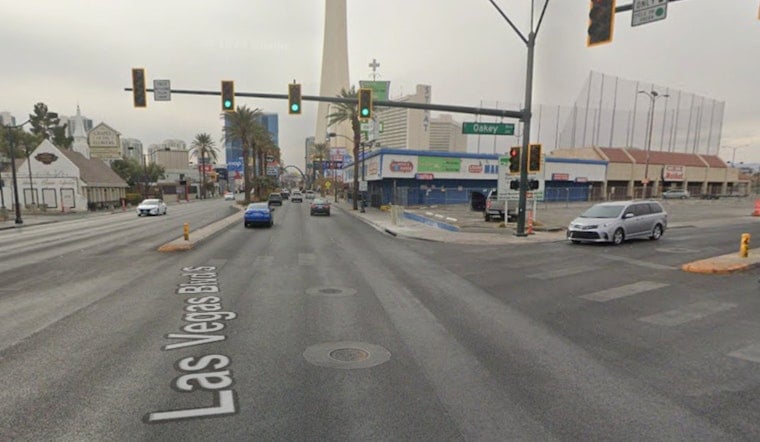
A nearly 1-acre lot at the southeast corner of Las Vegas and Oakey boulevards, once home to a tire shop, is now home to something developer Kamran Foulad calls his Campus: a roughly 36,700-square-foot complex of restaurants, bars and live music venues wedged between the Strip and downtown Las Vegas. Foulad bought the former tire-shop site in 2022 for $2.75 million, and construction costs have since climbed above $8 million.
Foulad's project — listed in city records and marketing materials under the name Brewhaus — sits along a stretch of Las Vegas Boulevard that is, in his own telling, still rough around the edges. As reported by the Las Vegas Review-Journal, the boulevard here is lined with wedding chapels, eateries, tattoo shops, strip clubs, vacant lots and boarded-up buildings. Foulad told the paper that reviving eyesore properties is the whole appeal of the work: “that is really what turns me on: get the worst property and make the best out of it.”
A Multicolored Complex Built From an Old Auto Shop
The finished project blends a leftover portion of the old auto shop with new construction, topped by rooftop decks and a multicolored design, per the Review-Journal's reporting. Foulad is aiming to fill the space with 11 or 12 tenants, and current plans call for at least one brewery and a tequila bar alongside other food-and-beverage spots, indoor and outdoor seating, and live music.
One of the complex's more eye-catching features didn't come from Nevada at all. Foulad spent around $15,000 on a wine barrel large enough to hold an estimated 750 to 850 gallons of wine, then had it purchased, converted and shipped in from California. The project is owned through Foulad's Proview Series, and the family later sought and won approval to add a small stand-alone building with its own rooftop deck.
Zero Parking Spaces at a Site That Needed 143
Perhaps the most contentious detail in the project's path to approval was parking — or the lack of it. Per city staff's report cited by the Review-Journal, the project would ordinarily have required 143 parking spaces, but the finished complex has zero on-site spots. Foulad's brother, Adam Foulad, who owns KLA Capital, told the Las Vegas City Council in 2024 that the area was “a little bit dead,” adding pointedly that “there's more people doing drugs in the alley around there than there are actual patrons.”
To cover the parking gap, the Foulad family owns a 65-space parking lot at Oakey and Main Street that customers could use, and Adam and Kamran Foulad are contemplating shuttle rides and parking validation for complex customers, as well as potentially taking over operation of that nearby lot themselves. City Councilman Mike Janssen has said the lot is currently operated by the city and gets little use. The city has also been adding street parking in the area and is planning a roughly 500-space garage a few blocks away, while the complex itself will include three ride-hailing service spots. The Las Vegas Planning Commission approved the developer's proposal in 2023, and the City Council approved revised plans after Kamran and Adam Foulad addressed the council in 2024. Councilwoman Olivia Diaz called the project a “shot in the arm” for the area.
Part of a Bigger Public Push Along the Corridor
The Foulads' project sits at a corridor the City of Las Vegas has poured public money into reviving. The city completed a $125 million overhaul of Las Vegas Boulevard between Sahara and Stewart avenues, replacing underground utility lines dating to the 1940s and 1950s and adding street trees, gateway arches and median improvements. Nearby, the city also installed restored historic neon signs — including the 1953 Par-A-Dice Motel sign and the 1968 Rummel Motel sign — in the median near Oakey Boulevard, part of an effort to link the Strip to The Neon Museum with a continuous neon trail.
Drainage work is also underway close by: the city launched a $49 million storm drain project on Charleston Boulevard, installing about a mile of underground box culverts and causing periodic closures along Casino Center Boulevard, with traffic detoured via Oakey Boulevard through late 2027, according to KSNV. Commercial property owners in the redevelopment area can also tap the city's Commercial Visual Improvement Program, which offers matching grants up to $25,000 for façade upgrades funded through the Redevelopment Agency's property tax increment financing.
A Growing Roster of Repurposed Buildings
Foulad's project joins a growing list of businesses in the neighboring Arts District that have taken over unlikely former spaces. Cornish Pasty Co. operates out of a former fabric store, Tacotarian occupies a former laundromat, and Soulbelly BBQ and Nevada Brew Works share a former auto-repair shop. Adam Foulad's KLA Capital has its own track record in the area, having built The Distrikt, a container-style retail and dining cluster on South Commerce Street housing tenants including Slice Deli and The Lucky Otter Irish pub — a project Hoodline covered in July. KLA Capital's broader portfolio includes other renovated Arts District buildings alongside multi-family residential and commercial properties across the downtown urban core.
The Brewhaus project also arrives as the city works on its own vision for growth nearby. The 18b Arts District spans 131 acres across 22 city blocks between Interstate 15 and South Las Vegas Boulevard, anchoring a ZIP code where the median home list price hit $422,500 as of June, according to CEDARst Companies. In January, the city issued a request for proposals for a 1.23-acre mixed-use site along South Las Vegas Boulevard requiring affordable artist live/work housing above ground-floor commercial space, limiting most units to households earning at or below 80% of the area median income. In July, the city followed with an RFP for an 11-acre “Downtown Core Assemblage” near Fremont Street and Symphony Park, aimed at creating a walkable link between downtown's activity hubs.




