

























































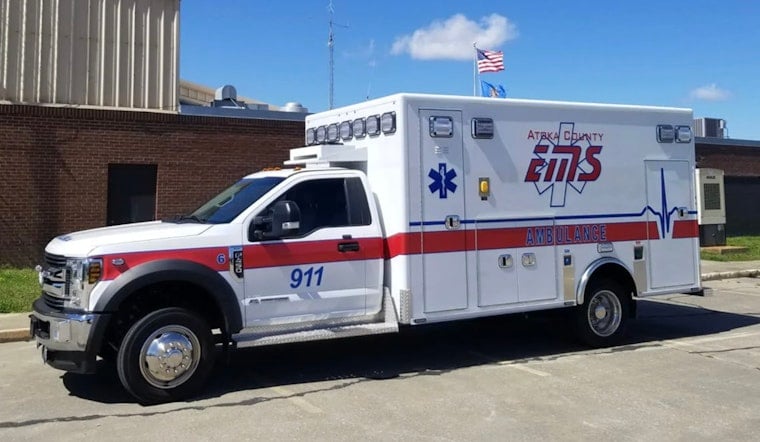
An 87-year-old man is dead and three paramedics are injured after his truck collided with an Atoka County ambulance on US-69 in Bryan County Tuesday morning. The ambulance was struck on its passenger side as it traveled north on the highway, according to investigators.
Wesley Weber was driving south on US-69 when he turned left onto Chickasaw Road, putting his vehicle into the ambulance's path, according to the Oklahoma Highway Patrol, as reported by KOKH. The ambulance struck the passenger side of Weber's vehicle, per Oklahoma Highway Patrol. Weber died from the crash, authorities said, while three paramedics aboard the ambulance were injured, according to authorities.
What Oklahoma Law Requires at That Intersection
The crash raises two distinct legal questions under Oklahoma traffic law, though officials have not yet said which, if either, applied at the moment of impact. Drivers approached by an emergency vehicle running active lights and sirens are required to pull over toward the right edge of the roadway and come to a complete stop until it passes, according to Justia Law. Separately, state statute requires any driver turning left across traffic to yield to oncoming vehicles close enough to pose an immediate hazard, per Oklahoma's traffic code as compiled by Justia Law. It remains unclear from available reporting whether the ambulance's emergency signals were active at the time Weber turned, or how OHP's ongoing investigation will apply either standard to the crash.
Paramedics Face Elevated Risk on the Road
Atoka County EMS, founded in 1981, is the only provider of pre-hospital emergency medical care for nearly 14,000 residents across the county, according to Atoka County EMS. That single-agency reliance underscores the stakes when its ambulances are pulled off the road by a collision. National data shows the risks paramedics face are not incidental: the Centers for Disease Control and Prevention has found that emergency medical services personnel experience a fatal crash rate double the national occupational average, with drivers most often suffering non-fatal injuries and incapacitating injuries occurring more frequently in the patient compartment.
The elevated danger extends to the vehicles themselves. Running lights and sirens raises an ambulance's crash rate from 4.6 per 100,000 responses to 5.5 per 100,000 emergency responses, according to the National Safety Council. Nationally, ground ambulance crashes average 29 fatal incidents and 33 deaths per year, with 63% of those killed being occupants of other vehicles, according to the U.S. Fire Administration's review of federal crash data.
Age and Left Turns Are a Recurring Factor in Fatal Crashes
Weber's age places him within a pattern researchers have documented in fatal intersection crashes. Federal crash research has found that in fatal two-vehicle collisions involving an older driver and a younger driver, the older motorist is five times more likely to have been turning left at the moment of impact, according to the National Highway Traffic Safety Administration. Older drivers also face outsized fatality risk once a crash occurs: the National Safety Council reports that roughly 66% of traffic deaths in 2024 involving older drivers were occupants age 65 or older.
A Corridor Already Under Scrutiny
The stretch of US-69 running through Bryan County has drawn state and federal attention for its intersection risks. The Oklahoma Department of Transportation previously secured a $62 million federal FASTLANE grant toward a project exceeding $120 million aimed at eliminating at-grade intersection conflicts and improving freight mobility along the US-69/75 corridor, according to the U.S. House Committee on Transportation and Infrastructure.
Tuesday's crash adds to a string of fatal highway incidents Bryan County has seen in recent weeks. In July, a fatal off-road vehicle fire on US Highway 70 near Mead and a fatal motorcycle crash on Highway 78 killed Durant rider Timothy Steely, both chronicled in earlier Hoodline coverage. Oklahoma Highway Patrol's investigation into the US-69 crash remains ongoing, and further details on vehicle speeds, signal activation, and restraint use are expected as the report is finalized.





