

























































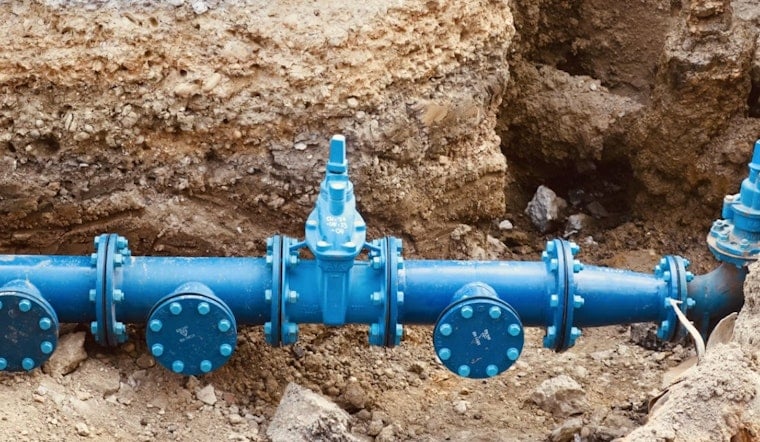
A water main break tore open a sinkhole on Turtle Rock Road in Valley Center yesterday, swallowing the road itself and cutting off access to roughly 10 nearby homes. The break struck around 4:40 PM near the intersection of South Cole Grade and Turtle Rock roads, sending residents scrambling as the ground beneath their street gave way.
Linda Locklear, who lives near that intersection, told FOX 5 San Diego that the road simply disappeared, leaving families unable to reach their own driveways. Her husband had just returned from a Costco run when the break hit, and rather than turn back, he carried groceries to the house by hand, with the couple's grandchildren pitching in to haul bags across the damaged ground. Locklear said the ordeal ended up bringing neighbors together as everyone adjusted to the sudden disruption.
Water district crews reached the scene and managed to isolate the leak within about 20 minutes of the break, according to the station's report. Even so, the damage was already done: Brian Lovelady, director of operations for the Valley Center Municipal Water District, said the break had likely dumped around 150,000 gallons of water before it was contained, and that roughly 10 homes in the area lost service. Crews spent the evening draining standing water and clearing debris from the sinkhole, the same report noted.
No Water Until Monday for Some Households
Locklear said families in the neighborhood were left with no running water at all, and her own household planned to refill and haul five-gallon jugs to the house until service returns. Lovelady estimated repairs would allow water to be restored sometime around midnight or 1 a.m. Monday, though that timeline depended on how the fix progressed overnight.
As for what caused the rupture, Lovelady said the likely culprit was a deteriorated section of steel pipe — a familiar failure point across Valley Center's water system. Turtle Rock Road itself is a private residential street branching off South Cole Grade Road, lined with single-family homes on multi-acre lots mostly built in the early 1980s, according to property records reviewed by Redfin. Streets like it are dead-end corridors without secondary access, which is part of why a single sinkhole was enough to strand an entire pocket of homes.
A System Built for a Community of 900
The break fits a pattern the Valley Center Municipal Water District has been contending with for years. The district was formed by a local ballot vote in June 1954 to bring imported Colorado River water to a rural community of roughly 900 people, and it adopted its first distribution master plan the following year, according to district history. That means large stretches of its network, now spanning some 340 miles of pressurized mains across a 100-square-mile service area, are approaching 70 years old.
Many of those original lines are tar-wrapped steel pipe, and state filings from the California State Water Resources Control Board describe how that steel is vulnerable to root intrusion and pipe wall oxidation as protective coatings degrade over decades — exactly the kind of failure Lovelady pointed to on Turtle Rock Road. The district has begun tackling the highest-risk corridors directly: a project running from summer 2026 through spring 2028 will replace about 11,000 linear feet of aging 12-inch steel main along Old Castle Road with PVC pipe, which carries an estimated 70-year service life and resists the corrosion that plagues its steel predecessors.
Funding the Fix Falls Increasingly on Ratepayers
The district isn't tackling this alone. Earlier this year, VCMWD joined other rural North County water providers in applying for federal funding to replace failure-prone mains and rehabilitate aging reservoirs, as reported by the Valley Roadrunner. It has also built redundancy into the system, partnering with neighboring Yuima Municipal Water District to lay more than 3,800 feet of 12-inch PVC main along Lilac Road specifically to create emergency transfer capacity during breaks or wildfires.
Still, the money increasingly comes from the same neighborhoods affected by breaks like this one. San Diego County Water Authority leadership has said that state and federal grants once covered 70% to 80% of major water infrastructure projects, but today local ratepayers shoulder the overwhelming majority of repair and replacement costs, according to Voice of San Diego. For a rural district covering 100 square miles with just 43 reservoirs and 28 pumping stations to maintain, that shift makes proactive pipe replacement an expensive, slow-moving race against pipes that are already decades past their original design life.





