

























































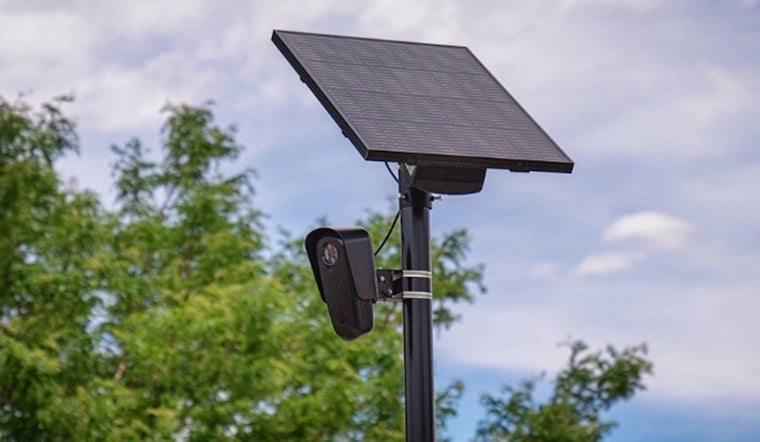
More than 150 people packed an Apex town council meeting to confront local leaders over the police department's use of Flock Safety license plate cameras, after officials disclosed that federal agencies had been mistakenly given access to the town's data and that outside agencies had run searches touching Apex's camera network. The turnout reflects a boiling-over of privacy concerns that have simmered since Apex first switched on its cameras in October 2025.
According to the Raleigh News & Observer, Apex Police disclosed on June 9, 2026 that an audit found two federal agencies, the U.S. Postal Inspection Service and the USAFB Police Department, had mistakenly been enabled for data sharing, even though federal agencies were supposed to be excluded from Apex's arrangement entirely. The department said it has since ended that unintended relationship and now reports no current federal data sharing. Apex Police also reported that USAFB conducted no searches identifiable by the department, but confirmed that the U.S. Postal Inspection Service ran three nationwide searches tied to an embezzlement case that included Apex data.
Deputy Chief Ryan Johansen would not disclose whether those federal searches turned up anything relevant from Apex's cameras, the paper reported. He also cautioned that searching every participating network at once, rather than narrowing to agencies with a plausible connection to a case, amounts to lazy or novice police work in most instances — even though outside agencies often do exactly that, searching all participating networks even without a suspected link to the crime under investigation. Outside agencies can choose which networks to include in any given Flock search, a flexibility that residents say leaves Apex's data exposed to searches far beyond local crime-fighting.
Residents Demand Accountability
The scale of the network fueled much of the unease at the meeting. Apex Police has shared data with roughly 1,000 police agencies, and the town's cameras have logged more than 15 million license plate scans since going live. Resident Timothy McLane told the council that Apex should be the peak of good living rather than the peak of surveillance, a line that captured the room's mood.
Terry Mahaffey said his primary concern was not the cost of the program but the technology, database, and access granted to agencies outside Apex. He said the town council should weigh every option, including renewing the Flock contract, adding new safeguards, switching vendors, or ending the camera program altogether. John Wagstaff urged residents to keep demanding transparency and accountability from government while also acknowledging that automated license plate reader hits can provide important investigative leads; he said he supports continued public scrutiny of the technology even as he sees its value. George Hogan pushed back on one alternative some had floated, telling the council that simply swapping Flock for another vendor, such as Axon, would not be an acceptable solution on its own.
What Apex Police Say the Data Shows
Apex Police reported no identified searches that violated law or department policy, and said it found no searches tied to immigration or abortion enforcement. The department said it approved each data-sharing relationship individually and that Flock searches are subject to audits and supervisory oversight. Apex's current contract covers eight cameras listed on its Flock transparency portal, and the department said seven installed cameras generated about 60,000 reads per day in June.
The department currently retains camera images for 30 days, though that practice sits well within the ceiling set by state law. Under North Carolina General Statute § 20-183.32, agencies statewide may retain automated license plate reader scan data for a maximum of 90 days, after which it must be destroyed unless preserved through a written request or search warrant, according to DeFlockILM. A companion statute, § 20-183.33, enacted in 2023, makes it a Class 1 misdemeanor for anyone to unlawfully obtain, access, preserve, or disclose license plate reader data outside those authorized limits.
A Statewide Push Collides With Local Doubts
Apex's debate is unfolding just as North Carolina moves in the opposite direction at the state level. A provision in the state budget passed in July 2026 permanently authorized law enforcement to place automated license plate reader networks on all state-maintained roads and highways, cementing a former State Bureau of Investigation pilot program that had already logged more than 150 million plate scans across 140 cameras, as reported by Hoodline. As of May 2026, at least 700 Flock Safety cameras were already deployed across more than 70 North Carolina counties and municipalities, per the Raleigh News & Observer.
Not every nearby town has followed that path. The Town of Holly Springs Police Department publicly clarified in July 2026 that it chose not to use Flock Safety at all, opting instead for Motorola's Vigilant ALPR system without permanent camera installations. Apex approved its own initial agreement for 10 Flock cameras on January 14, 2025, a two-year contract now running through January 31, 2027, at a cost of $71,750, according to reporting from INDY Week.
Misuse Cases Elsewhere Sharpen the Debate
Residents' fears about shared network access are not abstract. On July 29, 2026, the State Bureau of Investigation arrested Charlotte-Mecklenburg Police Department Officer Seth Elliott on a Class 1 misdemeanor charge of illegally accessing a government computer after he allegedly conducted unauthorized queries of Flock Safety and state CJLEADS databases. Court records in that case indicate Elliott used shared access to Flock data to identify an undercover drug officer's vehicle and passed that information to a suspect under investigation, according to WBT.
That case, along with similar misuse incidents reported elsewhere, pushed Flock Safety to announce nationwide changes. WCNC reported on August 13, 2026 that the company is cutting its default data retention period from 30 days to seven days and now requires an investigative case number, offense type, and stated reason for every search. Johansen said Apex had already been considering policy revisions of its own before Flock's announcement, though he did not say whether the town plans to shorten its own retention period.
National Advocates Weigh In
ACLU senior policy analyst Jay Stanley said people who are not suspected of any crime should not have their movements tracked even for a week, arguing that shorter retention alone does not resolve the underlying privacy concerns. He recommended that agencies adopt shorter retention windows, opt out of nationwide data sharing, and tighten controls on watch lists used to flag vehicles. Notably, New Hampshire has gone further than most states, requiring license plate data to be deleted within three minutes unless tied to an active investigation.
Council member Jacques Gilbert said no formal agenda had yet been set for the next public safety committee meeting, leaving open when — or how — Apex will resolve the fight over its cameras. Police departments elsewhere in the region continue to point to Flock's investigative value: Raleigh detectives used the technology on August 15, 2026 to track a homicide suspect over 400 miles to Pennsylvania within 24 hours of finding a local high school basketball coach stabbed to death, a case Hoodline covered in a camera-tracked manhunt. Whether that kind of outcome outweighs the risks residents raised in Apex remains the question the town council has yet to answer.





.jpg)