

























































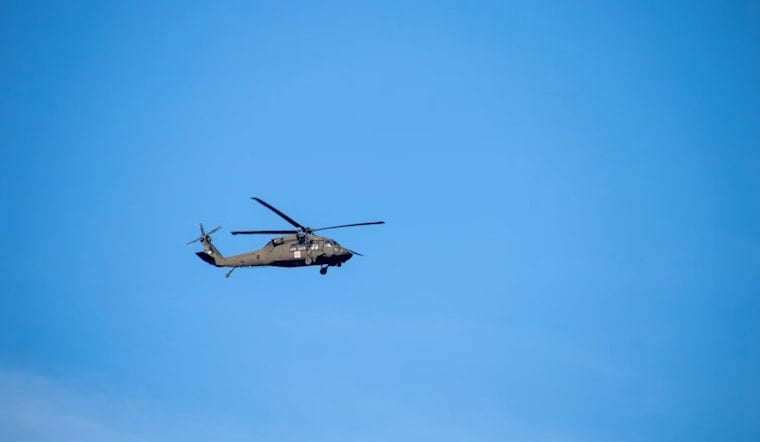
A U.S. Army Black Hawk helicopter carrying four people made an apparently unplanned landing in a wooded area of the Colorado foothills west of Denver on Tuesday, coming to rest on the east side of Thorodin Mountain north of Golden Gate Canyon State Park. All four people aboard escaped without injury, and there were no fuel leaks or fires at the scene.
The aircraft belongs to the 160th Special Operations Aviation Regiment, the elite Night Stalkers unit based at Fort Campbell in Kentucky, according to CBS Colorado. An Army spokesperson described the event as an aviation mishap that occurred during a training operation, and the regiment says it takes all training incidents and the safety of its personnel seriously. The Army has confirmed an investigation into the crash is underway, and questions about the mishap are being directed to the U.S. Army Special Operations Aviation Command Public Affairs Office.
The Gilpin County Sheriff's Office, which responded to the scene, reported that four people were aboard the helicopter and confirmed none suffered reported injuries. Emergency crews located the aircraft on Thorodin Mountain, a rugged Front Range peak that reaches 10,540 feet in the Roosevelt National Forest, according to PeakVisor. The mountain's steep rocky slopes, dense timber, and unpredictable high-altitude winds make it a demanding — and dangerous — environment for any rotary-wing aircraft.
A Remote Corner of a Small Colorado County
Gilpin County itself is one of Colorado's smallest and least populated counties, spanning roughly 150 square miles west of Denver with terrain ranging from 6,960 feet up to more than 13,200 feet along the Continental Divide, per the Colorado Encyclopedia. That kind of vertical relief, combined with dense forest cover, has long complicated search and rescue efforts in the area. The county's emergency managers rely on a digital alert system called Genasys Protect EVAC alongside dispatch services to send real-time map-based notifications to mountain residents when incidents like Tuesday's mishap occur.
The 160th SOAR flies specially modified MH-60 Black Hawks, MH-47 Chinooks, and MH-6 Little Birds engineered for low-altitude, night, and covert special operations insertions, according to Fort Campbell Army Garrison. Colorado's Front Range and mountain terrain make it a frequent training ground for military aviation units practicing under punishing altitude conditions. The state is also home to the High-Altitude Army National Guard Aviation Training Site in Gypsum, which trains rotary-wing pilots from around the world in high-elevation power management, according to the Colorado National Guard Public Affairs office.
A Regiment With a History of High-Altitude Risk
Tuesday's mishap lands the 160th SOAR back in headlines just under a year after a training tragedy elsewhere. Four special operations soldiers from the regiment were killed on September 17, 2025, when their MH-60 Black Hawk crashed in difficult terrain during a training mission near Joint Base Lewis-McChord in Washington state, according to Task & Purpose. Colorado itself has been the site of a past 160th SOAR fatality: on August 19, 2009, an MH-60 Black Hawk crashed on Mount Massive near Leadville during high-altitude training, killing four Night Stalkers, per Main Street Media of Tennessee.
Military aviation mishaps are formally classified by severity, with Class A designating crashes involving a fatality, a total loss of the aircraft, or damages of $2.5 million or more, while Class B and C mishaps involve lower financial thresholds and non-fatal injuries, according to MyBaseGuide. It remains unclear how Tuesday's incident will ultimately be classified, and the 160th SOAR has declined to provide additional comment or information while the safety investigation remains active.
New State Rescue Framework Just Took Effect
The mishap also arrives weeks after Colorado overhauled how it handles backcountry emergencies. A new statewide interagency agreement took effect on August 1, shifting state-level coordination for backcountry search and rescue from the Division of Homeland Security to Colorado Parks and Wildlife whenever local sheriff resources are exceeded, according to SECO News. Hoodline previously reported on the shift in Colorado's rescue overhaul, which replaced a volunteer-led coordination framework that had been in place for 53 years. In this case, Gilpin County's own sheriff's office was able to respond and confirm conditions at the scene without requiring escalated state assistance.
Open questions remain about exactly what caused the aircraft to come down, how much damage the Black Hawk sustained, and how long it will take military recovery crews to extract the helicopter from Thorodin Mountain's wooded, high-altitude slopes. For now, officials say the priority was accounting for the crew, and all four walked away from a landing that could have ended very differently in one of the Front Range's more unforgiving corners.





