

























































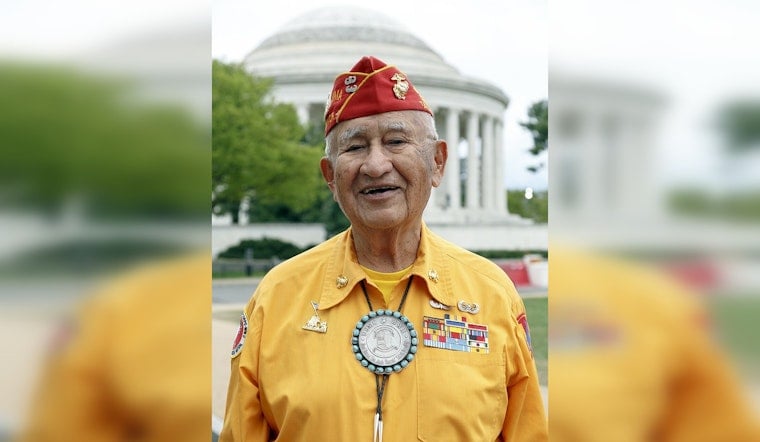
A crowd is expected to gather in Phoenix on National Code Talker Day to honor 101-year-old Thomas H. Begay, one of just two surviving Navajo Code Talkers from World War II. Begay grew up speaking only the Navajo language with his parents, later carrying that language into combat as part of a code that enemy forces never broke.
The commemoration, held every August 14, traces back to a 1982 proclamation signed by President Ronald Reagan designating the date to honor Navajo Code Talkers and other Native Americans who served in World War II, according to WFTV. Reagan's proclamation also acknowledged that Choctaw, Chippewa, Creek, Sioux and other tribes had used their own languages as battlefield codes, and Congress approved a joint resolution recognizing code talkers that same year. Dawn Manuelito said the Navajo language helped save the United States, per the outlet's report.
Begay enlisted in the Marine Corps at age 16, originally training to become an aerial gunner before officers unexpectedly reassigned him to the classified Code Talker program after boot camp, according to Honoring America's Veterans. He served with the 5th Marine Division Signal Company during the Battle of Iwo Jima starting February 19, 1945, transmitting tactical radio coordinates under heavy artillery fire, according to the Library of Congress. The military recruited and trained more than 400 Navajo men for the effort, the largest code-talking program in the military at the time, and their transmissions frustrated Japanese forces and helped achieve U.S. victories in the Pacific war, the same report notes.
A Language Once Forbidden, Then Essential
Begay learned English at age 13 in boarding school, the same institutions where Native children were often punished for speaking their own languages. Laura Tohe, the Arizona poet laureate and daughter of a Navajo Code Talker, said her father attended a boarding school where students were punished for using their native languages, and that Navajo Code Talkers served despite the complicated and dark history with the United States, per the same account.
Begay's discharge did not end his service. The Code Talkers' report notes he left the Marines in 1946, joined the U.S. Army in 1947, and served as a paratrooper during the Korean War, fighting at the Battle of Chosin Reservoir in late 1950 before leaving the military in 1953. His commendations across the two conflicts include the Presidential Unit Citation with three Bronze Stars for World War II service and the Meritorious Unit Citation with the Korean Service Medal with five Bronze Stars, according to Honoring America's Veterans.
After his military career, Begay worked as a communication specialist and spent decades as an employment assistance officer and senior administrator for the Bureau of Indian Affairs on the Navajo reservation, helping hundreds of Navajos obtain job training and placement, per the Library of Congress. Honoring America's Veterans named him a World War II Veteran Grand Marshal for the 2023 Phoenix Veterans Day Parade, cementing his ties to the city now honoring him again.
Secrecy, Silence, and a Long Fight for Recognition
The Navajo Code Talkers program remained classified until 1968, meaning the men who developed it were sworn to secrecy for decades after being discharged from World War II. Begay and other code talkers made a written request for recognition, and in 1971 President Richard Nixon sent a letter of appreciation to the Navajo Tribal Council, the report states. Code talker veterans later participated in the 1976 bicentennial parade in Washington, and in November 2017, Peter MacDonald and other World War II veterans met Donald Trump in the Oval Office in Washington, D.C.
MacDonald, the other surviving Navajo Code Talker, lied about his age to join the Marine Corps at 15, later worked as an engineer at a defense contractor after the war, and became a politician on the Navajo Nation, according to the same coverage. Native American men and women enlisted in the U.S. armed forces in massive numbers during World War II, more than 40,000 people, and code talking programs ultimately included members from at least 20 tribes, according to the National Museum of the American Indian as cited in the report. Comanche code talkers, separately, participated in operations in Europe including the D-Day invasion of Nazi-occupied France.
Federal Deletions and a Tribal Response
The commemoration arrives amid a dispute over how the federal government has handled records honoring these veterans. Following an executive order from President Donald Trump ending federal diversity and equity programs, the Defense Department deleted thousands of pages honoring women and minority groups, including Navajo Code Talkers and Native American veterans, per WFTV's reporting. Tribes condemned the deletions, and the Pentagon said the Navajo Code Talker material was erroneously removed; some webpages have since been restored.
That federal tension sits alongside a decades-old local frustration: despite their legacy, Navajo Code Talkers still have no dedicated museum, and earlier attempts to build one on the Navajo Nation have not come to fruition. Navajo Times reports that previous plans for a museum at Tsé Bonito stalled even after groundbreaking ceremonies were held there. Plans announced last week call for establishing a new Navajo Code Talkers Museum in Farmington, New Mexico, according to WFTV.
A New Museum Takes Shape in Farmington
That Farmington plan is now moving through official channels. In May, the State of New Mexico's Facilities Management Division issued a request for proposals for architectural and engineering services for an $11 million Navajo Code Talkers Museum to be built on the campus of Navajo Preparatory School, featuring a 6,500-square-foot core exhibit space, according to HigherGov.
The Navajo code itself remains the only military spoken code in modern history that enemy forces never broke or deciphered during combat, and it built on a precedent set in World War I, when Choctaw soldiers of the 142nd Infantry Regiment used their native language to transmit combat communications at Camp Bowie, Texas, and in France in 1918. Hoodline previously reported on that earlier chapter of code-talking history in a festival honoring WWI Choctaw code talkers, and also covered the 2024 death of fellow Navajo Code Talker John Kinsel Sr. at 107, when Begay and MacDonald were already noted as being among the last living code talkers.
Separately, Native American veterans returning to Arizona after World War II, including Navajo Code Talkers, were barred from voting in state elections until 1948, when the Arizona Supreme Court invalidated state restrictions against reservation residents, according to the Native American Rights Fund. That history underscores the distance between the battlefield sacrifices these men made and the civil rights they were denied at home upon their return.





