

























































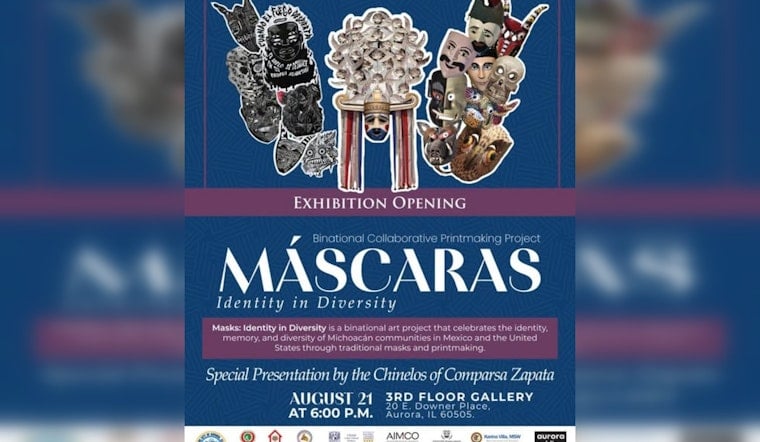
Downtown Aurora's public art gallery is opening its doors this Friday to a collection two decades in the making: more than 200 traditional masks from Michoacán, Mexico, alongside prints from 60 artists exploring identity and migration. The exhibition, titled Masks: Identity in Diversity, opens August 21 from 6 p.m. to 9 p.m. in the third-floor gallery at 20 E. Downer Place and will remain on view through November 1.
According to the City of Aurora, IL, Government, the show is a binational art project celebrating the identity, memory, and diversity of Michoacán communities in Mexico and the United States through traditional masks and printmaking. The exhibit marks the latest phase of a two-decade cross-border collaboration between the Federation of Michoacán Clubs in Illinois, known as FEDECMI, the National School of Higher Studies at UNAM's Morelia campus, and printmaking collectives on both sides of the border, as detailed by the City of Aurora.
A Collection Rooted in Purépecha Tradition
The physical mask display draws from more than 200 traditional Michoacán masks recently donated to FEDECMI, per the city's account. Those masks trace back to a carving tradition centered in indigenous Purépecha villages like Tócuaro near Lake Pátzcuaro, where craftsmen have long blended pre-Hispanic spiritual woodcarving with Spanish colonial religious folk theater such as the Danza de los Viejitos and Pastorelas, according to Villa Pátzcuaro.
FEDECMI itself was founded in 1996 by Midwestern immigrants and now serves as an umbrella organization for dozens of hometown associations, operating Casa Michoacán community centers in Chicago, DuPage County, Elgin, and West Chicago, according to Casa Michoacán. That infrastructure reflects a broader pattern in the region: Illinois holds one of the largest concentrations of Michoacán-born immigrants in the country, supported by more than 40 active hometown associations that fund civic and cultural projects in both Illinois and Mexico, per NewsTaco.
From Rural Woodcarving to Chicago Drywall
Alongside the historic masks, the exhibit features original paintings by Carlos Martinez Fernandez, a Morelia-born artist and student at the School of the Art Institute of Chicago. Fernandez will present paintings reflecting his Michoacán roots and the migrant experience, according to the seed announcement, and the city's exhibit page notes he created the works on drywall specifically to explore that heritage. The choice of medium sets construction-trade materials familiar to many immigrant workers in Chicagoland against the wood-carved tradition of the mask collection just steps away.
The show is organized into three components: a Binational Print Collection featuring works by 60 artists exploring the role of masks in identity and migration, the physical mask display from FEDECMI, and an evolving Day of the Dead ofrenda altar space, per the city's exhibit listing. The ofrenda installation honors that tradition and will continue accumulating community additions until it culminates in a closing ceremony during Day of the Dead weekend on November 1.
Curator Frames Masks as Metaphor
Exhibition curator Sangeeta Pande told Patch that the show uses masks as visual metaphors, examining how they conceal individual identity to highlight collective experience while creating dialogue around migration and belonging. That framing lands in a city where Hispanic or Latino residents make up 41.6% of the population, according to the U.S. Census Bureau, making them the largest racial or ethnic group in Illinois's second-most-populous city.
Opening night will include a special presentation by the Chinelos of Comparsa Zapata, a traditional Mexican carnival dance troupe recognized for elaborate velvet tunics, beaded hats, and mesh masks originating from the state of Morelos, according to El Sol de Cuautla. The brinco del chinelo performance is a popular cultural fixture among Morelos immigrant communities across Illinois.
Visiting the Exhibit
The gallery hosting the show, the David L. Pierce Art and History Center, was established by the city in 1996 to house both the Aurora Public Art Division's third-floor gallery and the nonprofit Aurora Historical Society, per the city's own history. Regular gallery hours run noon to 4 p.m. Wednesday through Friday and 10 a.m. to 4 p.m. Saturday, with the exhibition running through November 1 following Friday's opening reception.



