

























































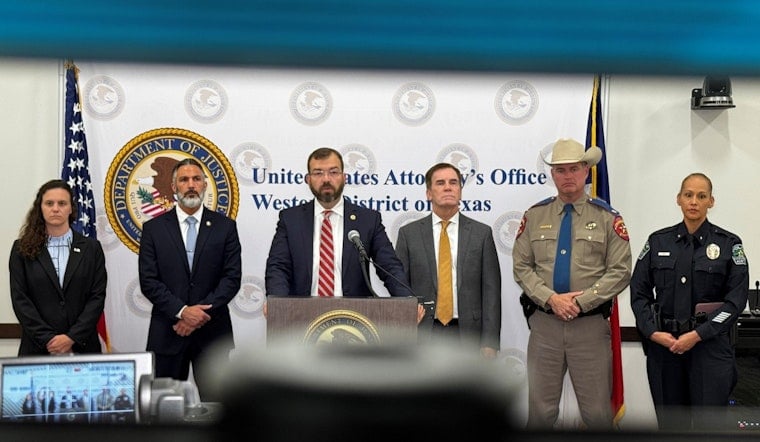
Federal prosecutors in Austin have filed roughly 40 gun-related cases in recent months, part of a multi-agency crackdown pulling together the ATF, Texas Department of Public Safety, Austin Police Department, and Travis County District Attorney's Office. U.S. Attorney Justin R. Simmons says taking illegal firearms off the streets is the central focus of the push, framing it as a direct response to a decade of rising violence in the city.
The announcement, posted Tuesday by U.S. Attorney WDTX and detailed in a release from the U.S. Department of Justice, leans heavily on statistics from the Major Cities Chiefs Association. According to that data cited by federal officials, homicides in Austin surged 187% between 2015 and 2025, while sexual assaults rose 65% and aggravated assaults climbed 38% over the same decade. Federal prosecutors pointed to gun-involved violence as a primary driver behind those long-term numbers.
U.S. Attorney Announces Surge in Federal Violent Crime Prosecutions in Austin @USAttySimmons @ATFHou @TxDPSCentral @Austin_Police https://t.co/FBkgI6hv1D pic.twitter.com/5kvLyoZZ1B
— U.S. Attorney WDTX (@USAO_WDTX) August 25, 2026
A Mass Shooting That Shaped the Response
The surge in federal filings follows a string of high-profile violent incidents in Austin, most notably the March 1, 2026 mass shooting outside Buford's Backyard Beer Garden on West 6th Street that left three people dead and 15 injured before responding officers killed the gunman. An investigation by the FBI determined the shooter acted alone using legally purchased firearms.
That shooting has loomed over public safety conversations in the city ever since, and it's woven directly into how prosecutors are now framing their case for aggressive federal intervention. Simmons has led the Western District of Texas since assuming the interim U.S. Attorney role on May 30, 2025, after being appointed by U.S. Attorney General Pamela Bondi to oversee federal prosecutions across 68 Texas counties, according to the San Antonio Express-News. Simmons previously worked as an Assistant U.S. Attorney in the district, prosecuting human trafficking, gang violence, and white-collar crime cases.
Why Federal Charges Carry More Weight
The strategy behind funneling gun cases into federal court rather than state court comes down to sentencing. Under 18 U.S.C. § 922(g), prohibited persons convicted of possessing a firearm face up to 10 years in federal prison, and repeat violent felons can face mandatory minimums reaching 15 years without parole under the Armed Career Criminal Act, per the United States Sentencing Commission. Federal gun charges carry stricter sentencing guidelines and no parole option compared to many state-level offenses, making them a preferred tool for prosecutors trying to keep violent offenders off the streets longer.
This isn't the first time federal authorities have stepped into Austin's crime landscape this way. Federal prosecutors previously launched a similar multi-agency initiative called Operation Undaunted in December 2020 under former U.S. Attorney Gregg Sofer to combat rising homicides and aggravated assaults, according to PolitiFact. That effort similarly combined federal, state, and local law enforcement resources, suggesting Austin has leaned on this playbook before when violent crime numbers spiked.
A More Complicated Recent Picture
The decade-long statistics cited by federal officials tell only part of the story. Preliminary data from the Major Cities Chiefs Association, reported by Axios, shows violent crime in Austin actually decreased during the first half of 2026 compared to the same period in 2025, dropping to 1,992 total violent incidents driven largely by a reduction in aggravated assaults. That decline mirrors a broader trend of violent crime falling across major U.S. cities following pandemic-era peaks.
The tension between those two data sets — a stark decade-long increase versus a recent short-term dip — sits at the heart of how this initiative is being justified. Federal officials are framing their intervention around the long arc of rising violence rather than the more recent downward trend, even as both figures come from the same association's data.
Recent Cases Show the Pattern in Action
Austin has already seen several concrete examples of this federal-local collaboration play out in court. In September 2025, federal prosecutors in the Western District of Texas secured a seven-count indictment against a Kyle resident for three armed robberies at Austin food and convenience stores using a .22 caliber revolver, a case Hoodline previously reported was investigated jointly by APD and the ATF.
More recently, in July, an Austin man was sentenced to 18 years in federal prison following a joint APD and federal investigation into counterfeit fentanyl pills linked to a fatal overdose on a Capital Metro bus. The defendant pleaded guilty to fentanyl distribution and gun possession in furtherance of drug trafficking, illustrating how federal authorities are combining firearm and narcotics charges to target violent street crime more broadly.
The Western District of Texas is one of the largest and busiest federal prosecutorial districts in the country, spanning nearly 93,000 square miles, 68 counties, and 7.6 million residents, according to the Department of Justice. It covers Austin, San Antonio, El Paso, and 660 miles of the U.S.-Mexico border — a footprint that puts significant operational demands on Simmons's office as it juggles this violent crime surge alongside its other caseloads.




