

























































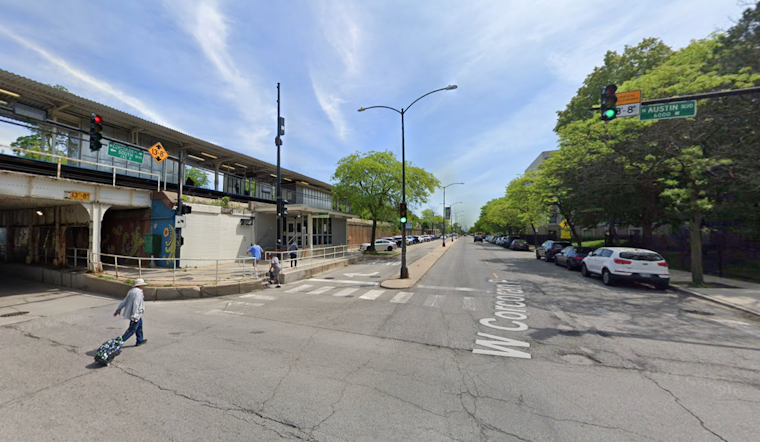
The Austin Green Line station on Chicago's West Side reopened Friday as a fully accessible stop for the first time in its history, capping a $25.6 million reconstruction that gave the century-old station its first major overhaul since 1962. Mayor Brandon Johnson joined Chicago Transit Authority officials and local leaders to mark the reopening at 351 N. Austin Blvd., framing the project as part of a broader push to make Chicago the most accessible city in the world.
Johnson made the case for the investment in a post on X, writing that “building the safest, most affordable big city in America means investing in accessible public transportation that serves the needs of every Chicagoan,” according to Mayor Brandon Johnson. He said he was proud to join CTA and local government partners “to welcome my neighbors in Austin” to the new station. City officials describe the project as the latest milestone under the CTA's All Stations Accessibility Program, or ASAP, the agency's 20-year blueprint, launched in July 2018, to make all 146 rail stations 100% vertically accessible by 2038, according to the City of Chicago.
With Austin's reopening, 110 of the CTA's 146 rail stations, or 75%, now meet Americans with Disabilities Act standards, up from 70% in early 2025, per the city's announcement. If the CTA hits its 2038 target, it would become the first legacy transit system in the country to reach full vertical accessibility across its entire network.
What Changed at the Century-Old Station
First opened on April 15, 1899, as part of the Lake Street Elevated Railroad, the Austin station had not seen a major renovation since it was rebuilt in 1962, according to the Forest Park Review. The main entrance closed in June 2025 to begin construction and reopened Friday with a new elevator, an escalator, a reconstructed stairwell, a new ADA-compliant ramp, an extended platform and new LED lighting, per the CTA.
The project's construction contract was awarded to John Burns Construction Company for $15.3 million, part of the total $25.6 million cost. Funding came from $20.3 million through the federal Surface Transportation Program and $5.3 million from Governor JB Pritzker's Rebuild Illinois Capital Plan, the station's reconstruction was reported by WTTW News.
A Neighborhood Watching Closely
The station's accessibility upgrade lands directly across the street from Corcoran Place, a 94-unit Section 8 senior affordable housing complex that secured nearly $40 million in 2026 for its own renovation, as Hoodline detailed in its earlier Corcoran Place coverage. For low-income seniors aging in place there, step-free access to the Green Line platform is more than a convenience — it shapes daily mobility and quality of life, according to Preservation of Affordable Housing.
The CTA isn't stopping at Austin. Under Phase 2 of the ASAP plan, the agency is preparing accessibility overhauls at the Cicero, Pulaski and Austin Blue Line stations, along with the Oak Park and Ridgeland Green Line stations, the Forest Park Review reported. Phase 1 projects are fully funded, but Phase 2 has secured only about half of the money it needs, leaving future phases unbudgeted.
Federal Funding Fight Looms
That funding gap is why officials are watching Washington closely. In July, U.S. Senators Tammy Duckworth and Dave McCormick introduced the All Stations Accessibility Program Reauthorization Act, known as S. 5086, to extend federal funding for legacy transit accessibility projects before the original 2021 Bipartisan Infrastructure Law grant authorization expires, according to Senator Duckworth's office. Illinois has received more than $185 million in federal ASAP grants since 2021, money that has helped fund station rebuilds like Austin's. Hoodline previously covered the reauthorization push in Duckworth's push to save CTA elevators.
Beyond full station rebuilds, the CTA has also set aside roughly $37 million starting in 2025 specifically to replace and modernize aging elevators across its active rail network, aimed at preventing the outages that regularly strand disabled riders at stations that are otherwise supposed to be accessible. The investment comes as CTA ridership continues to climb: systemwide trips reached 309.2 million in 2024, an 11% year-over-year increase, with average daily ridership topping 1 million trips in May of that year for the first time since 2020, per Metro Magazine.
For Austin residents, the reopened station represents a tangible, if long-delayed, upgrade to daily life on the West Side. Whether the CTA can keep pace with its 2038 accessibility deadline may depend less on local construction crews than on what happens next in Congress.





