

























































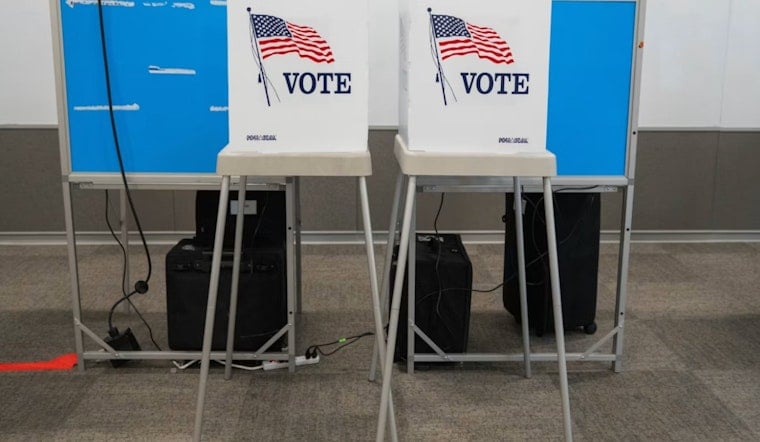
A coalition of Bay Area voters filed a lawsuit in Santa Clara County Superior Court on Monday seeking to strike what they call misleading and biased language from the ballot measure for a regional transit sales tax, setting up a legal fight with a hard deadline attached. The plaintiffs want a judge to rule by August 28, the printing deadline set by the Santa Clara County Registrar of Voters, or risk the language standing as written when ballots and voter guides go to press across five counties.
The ten petitioners include former State Senator Quentin L. Kopp, Committee for Affordable Bay Area Transit President Gregg Diéguez, and Contra Costa Taxpayers Association President Marc Joffe, according to reporting from The Antioch Herald. Their complaint names election officials across the five participating counties and the Public Transit Revenue Measure District, the Metropolitan Transportation Commission-affiliated governing body created to oversee the regional transit measure, as defendants, per The Mercury News. Joffe is both a plaintiff and treasurer of the Committee for Affordable Bay Area Transit, which has opposed the sales tax measure.
What the Ballot Actually Says
The challenged text asks voters to approve a 0.5% sales tax — 1% in San Francisco — for 14 years to generate an estimated $980 million annually, with language stating the money would help prevent major service cuts, preserve BART, and support cleanliness, safety, and road repairs, according to KQED. Plaintiffs argue that phrases like preserve BART and prevent major service cuts function as promotional slogans rather than the neutral summary state law requires, and they specifically asked a judge to remove those claims from the ballot label. The lawsuit contends that what counts as a major service cut differs from voter to voter, making the phrase inherently subjective rather than a factual description.
The complaint alleges the measure was written to favor a yes vote in violation of election law, citing California Elections Code Sections 9051(e) and 13119(c), which require neutral, non-argumentative ballot summaries. It leans on the 2012 appellate ruling in McDonough v. Superior Court, which established that government-authored ballot labels cannot use loaded terminology or advocate for a specific outcome, per the Antioch Herald's account of the filing.
Officials Defend the Language
Rebecca Long, a spokesperson for the Metropolitan Transportation Commission, said the ballot language and impartial analysis were prepared in accordance with California election law, and the commission has said it will defend the wording as approved. Joffe countered that the ballot text is supposed to be neutral and instead reads like a commercial for the tax, attributing the promotional tone to polling firms that test wording with voters before it is finalized.
Jeff Cretan, a spokesperson for Connect Bay Area, the campaign backing the measure, declined to comment directly on the lawsuit because Connect Bay Area was not named as a party. He said failure to pass the measure would cause catastrophic public-transit cuts hurting communities in all five counties, echoing measure supporters who describe the tax as critical to preserving regional transit.
The Stakes if the Tax Fails
The financial backdrop explains why both sides are fighting over a few phrases. BART has warned it may need to close two lines or shutter between 10 and 15 stations without the new revenue, while Caltrain has said it might cut weekend service or end weekday service after 9 p.m. Those warnings follow ridership declines across Bay Area transit agencies during the COVID-19 pandemic that hammered farebox revenue system-wide.
If approved in November, the tax is projected to raise roughly $17 billion over 14 years across Alameda, Contra Costa, San Francisco, San Mateo, and Santa Clara counties, according to the Antioch Herald. Under the funding framework set by Senate Bill 63, about 63% of that revenue would go directly to operating budgets for bus, rail, and ferry lines, per the Metropolitan Transportation Commission, while roughly one-third is guaranteed to county transportation agencies for local infrastructure, transit vehicles, or road repairs along bus routes. The remaining funds would go toward other transit infrastructure and rider improvements.
The measure needs only a simple majority across all five counties to pass, after advocates with the Connect Bay Area Transit Committee submitted more than 305,000 voter signatures earlier this year — far beyond the roughly 186,000 required — allowing it to proceed as a citizen-initiated measure. Governor Gavin Newsom has already signed off on a $590 million emergency loan to help Caltrain, Muni, AC Transit, and BART stave off cuts in the meantime, a stopgap officials have described as temporary while agencies pursue longer-term funding.
A Familiar Legal Playbook
This is not the first time ballot wording for a Bay Area transit-related tax has ended up in court. Attorney Jason Bezis, who represents the plaintiffs in this case, previously brought a similar challenge in August 2024 that led the Bay Area Housing Finance Authority to pull its proposed $20 billion Regional Measure 4 affordable housing bond from the ballot entirely, as reported by The Oaklandside. Local taxpayer advocates also filed a lawsuit last year seeking to block a Santa Clara County general sales tax measure from the ballot, and a separate Contra Costa County lawsuit this year sought changes to sales tax ballot wording. In both of those prior cases, a judge ruled in favor of changing at least some of the challenged ballot language, giving the current plaintiffs precedent to point to as they push for a ruling before the printing deadline.
Hoodline has followed the measure's path from its origins in the state legislature's passage of the Connect Bay Area Act through the signature drive that qualified it for the ballot and the opposition campaign that has grown across all five counties. Whatever the court decides in the coming days, the ruling will land just as county registrars prepare to lock in the exact wording millions of Bay Area voters will see in November.





