

























































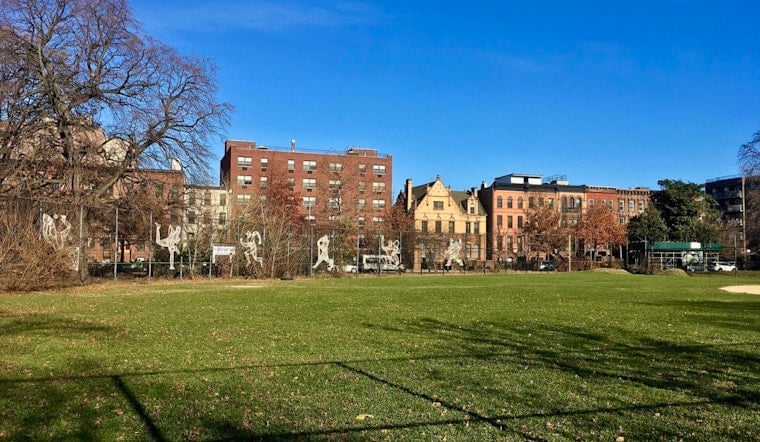
The fenced-in dog run at Herbert Von King Park in Bedford-Stuyvesant has been closed since August 18 after soil testing turned up elevated levels of arsenic and mercury, and now the neighbors who used it daily are learning the shutdown could stretch far longer than they first understood. City officials initially cited only the potential presence of contamination when they closed the run, but internal communications shared with a local dog owners' group now put a full reopening somewhere between fall 2028 and spring 2029.
What the Soil Testing Found
According to a Parks Department spokesperson cited by Brooklyn Paper, the testing found moderate exceedances of state residential soil standards for both metals at the surface, with more significant contamination discovered three to six inches deep. New York's residential soil standard is 16 parts per million for arsenic and 0.030 parts per million for mercury, according to state figures reported in the same account. The testing was conducted as part of a planned full reconstruction of the dog run, not because anyone suspected a problem, and the Parks Department has not released the full report or the exact contamination levels detected.
Sophie Torri, who said she and her corgi Shamis visited the dog run at least once a day before it closed, told the outlet she worried her dog could have ingested contaminated soil after watching dogs roll in muddy bark and Shamis pick up a ball in his mouth. She said the fenced-in run had been a genuine selling point for the neighborhood. Jose Garcia, who visited the run about three times a week, said he learned of the closure on August 18 and now plans to find another safe park — adding that he would avoid the dog run even after remediation is complete.
How Dangerous Is the Contamination
George Lozefski, a soils technician and education coordinator at the New York City Soil and Water Conservation District who also directs education at the Urban Soils Institute, told Brooklyn Paper the elevated levels were likely not high enough to present a serious health risk, especially for adults. He said reducing exposure simply requires avoiding the park for now. Primary exposure pathways for both metals include inhalation, ingestion, and skin contact.
The federal Environmental Protection Agency has linked arsenic exposure to several cancers, neurological damage, and cardiovascular disease, while mercury can damage the nervous system, kidneys, and gastrointestinal tract, per the same reporting. Both metals can occur naturally in soil at low levels, but higher concentrations typically trace back to human activity such as manufacturing, trash incineration, and vehicle use. Arsenic is used in roughly a thousand different chemicals and is commonly found in pesticides and rodenticides, while mercury shows up less often than arsenic in New York City soils. The Environmental Protection Agency notes that heavy metal contamination in urban parks commonly stems from historical industrial emissions, coal ash fill, municipal incinerators, and legacy agricultural pesticides — a pattern consistent with New York City's many older, formerly industrial park sites.
A Timeline That Keeps Sliding
The Department of Health and Mental Hygiene recommended that Parks block off the affected areas, according to a DOHMH spokesperson cited in the Brooklyn Paper report. Design work on the dog run's capital reconstruction has already been delayed by at least a year, and reconstruction itself is now set to begin in fall 2027, with construction expected to take another 12 to 18 months once it starts. Remediation could involve capping the contaminated soil with 6 to 12 inches of clean fill, or layering geotextiles, gravel, soil, and grass as a barrier — grass and other plants can help reduce toxin bioavailability by binding contaminants to the soil.
That timeline had already been evolving before the contamination surfaced. The NYC Parks Capital Project Tracker lists an estimated budget between $1 million and $3 million for the dog run reconstruction, funded jointly by the Brooklyn Borough President, City Council, and mayoral allocations, with design work that began in March 2024 originally slated to finish by March 2025 before slipping to an adjusted completion date of April 2026, per the tracker. But in an August update shared with the Facebook group Friends of Herbert Von King Dog Park, Parks management told members the run will stay closed through the completion of capital construction — now projected for fall 2028 or spring 2029, well beyond the fall 2027 start date and 12-to-18-month build window cited elsewhere. The Parks Department has not said publicly when the run might reopen. Full reconstruction plans call for canine turf with drainage throughout the run, and the department expects that project to complete full remediation, a spokesperson said. Other sections of Herbert Von King Park remain open as normal.
A Neighborhood Already Divided Over Dogs
The closure lands in a park where tensions over dog management were already running high. Herbert Von King Park allows off-leash hours before 9 a.m. and after 9 p.m., but citywide, 311 complaints about off-leash dogs more than doubled between 2019 and 2024, according to Patch. City Council Member Chi Ossé publicly intervened at the park in 2024 after constituents complained about unleashed dogs running across lawns, damaging grass, and leaving waste outside designated areas, Patch reported. Local organizers with Friends of Herbert Von King Dog Park had separately petitioned Parks to swap out No Pets signs on the lawns for On Leash Pets Only signage, hoping to preserve legal dog-walking space on the grass.
The Park's Deep Roots in Bed-Stuy
Herbert Von King Park carries a long civic history that predates the current dispute. The land was once part of a large estate owned by Tunis Johnson before New York City acquired it by condemnation in 1857, and landscape architects Calvert Vaux and Frederick Law Olmsted submitted design plans for the park in 1871. Originally called Tompkins Park, it was renamed in 1985 for Herbert Von King, a community activist known as the Mayor of Bed-Stuy who founded Boy Scout Troop 219 at age 20 and spent more than 50 years serving on local boards, according to NYC Parks history. Activist Almira Kennedy Coursey and the Tompkins Park Recreation and Cultural Association organized neighborhood advocacy in 1969 that pressed the city to redevelop the park and open a new recreation center by 1973 — a reminder that Bed-Stuy residents have shaped this park's fate for generations, and that the current fight over the dog run's future is only the latest chapter.





