

























































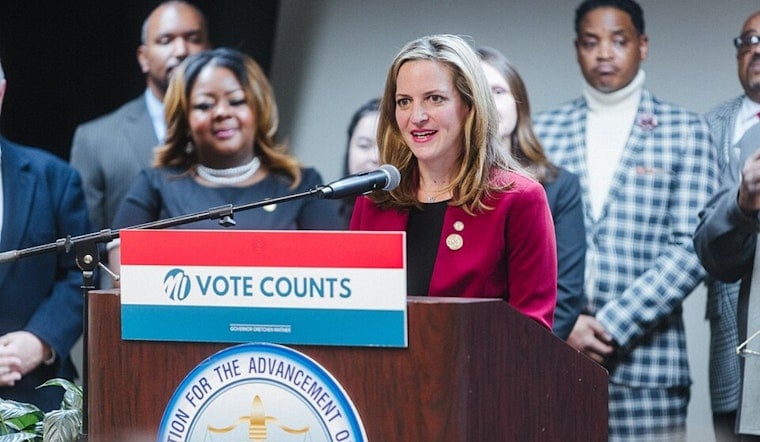
Detroit's Black electorate has become the single most contested prize in Michigan's open governor's race, with Democrat Jocelyn Benson and Republican John James both making direct appeals to the city's voters in recent weeks. Detroit holds the largest number of registered voters of any municipality in Michigan, with roughly 527,000 people on the rolls, and both campaigns are treating that base as decisive with the November 3 general election closing in.
The contest is happening on Detroit's own turf. As reported by the Michigan Chronicle, Benson met Black small-business owners at TechTown in the New Center neighborhood in August, an event hosted by TechTown CEO Ned Staebler on August 12. James, meanwhile, has been showing up at churches, concerts and community giveaways across the city, part of what the Chronicle describes as an effort by James and the Michigan Republican Party to chip away at a Democratic stronghold where Donald Trump's 2024 campaign and the state GOP have increased direct outreach to Black voters since 2020.
The numbers illustrate why. Trump earned nearly 20,000 votes from Detroit voters in 2024, an increase of about 8,000 votes compared with 2020, according to the same Chronicle report. Still, recent Fox News polling cited by the Chronicle shows Benson leading James among Black voters by 74 percentage points overall, with a more detailed breakdown putting Benson at 86% and James at 12%.
Benson Leans on Maternal Health and Small Business
Benson's pitch to Detroit's Black voters centers heavily on maternal health care. She plans to address Black maternal health care directly, including requiring bias training for maternal healthcare providers, increasing access to prenatal and postpartum care, and investing in Medicaid-covered doula and midwife services. She has also said she advocates expanding Rx Kids, the cash-assistance program for new mothers.
The stakes behind that push are stark. Michigan Department of Health and Human Services data compiled by the Center for Healthcare Research & Transformation in December 2025 found Black women in Michigan are 2.2 times more likely to die from pregnancy-related causes than white women, with state health officials noting nearly 75% of maternal deaths are preventable. Detroit Mayor Mary Sheffield built on that concern in February 2026 by officially launching the city's own Rx Kids program, an initiative originally founded in Flint in 2024 by Dr. Mona Hanna that provides $1,500 prenatally and $500 per month for six months to families, reaching roughly 8,000 babies born in the city annually.
Rx Kids is described as a universal cash program, and Benson has framed her small-business agenda in similar terms of broad-based investment. At TechTown, she said economic growth requires investment in multiple industries and small-business growth, and she said she wants to focus on state support for small businesses seeking additional resources. TechTown, founded in 2000 as a partnership between Wayne State University, Henry Ford Health System and General Motors, reported in March 2026 that its programs served over 1,200 entrepreneurs and created or maintained over 2,000 jobs in 2025.
Democratic Voices Warn Against Complacency
Benson's campaign has appeared at Black churches and organizations across Detroit, and some of the sharpest warnings against James have come from within those spaces. Yusef Jackson introduced Benson at the Trade Union Leadership Council building, calling her “Sister Jocelyn” and telling attendees she would face powerful lobbyists, interests and pressures if elected. Jackson urged Black Detroiters to register, organize and turn out voters.
Lakia Wilson-Lumpkins, president of the Detroit Federation of Teachers, delivered an even blunter message, per the Chronicle's reporting. She said voting for James would support Donald Trump and what she called a racist, sexist, xenophobic and fascist movement, and said staying home in November is not an option. Wilson-Lumpkins also said Benson understands the challenges facing Detroit's young people and educators.
James Pitches His Detroit Roots and Military Record
James has countered by leaning on his own Detroit ties. He has said he was raised in the city, and his campaign biography includes attending Brother Rice High School in Bloomfield Township before West Point, where he went on to fly Apache helicopters in combat. His father, John A. James, moved to Detroit and started a trucking company with one truck and one trailer after serving in Vietnam; he is considered a pioneer for Black truckers and was inducted into the Automotive Hall of Fame in September 2024. John James now lives in Shelby Township.
James has taken that biography directly into Detroit's cultural and religious spaces. He visited Pastor Lorenzo Sewell's 180 Church in July 2026, where he discussed election integrity, serving communities and Michigan's future. Sewell gained national political prominence after speaking at the 2024 Republican National Convention in Milwaukee and delivering a benediction prayer at Donald Trump's presidential inauguration in January 2025.
James also spoke at rapper 42 Dugg's 4 the Trenches Tour at the Aretha Franklin Amphitheater in Detroit on August 20, though he later posted and deleted a video of his remarks from that concert, the Chronicle reported. He was also pictured with rapper Icewear Vezzo at a backpack giveaway at O'Brien Park, where James said hundreds of community members prepared for back-to-school at the event. His broader message to Detroit voters, per the Chronicle, is one of more access to capital, contracts and a better future, alongside plans to grow jobs in the city.
An Uphill Climb Framed by History
James and the Michigan Republican Party face what the Chronicle describes as an uphill battle in a city long known as a Democratic stronghold, even as Republicans believe a growing population of disaffected former Democrats may vote for conservatives on cultural issues. That dynamic played out elsewhere in the state this August, when Republican Mike Rogers held an event with Democratic state Representative Karen Whitsett on Detroit's west side; Whitsett disavowed the Democratic Party in 2025, citing religious reasons.
The Detroit fight is unfolding against a broader backdrop that Hoodline has covered in detail. Benson picked Winnie Brinks as her running mate last Wednesday, forming what would be Michigan's first all-female gubernatorial ticket, while James and running mate Jay DeBoyer had their all-male ticket formalized days later at the Michigan Republican Party convention. James arrived at the general election after a costly primary battle; AdImpact tracking data cited by Bridge Michigan showed the 2026 GOP primary was the most expensive in Michigan history, with challenger Perry Johnson spending nearly $32 million of his own fortune before James secured the nomination with Donald Trump's endorsement.
Michigan's constitution adds another layer of pressure to the race. Under Article V, Section 3 of the state constitution, Governor Gretchen Whitmer is barred from seeking a third term, opening the executive office fully for the first time in eight years. Political analysis by Bridge Michigan has noted that no Michigan political party has won more than two consecutive four-year gubernatorial terms in roughly 35 years, a historical pattern that hangs over both Benson's bid to extend Democratic control and James's push to end it.
The article detailing these dueling Detroit appeals was written by journalist Sam Robinson, who covers regional politics and popular culture and also founded Detroit One Million, a local news website tailored toward young people, in 2024.





.jpg)