

























































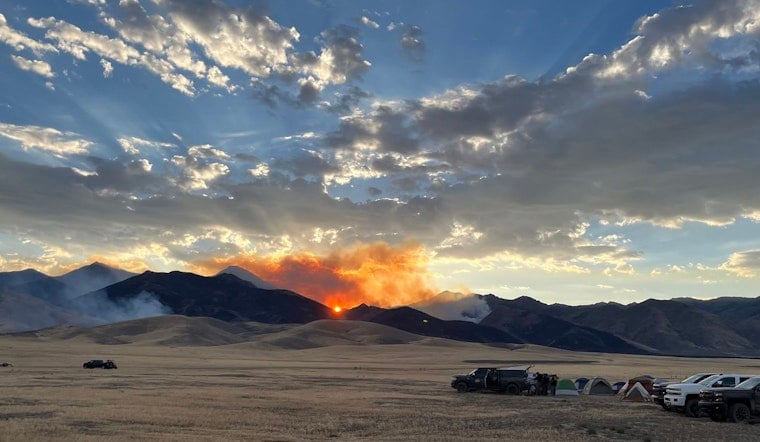
Crews battling the Blue Eagle Fire in Churchill County have pushed containment to 45% as of Sunday, even as gusty winds and rugged terrain continue to complicate efforts to fully surround the 9,218-acre blaze burning roughly 28 miles northwest of Austin. Firefighters are focused on strengthening lines along the fire's western and southern edges while smokejumpers prepare to parachute into the fire's toughest stretch, a rugged northwest section that ground crews still cannot easily reach.
The fire ignited on August 25 after dry lightning storms swept across Churchill and Humboldt counties, according to Current Wildfires. It's burning in the northern Clan Alpine Mountains Wilderness, an area so steep and rocky that firefighters initially couldn't launch direct ground attacks, according to a Bureau of Land Management - Nevada update. That same terrain is now forcing crews to rely on a rotating series of spike camps rather than a single base of operations, with a new camp established each night as firefighters work their way from the south toward the southwest, up the west side and toward the fire's northern end.
Smokejumpers Head Into the Fire's Hardest-to-Reach Corner
Per the same account, rugged terrain makes access to the northwest portion of the fire particularly difficult, which is why smokejumpers are being inserted directly into that area rather than hiking crews in. A Type 1 helicopter and a Type 2 helicopter will support the operation, with helicopters also transporting meals, equipment and supplies to crews working far from any road. One helicopter already ferried supplies from the incident command post to a remote spike camp, and helicopters have conducted water drops as part of the broader suppression push.
The Blue Eagle Fire showed moderate fire behavior on Saturday, with winds dispersing smoke from the blaze even as smoldering vegetation produced significant smoke of its own. Warm and dry conditions have fueled continued burning in interior pinyon, grass and juniper areas, and firefighters focused their efforts on the fire's southern heel over the weekend. Crews plan to establish fireline along approximately 12 miles of the still-uncontained perimeter over the next three to four days.
Costly Fight Playing Out Amid a Statewide Wildfire Cluster
Federal wildland fire updates from the National Interagency Fire Center reported that active fire behavior, including running, flanking and torching, has directly threatened nearby residential structures and critical energy infrastructure. Estimated suppression costs for the Blue Eagle Fire had reached $2,682,840 as of Sunday, the same figure noted by Current Wildfires. Gusty and erratic winds are expected to continue during operations, and a warming and drying trend is forecast, with thunderstorms expected later this week that could bring additional wind and weather-related challenges.
The Blue Eagle Fire, managed within the BLM's Carson City District, is burning on terrain near areas scorched earlier in August by the Shoshone and New Pass fires, which together consumed more than 62,000 acres of public land in Churchill County. Hoodline previously reported on the New Pass Fire after lightning sparked that blaze near Austin earlier in the month. It's part of a punishing stretch for the region: the fire is burning concurrently with several other massive Nevada blazes, including the 32,392-acre McConnell Fire, the 52,000-acre Mouse Meadow Fire and the 18,319-acre Calico Fire, according to 2 News Nevada.
National Resources Stretched Thin
The strain extends well beyond Nevada. The National Multi-Agency Coordinating Group raised the U.S. National Fire Preparedness Level to PL5, the nation's highest alert status, on July 18 and has maintained it into late August because of heavy resource commitments across the West. Nationwide, wildland fires had burned more than 8.2 million acres across 51,961 incidents through Sunday, representing 163% of the ten-year national average for burned acreage, per the National Interagency Fire Center.
BLM Nevada oversees roughly 48 million acres of public land, the second-largest BLM fire program in the country after Alaska, backed by 51 engines, six dozers, two hotshot crews and six district offices including Carson City. The agency also enforces a statewide Fire Prevention Order banning fireworks, binary explosive targets, tracer ammunition and steel-component bullets on all public lands and trails, a restriction aimed at preventing new ignitions while crews remain stretched across multiple major fires.





