

























































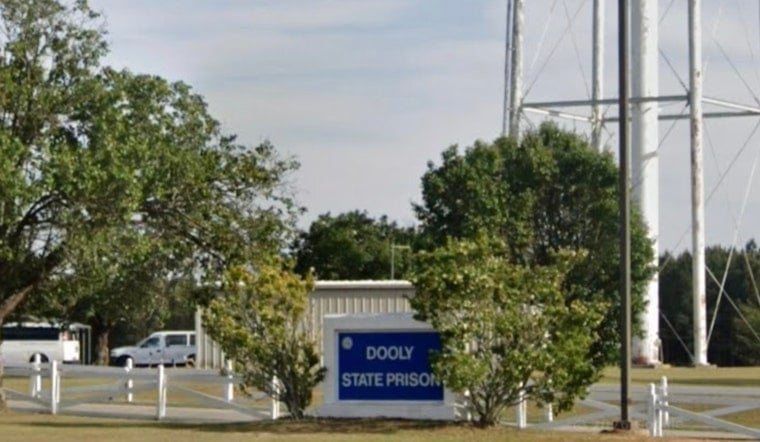
A former Georgia Department of Corrections cadet from Bonaire has been sentenced to 10 years in federal prison after officers caught him trying to smuggle 640 grams of pure methamphetamine into Dooly State Prison, taped inside his own pants during a routine shift shakedown. Julius Deshawn Williams Jr., 29, had been training to become a correctional officer at the Unadilla facility when the drugs were discovered on June 24, 2024.
According to Tampa Free Press, officers conducted a required security check as Williams arrived for his shift and found four packages of methamphetamine wrapped in black tape hidden inside his pants. Investigators then searched his vehicle outside the prison and uncovered four more tape-wrapped packages along with a handgun, bringing the total to eight packages containing 640 grams of 100% pure methamphetamine. Per investigators, Williams admitted he had planned to deliver the drugs directly to an inmate.
Williams pleaded guilty on December 1, 2025, to one count of possession with intent to distribute methamphetamine, a case Hoodline first covered in its report on his guilty plea. U.S. District Judge C. Ashley Royal handed down the sentence on Wednesday, ordering Williams to serve 120 months in federal prison followed by five years of supervised release. Because the amount involved exceeded 500 grams of pure methamphetamine, federal law carried a mandatory minimum of 10 years and a maximum of life imprisonment, and federal sentences come with no possibility of parole.
A Cadet Who Never Made It to the Job
Williams was still in training to become a correctional officer at Dooly State Prison when he was caught, meaning he never formally held the position he was working toward. The Georgia Department of Corrections and the Drug Enforcement Administration handled the investigation jointly. GDC Commissioner Tyrone Oliver praised the officers who stopped the contraband from entering the facility, saying the department does not tolerate actions that discredit its values and jeopardize public safety.
DEA officials framed the case as a warning to anyone who might exploit their position inside the system. Atlanta Field Division Special Agent in Charge Jae W. Chung said a person entrusted with becoming a correctional officer instead participated in smuggling methamphetamine into a prison, adding that the conduct threatens the safety and security of the entire correctional system. Chung said law enforcement partners will continue identifying people who bring dangerous drugs behind prison walls and ensuring there are consequences. Acting U.S. Attorney William R. “Will” Keyes echoed that message, saying penalties are steep when trusted prison-system members smuggle contraband behind bars, and that such smuggling exponentially increases danger for people both inside and outside prison walls.
Dooly State Prison's Recurring Contraband Problem
Williams's case is not an isolated incident at the medium-security facility, which opened in 1994 and holds up to 1,702 adult male felons in Dooly County. In October 2025, another Dooly guard, Ahryanna Trice, was arrested and charged with felony ecstasy trafficking and contraband smuggling after allegedly accepting $200 from an inmate to bring in ecstasy, marijuana, and tobacco, as reported by 13WMAZ. Georgia Department of Corrections records also show security staff and K-9 units arrested a civilian near the prison's farm in March 2026 after finding a hidden bookbag containing 4,660 grams of tobacco, 91 grams of marijuana, and promethazine.
The problem extends well beyond one facility. A 2023 investigation covered by FOX 5 Atlanta found that at least 360 Georgia Department of Corrections employees had been arrested for smuggling contraband into state prisons between 2018 and September 2023, with nearly 80% of those arrested being women and almost half under age 30. During a December 2025 state legislative hearing, GDC officials testified that 120 inmates were charged and 362 civilians were arrested in connection with prison contraband deliveries statewide during the fiscal year ending June 2025, with smuggling methods ranging from tossing packages over fences to heavy-payload drones.
Why Federal Prosecutors Keep Stepping In
That drone method has already produced one of the region's biggest cases: in June 2026, federal prosecutors in the Middle District of Georgia unsealed a 17-count indictment charging 12 people in a multi-state conspiracy that used heavy-payload drones launched from a former Macon daycare to drop meth, weapons, and other contraband into 10 prisons across eight states, according to Rough Draft Atlanta. Federal authorities have described it as the largest DOJ prison drone prosecution to date.
Georgia state law does provide its own penalties for prison smuggling: under O.C.G.A. § 42-5-18, introducing contraband into a correctional facility is a felony carrying one to five years, with a mandatory minimum of two years for non-inmates caught bringing in weapons or controlled substances, according to Justia Law. But state cases have not always held up. An Atlanta Journal-Constitution investigation published in June 2025 found that 11 drug smuggling cases at Calhoun State Prison were dismissed by local prosecutors because investigators never submitted the seized drugs to state crime labs for testing, including a case involving an officer found with 112 grams of meth. That kind of evidentiary breakdown helps explain why federal prosecutors, armed with mandatory minimum sentencing and DEA lab resources, have increasingly taken over the state's most serious prison contraband cases.



