

























































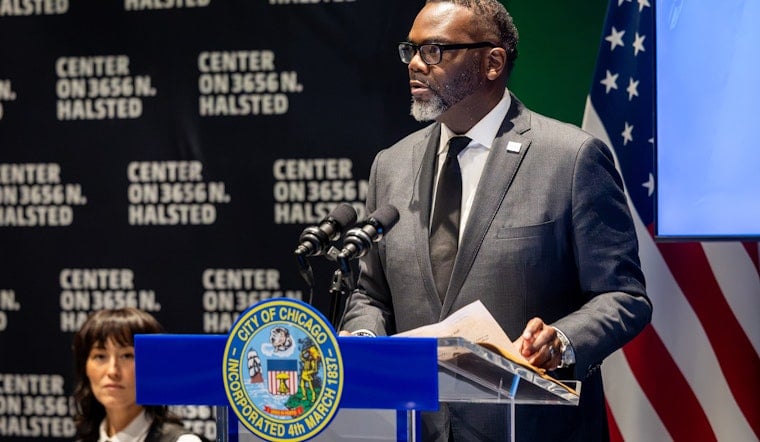
Chicago Mayor Brandon Johnson has become the first announced or likely candidate in the city's next mayoral election to acknowledge paying a content creator to post a political video supporting him, a move that surfaced last month as his team quietly courted the city's influencer class. Johnson has not officially launched a 2027 reelection bid, but the payment, made in July 2026, marks an early signal of how his campaign plans to compete for attention outside traditional media.
The disclosure came as part of broader reporting by the Chicago Tribune into how content creators are shaping the early contours of Chicago's mayoral race. Christian Perry, who works with the Johnson campaign, said the campaign paid for posts from one creator and that working with content creators was a top priority, though he declined to disclose how much the creator was paid. Perry added that campaigns will increasingly pay influencers for screen time and that the campaign had not yet decided whether to pay for additional influencer posts going forward.
Johnson himself struck a different tone when asked about the arrangement in July, saying he was not aware of influencers being paid to share flattering videos about him and describing the influencer support he has received as organic. The Johnson campaign will likely disclose the payment amount in upcoming campaign finance reports, though under Illinois's disclosure rules, political committees must file quarterly reports on contributions and expenditures exceeding $5,000 in a 12-month period, per the Illinois State Board of Elections, meaning the public may not see the full financial picture for months unless the spending trips a faster 30-day pre-election reporting threshold.
The Creators at the Center of the Story
One of the creators involved is Rebecca Lehmann, who posted three clips from a friendly one-on-one interview with Johnson and has since posted five videos marked as paid partnerships involving the mayor. Lehmann told the Tribune she was fairly compensated for the interview but said she is not aligned with any particular candidate, telling the paper she is simply for Chicago. She was among the creators who attended a bill signing hosted by Gov. JB Pritzker on August 7 in Illinois, alongside fellow content creator Tatyana Najee Woods.
Najee Woods, who has more than 165,000 followers across her accounts, has built a following by posting analyses of every sitting Chicago alderman, garnering more than 1 million combined views in the process. She has not met Johnson and is not paid by the Johnson campaign, according to the Tribune's reporting. Rachel Cohen, described as a progressive influencer with more than 650,000 followers, posted six videos supporting Johnson but declined a basic stipend the campaign offered her, saying she would support Johnson if he ran for reelection regardless of payment.
A Campaign Courting Content Creators
The Johnson campaign held two days of meetings and interviews with Chicago content creators and Johnson allies in July, an effort that Andrew Gunderman's Chicago-based company, Renowned Chicago, helped facilitate by connecting creators with brands and elected officials. Joanna Klonsky told the Tribune that the 2027 race will be the first Chicago mayoral contest where content creators play a key role, reflecting how campaigns nationally now often lack the in-house ability to handle social media content creation themselves.
The trend isn't limited to friendly territory. Dark money groups offered influencers $1,500 for posts attacking certain candidates during the Illinois 9th Congressional District Democratic primary in 2026, illustrating how paid influencer content can cut in more adversarial directions as well. Johnson gained a large short-video following last fall after condemning Donald Trump and federal immigration enforcement, a moment that helped establish him as a figure with organic reach even before his campaign began paying creators directly. He now has more than 630,000 Instagram followers.
Regulators Racing to Catch Up
The practice of paying influencers for political content sits inside what amounts to a regulatory blind spot. While the Federal Trade Commission enforces strict material-connection disclosure rules for commercial product endorsements under its 2023 Endorsement Guides, according to the Columbia Undergraduate Law Review, those same disclosure requirements do not apply to political campaign endorsements, which instead fall under the Federal Election Commission's separate and far less specific rules. Instagram and TikTok require users to label paid advertisements, but both platforms often fail to enforce those rules, leaving many sponsored political posts unmarked.
Federal Election Commission rules updated in December 2023 exempt unpaid, organic reposts from public communication regulations but leave paid arrangements to re-disseminate campaign messaging in what the law firm Wiley Rein describes as an ambiguous regulatory status. The Campaign Legal Center petitioned the FEC in October 2025 to require on-ad “paid for by” disclaimers for influencer political posts, arguing existing federal rules fail to explicitly cover paid digital creators.
Congress has taken notice. Sen. Adam Schiff and Rep. Mark Takano introduced the Promoting Authenticity with Influencer Disclaimers Act in July 2026, federal legislation that would amend the Federal Election Campaign Act to mandate clear and prominent disclaimers on social media posts funded by political committees or candidates, according to Semafor. Schiff also introduced a companion measure, the AI Ads Act, aimed at prohibiting deceptive misrepresentations of political candidates through artificial intelligence-generated media. Only California and Texas currently have active state laws mandating political disclaimer disclosures for paid content creators, and California lawmakers are now weighing legislation that would let regulators fine non-compliant influencers up to $5,000 per violation, per the Canadian Lawyer.
Money Moving Fast, Rules Moving Slowly
The scale of digital political spending helps explain why campaigns are leaning into creator partnerships. Political advertisers spent at least $1.9 billion on online digital advertising during the 2024 election cycle, according to an analysis by the Brennan Center for Justice, a figure that excludes the direct, unquantified payments campaigns make to individual influencers. Democrats credentialed more than 200 content creators and social media influencers for the 2024 Democratic National Convention in Chicago, a sign of how thoroughly creators have already been woven into the party's outreach machinery.
For Johnson, the influencer strategy arrives amid a rockier political backdrop. An April poll from Suffolk University and the Chicago Tribune found 44% of Chicago residents held an unfavorable view of the mayor compared with 34% favorable, a gap Hoodline detailed in its reporting on the poll numbers. The administration is also navigating fiscal turbulence after Budget Director Annette Guzman resigned in early August amid a projected $90 million shortfall, a departure Hoodline covered in a piece on the budget director's exit. Whether paid creator content proves to be authentic grassroots enthusiasm or a new form of covert political advertising remains an open question that voters and regulators alike are still working to answer.





