

























































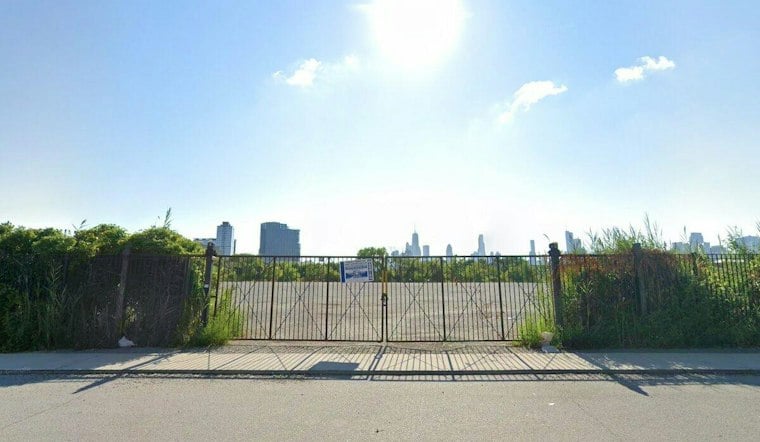
Salt Shed owners have submitted zoning plans to the city for a major expansion that would transform a vacant lot across the street into a sprawling amphitheater complex, complete with a public riverwalk, boat dock and a plaza connecting it to the existing venue. The project would rise on a 10-acre site at 1459 North Magnolia Avenue in West Town, directly across from the music complex that has hosted concerts since 2023 inside the former Morton Salt warehouse.
R2 Companies and Blue Star Properties, which own the Salt Shed music complex, filed the zoning submission alongside hospitality group 16” On Center, according to Chicago YIMBY. The plans call for removing Blackhawk Street, which already closes during events for queuing and security checks, to make way for a large plaza linking the original Salt Shed buildings to the new amphitheater site. North of that plaza, developers want to build a publicly accessible riverwalk and boat dock along the waterfront, a design element that lines up with the City of Chicago's riverfront design guidelines, which require public waterfront setbacks and continuous riverwalk trail connections along the North Branch Industrial Corridor.
The new venue itself would sit directly north of the plaza. It has previously been described as holding up to 15,000 people, though per the filing, its final capacity remains undisclosed. That would mark a dramatic leap beyond the existing Salt Shed footprint — the 5,500-capacity outdoor Fairgrounds, which opened in August 2022, and the 3,600-capacity indoor Shed, which opened in February 2023 inside the repurposed 1929 Morton Salt warehouse, according to Wikipedia.
Grass Terraces, VIP Decks and a New Production Building
Renderings described in the filing show an amphitheater-style venue built around three sloping, grass-covered seating structures capped by general-admission standing decks. The lawn would include a central bar, with assigned seating positioned between the bar and the stage. Elevated, staggered VIP seating would run along the venue's west end, alongside new restrooms and guest facilities.
Behind the stage, a courtyard building would house artist changing rooms, while a separate production facility building and a loading dock for production vehicles and venue supplies — accessed from Magnolia — round out the backstage logistics. The plan also includes a parking lot with more than 100 spaces, per Chicago YIMBY's reporting on the submitted documents.
A $60 Million Deal Years in the Making
Talk of this expansion isn't new. Crain's reported in 2025 that Salt Shed owners potentially planned to purchase the lot, with the overall development estimated to cost between $60 million and $70 million. By October 2025, The Real Deal reported the 5-acre expansion parcel had been placed under contract from a business entity tied to the Labkon family, which had operated the General Iron scrap metal recycling plant nearby before it shut down in 2020 — a notable shift for a stretch of the Chicago River that spent decades handling heavy industrial scrap rather than concertgoers.
Blue Star Properties developers said the riverfront site needs significant infrastructure work before any vertical construction can begin, including new riverfront seawalls and water and sewer line installation, the same outlet's report noted. Developer Craig Golden said the proposed outdoor amphitheater is designed to host 30 to 40 summer concerts per year and could double as a venue for neighborhood street festivals or a winter ice-skating rink in the off-season.
From Scrap Yards to Craft Beer: A Changing Corridor
The Salt Shed complex has steadily grown since its original warehouse conversion. R2 Companies and Skydeck purchased the 4.2-acre Morton Salt warehouse site for $15 million in 2017 and spent roughly $40 million on adaptive-reuse renovations before Blue Star Properties joined as an equity partner and general contractor, per the Commercial Real Estate Development Association. The original Morton Salt distribution facility operated on the site from 1929 through 2015, processing up to 150,000 tons of salt annually, and its landmarked “Umbrella Girl” sign is still visible from the Kennedy Expressway.
The campus has also become a hub for other tenants beyond live music. Goose Island Beer Co. closed its historic 1988 Clybourn Avenue brewpub in late 2023 and opened a new venue inside a converted Morton Salt vehicle maintenance building on the site in May 2024, as Hoodline previously reported. Hospitality group 16” On Center, co-founded by Bruce Finkelman and Craig Golden, also operates The Empty Bottle, Space in Evanston and Pilsen's historic Thalia Hall, giving the group deep roots in Chicago's independent venue scene.
Traffic, Parking Questions Loom Over Approval Process
Before any of it gets built, the project still needs full approval and infrastructure work to clear the way for vertical construction. Early community feedback following the October 2025 expansion announcement centered on traffic bottlenecks along Magnolia Avenue, rideshare drop-off congestion and the potential loss of surface parking currently used on show nights, since the vacant lot now serves as a parking area during concerts. How the developers and city officials resolve those concerns — along with the seawall and utility costs that could prompt a push for tax-increment financing — remains to be seen as the zoning plans move through review.





