

























































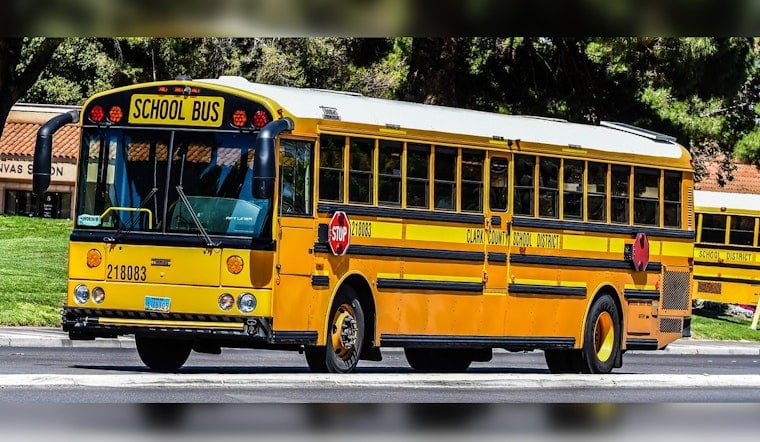
A Las Vegas parent says three children were stuck on a Clark County School District bus with no working air conditioning during a ride of more than 35 minutes as the outside temperature hit 110 degrees. The complaint, posted to social media Wednesday night, prompted a public response from the district asking for details so it could look into the report.
Parent Sounds Alarm Over Broken Bus A/C
The account, posted under the handle @BayChef415 and tagged with hashtags referencing Las Vegas, CCSD, and kids, reported that the bus air conditioning was still not working during the ride and appealed directly to local station FOX5 Vegas for help. In response, the official CCSD account replied on X, telling the parent, “Hello, thank you for reaching out. If you are able to DM us with your child's school bus number, we can pass this on to the appropriate department,” according to CCSD. The district requested the specific bus number via direct message so the complaint could be routed internally.
CCSD, which operates more than 370 schools and serves over 300,000 students across Southern Nevada, runs the largest district-owned school bus fleet in the country, moving roughly 125,000 students daily along about 1,400 to 1,500 routes, according to Blue Bird Corporation. That scale means even isolated mechanical failures can affect a large number of families across the valley in a single afternoon.
Why Broken A/C Is More Than an Inconvenience
Public health research cited in fleet safety analyses shows that children regulate heat less efficiently than adults and warm up faster, which raises the stakes when a bus cooling system fails during triple-digit heat, per BusesForSale. Prolonged exposure to excessive heat in a closed passenger compartment can rapidly bring on heat exhaustion or heat stroke in minors, the outlet notes. In a desert climate where summer temperatures routinely exceed 110 degrees, a stalled A/C unit on a school bus is treated as a safety concern rather than a simple comfort issue.
The complaint arrived during a stretch already marked by transportation strain for CCSD. Earlier in August, the district was fielding public complaints over bus routing and scheduling delays as the new school year began, with officials working to stabilize routes while parents voiced frustration over pickup timeliness, according to KSNV NBC News 3. Longer waits at unsheltered stops compound the same heat exposure risks now raised by the reported A/C failure.
A Fleet Under Growing Climate Pressure
CCSD has been working to modernize its aging bus fleet, including a $9.875 million federal grant received in August 2024 through the EPA's Clean School Bus Program to support a shift toward zero-emission electric buses with extended-range batteries, per Blue Bird Corporation. Running full air conditioning on those electric buses in extreme heat can reduce battery range by roughly 10%, adding a new wrinkle to the district's cooling calculus even as it tries to cut emissions.
The district has also partnered with the Regional Transportation Commission of Southern Nevada to offer free public transit passes to eligible high schoolers who live more than two miles from their assigned schools, easing some pressure on the yellow bus fleet, according to the Regional Transportation Commission of Southern Nevada. That Ride On program combines fixed residential routes with on-demand microtransit service.
Extreme heat has strained more than just buses. CCSD undertook emergency repairs on 13 campus HVAC systems in July, completing work on six before the new academic year began, according to KVVU FOX5 Las Vegas. A CCSD-commissioned efficiency study reviewed in June found that after the district spent $5.2 million on air conditioner repairs during the summer of 2023, preventive maintenance had pushed overall system reliability to a 97% performance rate, the Las Vegas Sun reported. That same study also recommended an opt-in busing model to eliminate empty seats and cut costs, though it remains unclear whether that recommendation has been implemented.
Cooling has been a recognized necessity in Las Vegas classrooms and buses for decades. CCSD first installed school bus air conditioning back in 1983 by retrofitting a handful of Type B minibuses, later adopting auxiliary diesel-powered cooling units in 1985 before making factory-installed A/C mandatory on all new bus purchases, according to CCSD Archives. Even with that long history, recurring breakdowns keep surfacing: air conditioning failed at Silverado High School in August 2025 during temperatures above 100 degrees, requiring temporary cooling equipment despite a prior $5 million initiative to upgrade A/C units across 37 campuses, according to X107.5 Las Vegas.
It remains unclear what specifically caused the reported failure on the bus described by @BayChef415, or whether CCSD has identified and repaired the unit since the exchange Wednesday night. The district has not publicly detailed the outcome of the request for the bus number beyond its initial reply.





_School_Bus.jpg)