

























































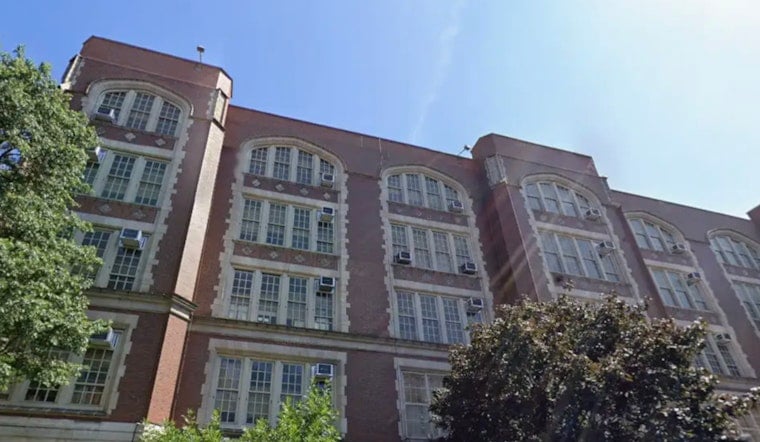
A 5-year-old nonverbal boy with autism was hospitalized in January after doctors recorded a blood lead level of 51 micrograms per deciliter, a diagnosis so severe it required chelation therapy to pull the toxic metal from his bloodstream. His mother, Miguelina Rodriguez, says the boy was exposed inside his Bronx public school classroom rather than at home, and she has since filed a lawsuit against the city's Department of Education.
According to Gothamist, Rodriguez's lawsuit accuses the education department of prioritizing general-education students' safety over students with disabilities. The boy attends the Bronx School for Continuous Learners, a District 75 site that serves students with disabilities, and his classroom, Room 551, had not received a single lead-paint inspection in 2025. Per the outlet's own review of inspection records, the room had not been checked at all since the city's current inspection regime began in 2019.
A Classroom That Went Unchecked for Years
Health officials say they found multiple areas of deteriorating lead paint inside the classroom, the kind of hidden hazard that can lurk in buildings constructed before the federal government's 1978 ban on lead-based paint, according to Microecologies. The health department ordered the education department to immediately remediate the hazard and issued 16 lead-paint violations for Room 551 on February 6, giving the department five days to correct them. When inspectors returned for a follow-up check on February 19, they found the violations had not been resolved.
The Bronx school building dates to 1911, with an addition constructed in 2019, meaning it falls under the presumption of lead-based paint established by Local Law 1 of 2004, which requires annual inspection and remediation of peeling paint in structures built before 1960. Education department officials began abatement work in Room 551 on February 13, and crews removed lead paint on and around a radiator but did not replace the paint they stripped away. The city hired Athenica Environmental Services to wet-scrape and repaint the room; the firm reported on February 15 that lead levels in Room 551 were below the legal maximum, even as the city's own reinspection that same month found lead paint on roughly one in three of the 48 surfaces tested in the classroom.
Inspection Rates Lag Far Behind for Special Education
General-education elementary classrooms received at least one lead-paint inspection in 2025 about 20 percent of the time, while classrooms serving students with disabilities were inspected only about 10 percent of the time. Citywide, lead-paint inspections turned up deteriorated or damaged paint in less than 1 percent of checks conducted between 2023 and 2025. The education department inspected 893 buildings in 2024 and found lead hazards in 74 of them.
Eric Dinowitz called the low inspection rates for special education classrooms "a severe problem." Rendy Desamours said the disparities must be addressed by the mayoral administration. Nicole Brownstein said the education department is reviewing its procedures to ensure student safety, adding that school custodians meet lead-paint inspection requirements, even though citywide rules under Local Law 31 of 2020 call for full surface-by-surface testing using X-ray fluorescence analyzers conducted by EPA-certified inspectors, not just custodial visual checks.
Doctors Warn Disabled Children Face Higher Lead Risk
Public health experts say students with developmental disabilities are more likely to mouth painted surfaces or eat chipped and peeling paint than their peers. Morri Markowitz said children with disabilities are at higher risk from lead paint exposure and argued that classrooms with children who exhibit hand-to-mouth behavior should be inspected first. Research compiled in PubMed has long shown that children with autism who exhibit pica, the persistent ingestion of non-nutritive substances, register significantly higher blood lead levels from frequent mouthing of chipped paint.
Rodriguez's son has pica, and in the weeks before his diagnosis he began chewing the walls and windowsills of the family's apartment, which was built in 2015. Investigators later tested 50 surfaces in the apartment and found no traces of lead. At school, he also began biting and hitting classmates.
Chewing Walls, Then a Diagnosis
The boy's blood lead level of 51 micrograms per deciliter in January exceeded by more than 14 times the federal blood lead reference value, which the CDC lowered to 3.5 micrograms per deciliter in 2021. Under American Academy of Pediatrics guidelines, chelation therapy is required once a child's confirmed blood lead level reaches 45 micrograms per deciliter, to prevent acute encephalopathy and organ damage. Rodriguez's son needed intravenous chelation after he removed the treatment tube being used on him, and by late February his level had dropped to 27 micrograms per deciliter.
A Legal Loophole and a District-Wide Pattern
New York City law, updated by the City Council in January 2020, requires lead-paint inspections three times a year in classrooms serving children under six in buildings built before 1985. Rodriguez's son turned six in April, and city law does not require inspection based solely on his age once he passed that birthday, even though he has continued attending school in the same classroom. Rebecca Ann Muhle said inspection decisions should be based on a child's developmental age rather than chronological age, and Reuven Frankel said children like Rodriguez's son should be in a lead-free environment regardless of that milestone.
New York's District 75 program, which serves roughly 26,000 students with significant disabilities across more than 500 sites citywide, includes the Bronx School for Continuous Learners. The school enrolled 66 kindergarteners and 67 first-graders last school year and received no lead-paint inspection at all in 2025. New York City's health department investigates every case of an elevated childhood blood lead level and, under its own protocol, cannot clear a child for discharge from chelation therapy until officials inspect and clear the environment where the exposure occurred; it was the health department that ultimately ordered the immediate remediation of the boy's classroom.
History Repeating: The 2019 Investigation
The current classroom inspection regime traces back to a 2019 Gothamist investigation that prompted the city to launch citywide lead-paint checks, which turned up more than 1,800 3-K through first-grade classrooms with lead hazards. At P.S. 46 Edgar Allan Poe, staff identified and remediated peeling lead paint in four classrooms between 2019 and 2021, and that school received two classroom inspections in 2025, far more scrutiny than Room 551 got over the same stretch.
The Bronx case follows other recent lead-paint fights across the city's early childhood facilities. Hoodline reported that Mayor Mamdani pledged lead-free NYCHA daycares citywide after a Harlem case drew attention, and that a Queensbridge public housing daycare center received $750,000 in funding to remove lead paint and repair its kitchen. Lead exposure in early childhood can cause long-term brain-development damage, with no safe blood lead level identified in young children, according to the CDC.





