

























































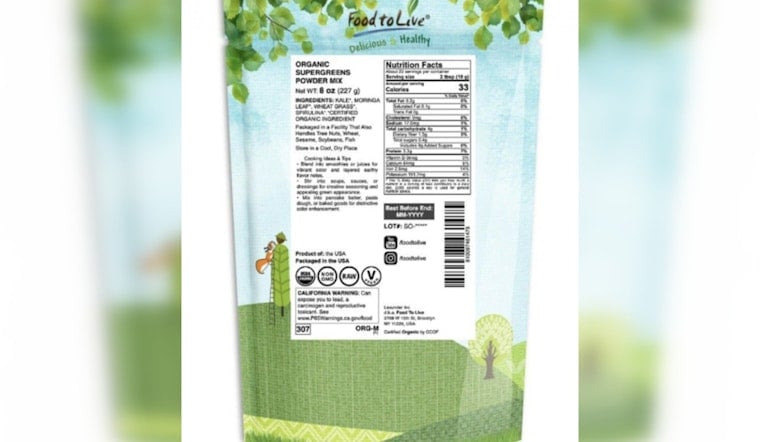
A Brooklyn superfood brand is pulling nine of its green drink powders off shelves and warehouse floors nationwide after a routine test turned up Salmonella in one of its bestselling products. Lexunder Inc., which does business as Food to Live, announced the recall on Friday after a retail sample of its Organic Supergreens Mix tested positive for the bacteria, prompting the company to halt production and distribution while it investigates the source.
According to the Houston Chronicle, the U.S. Food and Drug Administration notified Food to Live that a sample of one green powder product had tested positive for Salmonella, and the company announced the recall Friday. The affected 8-ounce package of Organic Supergreens Mix carried lot code SO-77820, and federal officials say the contamination was caught through retail surveillance rather than reported illnesses.
No illnesses have been reported in connection with the recalled products, the Chronicle notes, but the FDA is still urging anyone holding them to stop eating or drinking them immediately.
Nine Product Lines, Bags to 55-Pound Bulk Cases
The recall is far broader than a single bag of supergreens mix. It covers nine separate product lines — including Food to Live Organic SuperGreens Powder Mix, Organic Moringa Leaf Powder, Organic Kale Powder, Kale Powder, and Organic Wheatgrass Powder — sold in everything from small retail bags to commercial bulk cases weighing up to 55 pounds, with lot codes running through SO-79374, according to the FDA. The products were sold in bulk online nationwide to both consumers and businesses, the Chronicle reports, distributed through Food to Live's own website as well as through foodinbulk.com.
Food to Live describes itself as a certified organic handler through CCOF, processing raw, bulk, and packaged plant-based products out of Brooklyn — everything from nuts and seeds to grains and specialty botanical powders, per CCOF. That range of products has made the company a go-to bulk supplier for health-food shoppers and small businesses alike, which is part of why this recall carries such a wide geographic footprint.
A Second Recall in Under a Year
This isn't the first time Food to Live has had to pull moringa and supergreens products over Salmonella. The company issued a nationwide voluntary recall in November 2025 for its Organic Moringa Leaf Powder and Organic Supergreens Powder Mix after contamination was traced to a supplier lot, with affected codes spanning SO-69006 through SO-72558, according to Food Safety News. Coming less than a year after that earlier recall, the new incident suggests the company has faced persistent vulnerabilities somewhere in its raw ingredient sourcing or post-harvest drying and processing, per the research compiled around this case.
The broader moringa and green-powder supplement category has been under scrutiny well beyond Food to Live. A federal investigation into a nationwide Salmonella outbreak tied to moringa leaf powder supplements sickened 131 people across 38 states and caused 36 hospitalizations before the CDC closed the inquiry in July, according to the CDC. Hoodline previously covered a multi-state moringa scare in February, when the CDC and FDA were investigating a similarly widespread outbreak tied to moringa capsules.
Why These Recalls Keep Resurfacing
Health officials warn the risk from this kind of contamination doesn't fade quickly. Because dried, non-perishable green powders can sit in home pantries for years, contaminated batches can pose a lingering hazard long after the initial recall notice, with shelf lives extending into 2027 and 2028, according to the Washington State Department of Health. That's part of why the FDA is pushing for public awareness now, even though no illnesses have yet been tied to this particular batch.
Salmonella remains the leading cause of foodborne illness hospitalizations and deaths in the United States, with the CDC estimating roughly 1.35 million infections, 26,500 hospitalizations, and 420 deaths annually. Most infections cause diarrhea, fever, and abdominal cramps, but the FDA notes that severe cases can enter the bloodstream and lead to endocarditis, arterial infections, or reactive arthritis, particularly among vulnerable populations.
What Consumers Should Do
The FDA is recommending that anyone holding the recalled products not consume them. Consumers who return the affected items to their place of purchase can receive a full refund, the Chronicle reports, and wholesale buyers or individual shoppers can also contact Lexunder Inc. directly at (718) 717-1029 or by email at [email protected] to arrange returns.
The FDA's authority to force action in cases like this stems from Section 423 of the Food, Drug, and Cosmetic Act, updated by the Food Safety Modernization Act, which gives the agency mandatory recall power over contaminated foods and dietary supplements if a company refuses to voluntarily withdraw hazardous products. Food to Live has not refused; the company suspended production and distribution voluntarily while it investigates the source of the contamination.


